


Amber glass bottles are widely used in laboratories because they help reduce light exposure that can degrade light-sensitive chemicals. They are often used for certain acids, oxidizing agents, solvents, pharmaceuticals, and natural compounds, but they are not suitable for every application. The right choice depends on light sensitivity, chemical compatibility, closure material, and storage conditions.
This guide explains why labs use amber glass bottles, which chemicals are commonly stored in them, and when other container materials may be more appropriate.
What Makes Amber Glass Suitable for Chemical Storage?
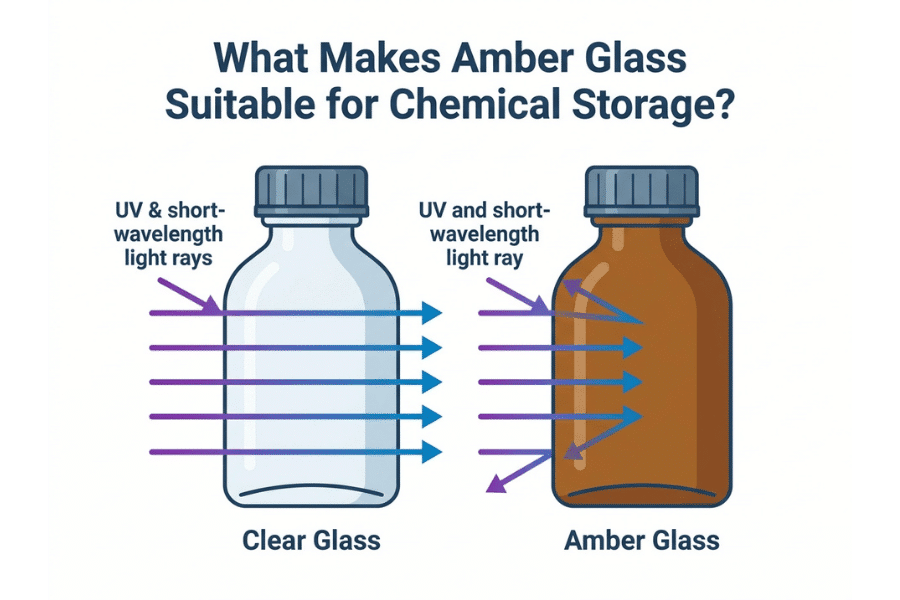
Amber glass is designed to reduce the transmission of ultraviolet light and certain wavelengths in the visible spectrum, especially those associated with photodegradation. This matters because some chemicals can degrade when exposed to light, even under normal laboratory conditions.
In clear glass, more light reaches the stored substance. In amber glass, metal oxides added during manufacturing help absorb more of that incoming energy. As a result, amber bottles are commonly used when chemical stability may be affected by repeated or prolonged light exposure.
This protection is especially useful for chemicals that may:
- lose potency over time
- oxidize more quickly
- discolor or decompose
- produce hazardous byproducts when exposed to light
Amber glass is also valued because its protective properties are part of the glass itself rather than a surface coating. With proper handling, the bottle continues to provide light protection throughout routine lab use.
Which Chemicals Are Commonly Stored in Amber Glass Bottles?
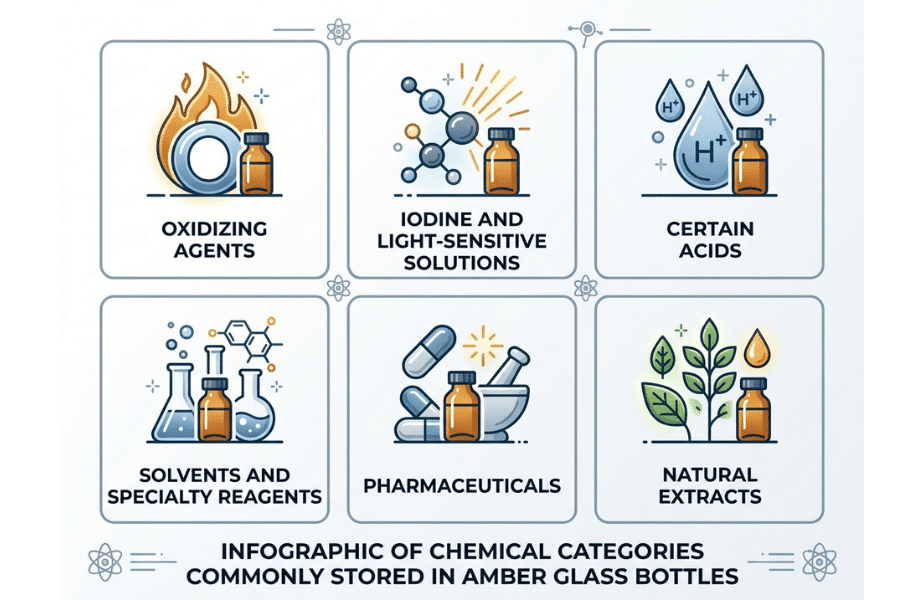
Amber glass bottles are widely used for chemicals and materials that benefit from light-protected storage. Exact storage requirements vary by substance, concentration, and supplier guidance, so the Safety Data Sheet (SDS) should always be checked before use.
Common examples include:
Oxidizing agents
Some oxidizing agents, such as hydrogen peroxide, may decompose more quickly when exposed to light. Amber glass helps reduce that exposure and is often used when maintaining reagent stability is important.
Iodine and other light-sensitive solutions
Iodine preparations and some halogen-containing solutions are frequently stored in amber bottles to help reduce photochemical degradation and preserve concentration.
Certain acids
Some acids, especially those with light-sensitivity considerations, may be stored in amber glass when compatibility with glass has been confirmed. Nitric acid is a commonly cited example in laboratory handling discussions, though storage practices should always follow SDS instructions and facility rules.
Solvents and specialty reagents
Some solvents and specialty chemicals are better protected when light exposure is reduced. In these cases, amber glass may be selected as part of a broader storage strategy that also includes correct sealing, ventilation, and segregation.
Pharmaceuticals and analytical standards
Amber glass is widely used in pharmaceutical labs, compounding environments, and quality control settings for substances that require protection from light during storage or handling.
Natural extracts and biological compounds
Essential oils, plant extracts, vitamins, and certain biological preparations are often packaged in amber containers because light exposure can reduce quality or stability over time.
When Amber Glass Is Not the Right Choice
Amber glass is useful, but it is not universal. Labs should not assume that a dark bottle is automatically the safest option.
Hydrofluoric acid
Hydrofluoric acid should not be stored in glass because it attacks silica. In these cases, compatible plastic or fluoropolymer containers are typically required.
Strong alkalis
Concentrated sodium hydroxide, potassium hydroxide, and similar strong bases can attack glass over time. For these materials, HDPE or other compatible alternatives are often preferred.
Pressurized or gas-generating contents
Standard glass reagent bottles are not intended for materials that may build pressure during storage. Pressure-rated systems should be used where required.
Applications requiring impact resistance
In some environments, plastic containers may be preferred because they are less likely to break during transport or high-frequency handling.
The key point is simple: amber glass is only the right choice when both light protection and glass compatibility are required.
Amber Glass vs. Clear Glass vs. HDPE vs. PTFE
Different storage materials serve different laboratory needs. Here is a practical comparison:
| Material | Main Advantage | Common Limitation | Typical Use |
|---|---|---|---|
| Amber Glass | Light protection + chemical resistance | Breakable; not suitable for all chemicals | Light-sensitive reagents |
| Clear Glass | Visibility of contents | No light protection | General lab storage where photoprotection is unnecessary |
| HDPE | Good chemical resistance and impact resistance | Vapor permeability; not ideal for some solvents | Bases, general-purpose chemical storage |
| PTFE | Very broad chemical compatibility | Higher cost | Highly aggressive or specialty chemicals |
Amber glass is often preferred when the contents are light-sensitive and chemically compatible with glass. Clear glass is useful when visual inspection matters more than light protection. HDPE works well for many routine storage needs, especially for strong bases. PTFE is typically reserved for highly demanding chemical applications.
How to Choose the Right Amber Glass Bottle for Lab Use
Not all amber bottles are the same. Selection should be based on the following factors:
1. Glass type
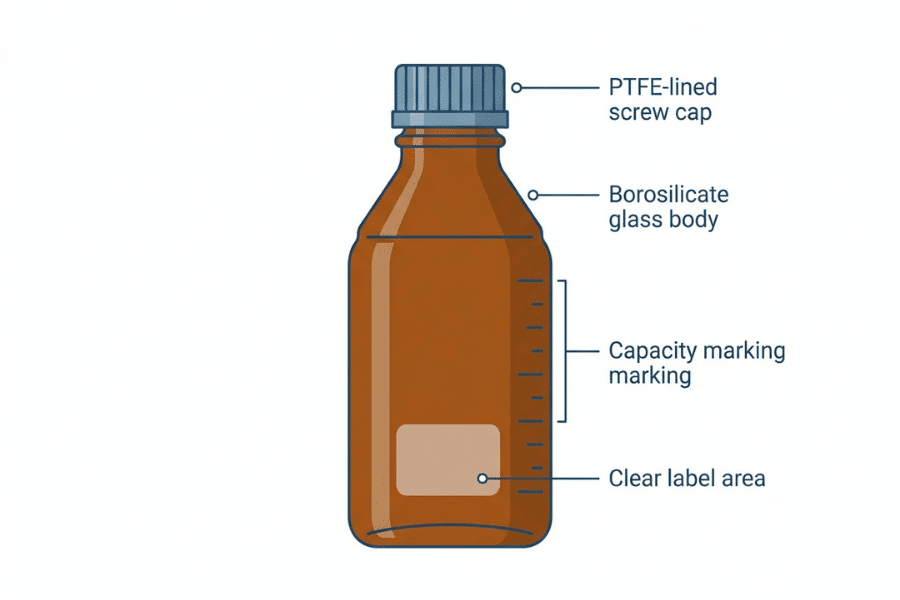
For laboratory use, borosilicate glass is generally preferred because it offers better thermal and chemical resistance than soda-lime glass.
2. Bottle size
Choose a capacity that matches the working volume as closely as possible. Reducing unnecessary headspace may help improve storage stability for some materials.
3. Closure compatibility
The cap and liner matter as much as the bottle itself. PTFE-lined caps are often preferred for broader chemical compatibility, especially with solvents, acids, and more demanding lab applications.
4. Storage conditions
Consider whether the bottle will be stored on shelving, inside a chemical storage cabinet, in refrigerated conditions, or in a controlled chemical room.
5. Frequency of use
For frequently accessed chemicals, ease of handling, pouring, sealing, and relabeling also becomes important.
6. Safety and compliance
Storage decisions should align with SDS guidance, internal lab protocols, labeling requirements, and hazard segregation rules.
Additional Benefits of Amber Glass in Laboratories
Beyond light protection, amber glass offers several practical advantages for lab environments.
Chemical inertness
Borosilicate amber glass is compatible with a wide range of substances and is less likely than many plastics to introduce extractables or leachables.
Low vapor permeability
Glass does not allow vapor transmission through the container wall in the way plastics can. This can be important for volatile chemicals and long-term storage.
Heat resistance
Many amber borosilicate bottles can tolerate demanding lab conditions better than standard plastic alternatives, making them suitable for broader laboratory use.
Reusability
Amber glass bottles can often be cleaned and reused when the previous contents and cleaning procedures allow it.
Sustainability
Glass is recyclable and may support sustainability goals in labs looking to reduce dependence on disposable plastic packaging.
Best Practices for Storing Chemicals in Amber Bottles
Using an amber bottle is only one part of proper chemical storage. Good laboratory practice still requires the following:
Check the SDS first
Always confirm whether the chemical requires protection from light and whether glass is a compatible storage material.
Use compatible closures
A chemically resistant cap liner helps reduce leakage, evaporation, and the risk of contamination.
Label clearly
Every bottle should be labeled with the chemical name, concentration, hazard information, and relevant handling details.
Use secondary containment
Trays, sumps, or cabinet-integrated containment help reduce the impact of spills or bottle breakage.
Segregate incompatible chemicals
Acids, bases, oxidizers, flammables, and reactive chemicals should not be stored together simply because they are all in amber bottles.
Store in appropriate cabinets
Hazardous chemicals should be stored in suitable chemical storage cabinets rather than left on open shelving.
Inspect regularly
Check for chips, cracks, clouding, worn labels, or seal degradation as part of routine lab safety checks.
Frequently Asked Questions
Are amber bottles better than clear glass for chemical storage?
Amber bottles are better for chemicals that need protection from light. For chemicals that are not light-sensitive, clear glass may be acceptable if compatibility with glass is confirmed.
Are brown bottles and amber bottles the same?
Yes. In laboratory and packaging contexts, “brown bottles” and “amber bottles” generally refer to the same type of light-protective glass container.
Can all chemicals be stored in amber glass?
No. Some chemicals, such as hydrofluoric acid and certain strong alkalis, should not be stored in glass at all.
Can plastic replace amber glass?
Sometimes. Opaque plastic containers may work for some applications, but they do not always offer the same combination of chemical inertness, vapor resistance, and lab-grade handling characteristics as amber borosilicate glass.
Is the bottle alone enough for safe storage?
No. Safe chemical storage also depends on labeling, compatibility, segregation, secondary containment, ventilation where needed, and proper cabinet selection.
Conclusion
Amber glass bottles remain a practical and widely used choice for storing light-sensitive chemicals in laboratories. They help reduce photodegradation, support reagent stability, and offer the durability and chemical resistance needed in many lab environments. However, they are not a one-size-fits-all solution. The right choice depends on the chemical itself, the closure system, storage conditions, and the broader safety setup of the lab.
For laboratories looking to improve chemical organization and safety, bottle selection should be considered alongside cabinet selection, hazard segregation, and overall storage planning. A well-designed lab storage system does more than hold chemicals—it helps protect people, materials, and workflow quality.
If you are planning a new lab, upgrading your chemical storage setup, or sourcing laboratory storage furniture, Glorylab Furniture can support your project with practical storage solutions for professional laboratory environments.
