Stainless steel lab tables are widely used in research, clinical, pharmaceutical, and industrial laboratories for their corrosion resistance, hygienic non-porous surfaces, and long service life. For most general-purpose applications, Grade 304 is sufficient, while Grade 316 is better suited to environments with chloride exposure or more aggressive chemicals.
The right choice depends on your lab’s chemical profile, load requirements, cleaning protocols, and overall operating environment. This guide explains the main benefits of stainless steel lab tables, compares Grade 304 and Grade 316, and outlines the key factors to consider before buying.
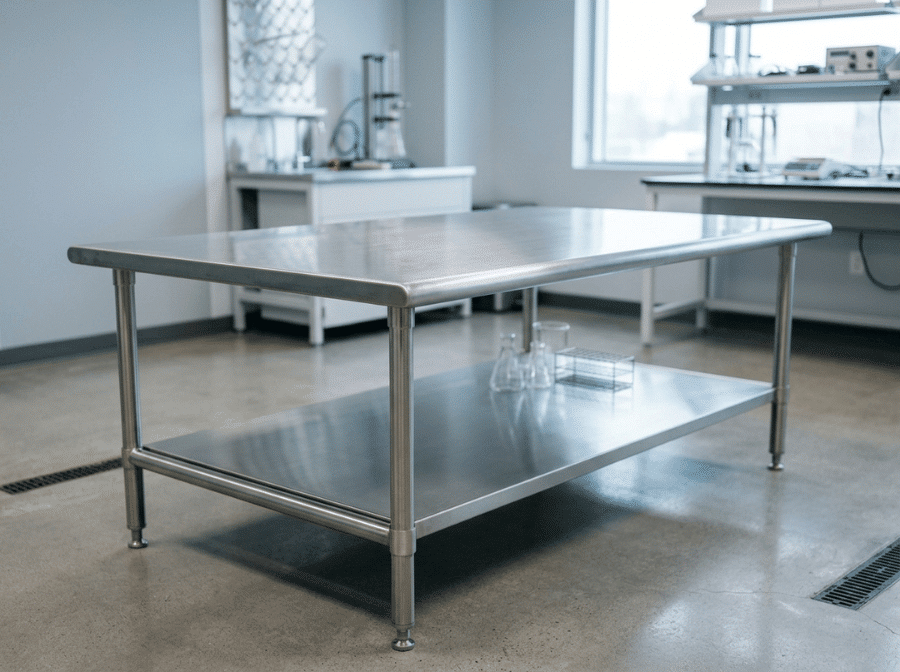
Key Benefits of Stainless Steel Lab Tables
Corrosion Resistance
Stainless steel resists oxidation and surface degradation due to the presence of chromium in the alloy—typically a minimum of 10.5% by mass, which forms a passive oxide layer on the surface. This layer reforms when damaged, giving stainless steel a degree of self-protection that most other worktop materials cannot replicate.
In laboratories where dilute acids, alkalis, and aqueous solutions are regularly used, this property translates directly into longer surface life and reduced replacement cycles. The degree of resistance varies by grade, which is covered in detail in the next section.
Hygienic, Non-Porous Surface
Stainless steel does not absorb liquids or harbor bacteria in the way that porous materials can. Its smooth, non-porous surface is straightforward to decontaminate and does not support microbial colonization under standard conditions.
This makes stainless steel lab tables a practical specification for microbiology, food science, pharmaceutical, and clinical environments where surface hygiene and contamination control are part of routine protocol. Many regulatory frameworks and cleanroom standards favor non-porous, cleanable surfaces for this reason.
Load-Bearing Strength
Stainless steel offers a high strength-to-weight ratio and performs consistently under sustained static loads. Laboratory workbenches frequently carry analytical instruments, centrifuges, autoclaves, or equipment with significant mass—conditions that can compromise less robust materials over time.
A well-fabricated stainless steel lab table maintains structural integrity under both point loads and distributed weight across the work surface without warping or deflecting.
Easy Cleaning and Decontamination
The surface characteristics of stainless steel make routine cleaning straightforward. Most common laboratory disinfectants, detergents, and cleaning protocols are compatible with stainless steel, and residues can be wiped away without damaging the surface finish.
Brushed finishes, in particular, are widely used in lab settings because they are easier to maintain visually—minor surface marks are less apparent than on polished surfaces.
Long Service Life
Properly specified and maintained stainless steel lab tables carry a service life that typically extends well beyond that of laminate or wood-based alternatives. The material does not chip, swell, delaminate, or absorb spills, which are the failure modes most commonly seen in alternative materials. Over the full asset lifecycle, this durability often offsets the higher initial procurement cost.
Grade 304 vs. Grade 316 Stainless Steel: Which Is Right for Your Lab?
Both Grade 304 and Grade 316 are austenitic stainless steels widely used in laboratory furniture. They share a broadly similar appearance and fabrication profile, but differ in their alloy composition and, consequently, their chemical resistance.
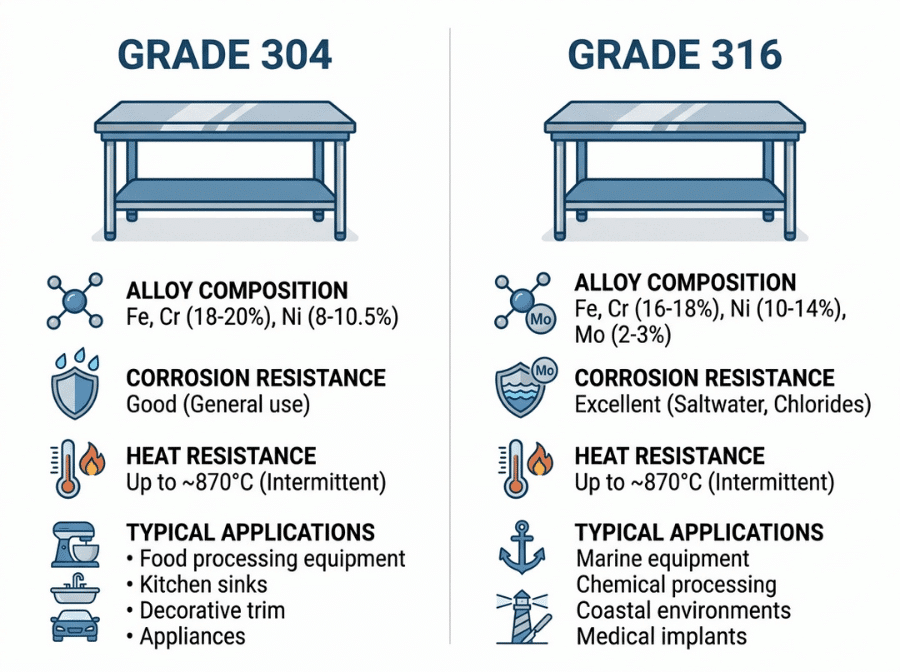
Grade 304 contains approximately 18% chromium and 8% nickel. It is the most commonly used stainless steel grade in laboratory furniture globally. Grade 304 performs well against a wide range of dilute acids, alkalis, and organic compounds, and is well-suited for general-purpose laboratory environments where aggressive chemical exposure is not the dominant concern.
Grade 316 adds molybdenum to the alloy (typically 2–3%), which significantly increases resistance to chloride-induced corrosion and pitting. This makes Grade 316 the preferred specification in marine environments, cleanrooms where saline solutions or chloride-based disinfectants are used frequently, pharmaceutical manufacturing, and applications involving halogenated compounds.
The practical guidance is straightforward: Grade 304 is appropriate for most standard laboratory environments. Grade 316 is warranted where chlorides, halides, or particularly aggressive chemical exposures are part of the regular operating conditions. In ambiguous cases, it is worth consulting with your furniture supplier and reviewing the chemical compatibility data for the specific reagents in use.
From a cost perspective, Grade 316 typically carries a price premium of 20–30% over Grade 304 due to the higher alloy content. For most procurement decisions, specifying Grade 316 across an entire facility where Grade 304 would suffice is unnecessary—but underspecifying in a high-risk chemical environment creates a real maintenance and longevity problem.
How Does Stainless Steel Compare to Other Lab Table Materials?
No single worktop material is ideal for every application. A balanced comparison helps clarify where stainless steel performs best and where alternatives may be more appropriate.
Stainless Steel vs. Epoxy Resin
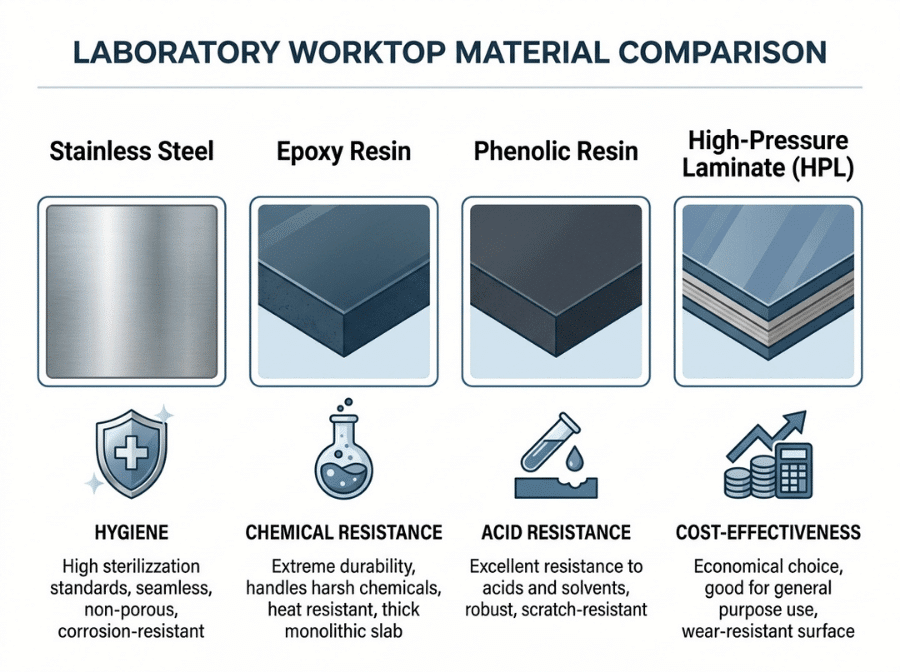
Epoxy resin is a common choice for chemistry and biology labs. It offers broad chemical resistance, including to strong acids and bases, and performs well against UV exposure. Epoxy resin surfaces are non-porous and durable under most standard laboratory conditions.
Stainless steel has the advantage in high-load applications and cleanroom environments. Epoxy resin is generally more cost-effective for standard chemistry labs and performs comparably for most routine chemical exposures. The choice between them often comes down to whether the priority is breadth of chemical resistance (epoxy resin) or mechanical strength, hygiene protocol requirements, and surface cleanability (stainless steel).
Stainless Steel vs. Phenolic Resin
Phenolic resin surfaces are dense, non-porous, and highly resistant to a wide range of chemicals, including many solvents and acids. They also perform well against moisture and impact.
Stainless steel and phenolic resin are both used in demanding laboratory environments, and the materials are not always directly interchangeable. Phenolic resin tends to be specified where strong acid resistance is a primary requirement. Stainless steel is typically preferred in pharmaceutical, food science, or cleanroom settings where surface hygiene protocols and decontamination frequency are high.
Stainless Steel vs. High-Pressure Laminate (HPL)
Laminate surfaces are cost-effective and suitable for lower-intensity laboratory environments—teaching labs, administrative support spaces, or instrument rooms where chemical exposure is minimal or controlled. They offer a range of aesthetic options and are easy to replace.
However, laminate is susceptible to moisture penetration at edges and seams, surface chipping under impact, and degradation under repeated chemical exposure. For environments involving regular liquid work or aggressive reagents, laminate is generally not the right long-term specification. Stainless steel or resin-based surfaces are more appropriate.
Stainless Steel vs. Wood
Solid wood and wood-framed constructions appear in teaching laboratories and lower-intensity settings where chemical exposure is limited. Wood-framed lab benches with alternative worktop surfaces (steel, resin, or HPL) are a common configuration.
As a worktop surface in an active chemistry or research environment, untreated or lightly treated wood is not recommended. It is susceptible to moisture absorption, chemical staining, bacterial colonization, and structural degradation over time. Stainless steel substantially outperforms wood as a primary work surface in most professional laboratory contexts.
How to Choose the Right Stainless Steel Lab Table
What is the lab environment and application?
The starting point for any specification decision is a clear understanding of the chemical and physical demands the work surface will face. A pharmaceutical formulation lab, a microbiology suite, a food safety testing facility, and a materials science research bench all have different exposure profiles. Map the reagents, cleaning agents, and physical conditions before committing to a grade or finish.
What dimensions and customization are required?
Standard stainless steel lab table dimensions work well for many installations, but laboratory layouts frequently require custom lengths, widths, or configurations—particularly in multi-room builds or when integrating with existing casework. Suppliers capable of manufacturing to custom dimensions without significant cost penalties are preferable for project-based procurement. Glorylab’s stainless steel laboratory workstations are available in custom configurations to match specific room layouts and project specifications.
What are the load requirements?
Determine the weight of the instruments and equipment that will be placed on the work surface. Static load capacity should be clearly specified, and the structural frame—typically steel—should be assessed alongside the worktop itself. Heavy analytical equipment, autoclaves, and centrifuges have different load profiles than lighter glassware and sample preparation work.
What accessories and configuration options are needed?
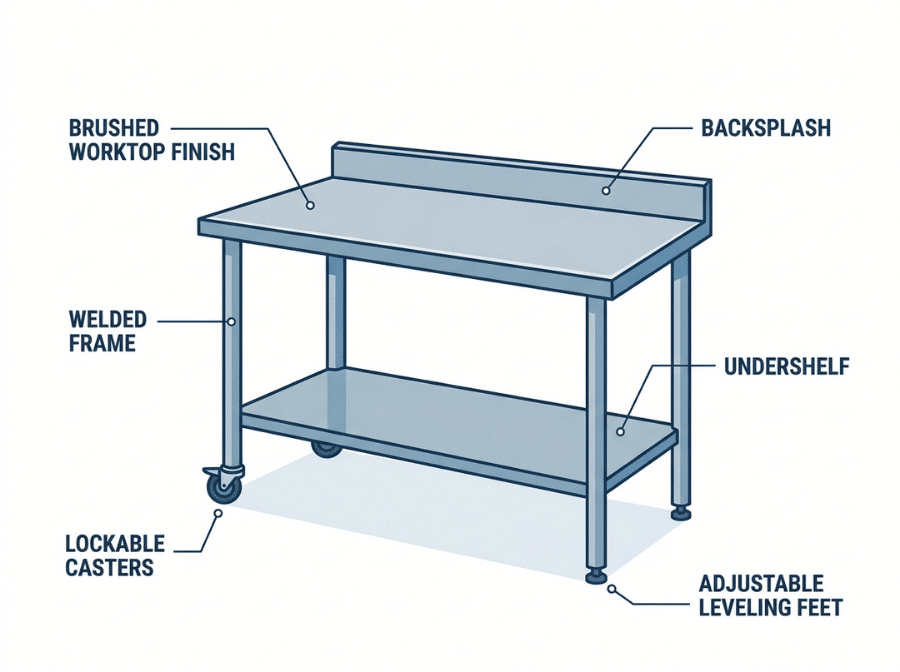
Stainless steel lab tables can be configured with a range of integrated accessories that significantly affect functionality:
- Undershelf: Provides additional storage below the work surface, useful for equipment or supplies that need to remain accessible.
- Backsplash: A raised edge at the rear of the work surface that contains spills and prevents liquids from reaching the wall or services at the back of the bench.
- Casters: Lockable casters allow for reconfiguration or repositioning of benches. Useful in flexible or multi-use spaces.
- Leveling feet: Adjustable feet accommodate uneven flooring and allow fine-level adjustment during installation.
Specifying the right combination of these options at the design stage avoids costly modifications during installation or after commissioning.
Brushed or polished surface finish?
Brushed finishes (typically 2B or No. 4) are more practical for active laboratory use. They are easier to maintain, less prone to showing fingerprints and minor marks, and are the standard specification in most research and clinical settings.
Polished finishes offer a higher degree of surface smoothness, which can be beneficial in specific cleanroom or pharmaceutical environments where particle accumulation is a concern. However, polished surfaces require more careful maintenance to preserve their appearance and are more demanding in high-traffic work areas.
Is this for a cleanroom or wet area?
Cleanroom-grade stainless steel lab tables typically require specific finish standards, electropolishing in some cases, and careful attention to joints and welds that could trap particulates. For wet area applications—dishwashing benches, sink benches, or areas with frequent liquid exposure—fully welded and sealed construction is important to prevent moisture ingress at joints.
Stainless Steel Lab Table Maintenance Best Practices
Stainless steel performs best when maintained consistently. A few practical guidelines:
- Routine cleaning: Wipe down surfaces regularly with a mild detergent solution and a soft cloth or non-abrasive pad. Always wipe in the direction of the surface grain on brushed finishes to avoid cross-grain scratching that becomes visible over time.
- Avoid chloride-based cleaners on Grade 304: Bleach and chlorine-containing disinfectants can cause pitting and surface staining on Grade 304 over repeated use. Where chloride-based disinfectants are part of the regular cleaning protocol, Grade 316 is the more appropriate specification—or the contact time of chloride solutions should be minimized and surfaces rinsed promptly.
- Address surface staining promptly: Iron particle contamination from nearby carbon steel tools or construction debris can deposit on the surface and cause rust-colored staining. This is not corrosion of the stainless steel itself but surface contamination. It can be removed with appropriate stainless steel cleaning products or passivation treatments.
- Inspect welds and joints periodically: In wet areas, joints, welds, and seams are the most likely points of vulnerability. Inspect these areas periodically and address any signs of crevice corrosion early.
- Avoid abrasive pads and steel wool: These damage the passive oxide layer and the surface finish, creating sites for corrosion initiation.
Frequently Asked Questions About Stainless Steel Lab Tables
What grade of stainless steel is best for laboratory use?
Grade 304 is appropriate for most general-purpose laboratory environments. Grade 316 is recommended where chlorides, halides, or particularly aggressive chemicals are in regular use. In pharmaceutical, marine, or cleanroom environments, Grade 316 is generally the preferred specification.
How much weight can a stainless steel lab table support?
Load capacity depends on both the worktop gauge and the structural frame. Many commercial-grade stainless steel lab tables are rated to support between 200 and 500 kg of distributed load. For heavy instrument placement, confirm the rated point load capacity with the manufacturer before specifying.
Is stainless steel suitable for cleanroom laboratory environments?
Yes. Stainless steel is widely used in cleanrooms due to its non-porous surface, compatibility with rigorous decontamination protocols, and resistance to particle generation. Electropolished Grade 316 is often specified in ISO Class 5 and above environments. Standard brushed Grade 304 or 316 is used in lower-classification cleanrooms.
What is the difference between a brushed and polished stainless steel finish for lab tables?
Brushed finishes (No. 4 or 2B) are more practical for most active lab settings—they are easier to maintain and show fewer marks. Polished finishes are smoother and may be required in high-specification cleanroom or pharmaceutical environments, but they require more careful day-to-day maintenance.
How should I clean a stainless steel lab table?
Use a mild detergent and a soft, non-abrasive cloth. Wipe in the direction of the surface grain. Rinse and dry after cleaning to prevent water spots. Avoid chloride-based cleaners on Grade 304. Abrasive pads and steel wool should not be used as they damage the surface finish.
Can stainless steel lab tables be custom-made to non-standard dimensions?
Yes. Custom dimensions are standard practice for project-based laboratory procurement. Most lab furniture manufacturers—including factory-based suppliers—accommodate custom lengths, widths, and configurations as part of the standard manufacturing process.
When is epoxy resin a better choice than stainless steel for lab worktops?
Epoxy resin is often preferable in chemistry labs where resistance to strong acids, bases, and a broad range of solvents is the primary requirement, and where the load-bearing and hygiene demands of a clinical or pharmaceutical environment are not the primary drivers. It is also typically lower in cost than stainless steel.
Specify with Confidence
Stainless steel lab tables represent a well-established, high-performance specification choice for laboratory environments that demand durability, cleanability, and reliable chemical resistance. Getting the specification right—grade, finish, dimensions, and accessories—significantly affects both performance and total cost of ownership over the asset’s service life.
For procurement teams and facility planners sourcing stainless steel laboratory workstations for a new build, refurbishment, or multi-site project, working directly with a factory-based manufacturer allows for greater specification flexibility, cleaner pricing, and tighter control over lead times.
Glorylab manufactures stainless steel lab tables and laboratory furniture across a full range of configurations at its facility in Jiangsu Province, China. Custom dimensions, Grade 304 and Grade 316 options, and integrated accessories are all available as part of standard production. Contact the Glorylab team to submit your project specifications or request a consultation.