Stainless steel lab tables can look identical on paper — same finish, similar dimensions, comparable prices. But in a regulated laboratory, cleanroom, hospital, or food-grade environment, a misspecified table can trigger compliance failures, accelerated corrosion, or structural problems under normal loads. For procurement officers and lab planners, the cost of getting it wrong reaches far beyond the price of the table itself.
This guide organizes the decision into 13 considerations, ranked by how often they determine long-term performance. The first five are core structural and material choices — steel grade (304 vs. 316), tabletop gauge, construction method, chemical resistance, and load capacity — that should be locked in before anything else. The rest refine and validate that foundation, giving you a clear framework whatever your environment.
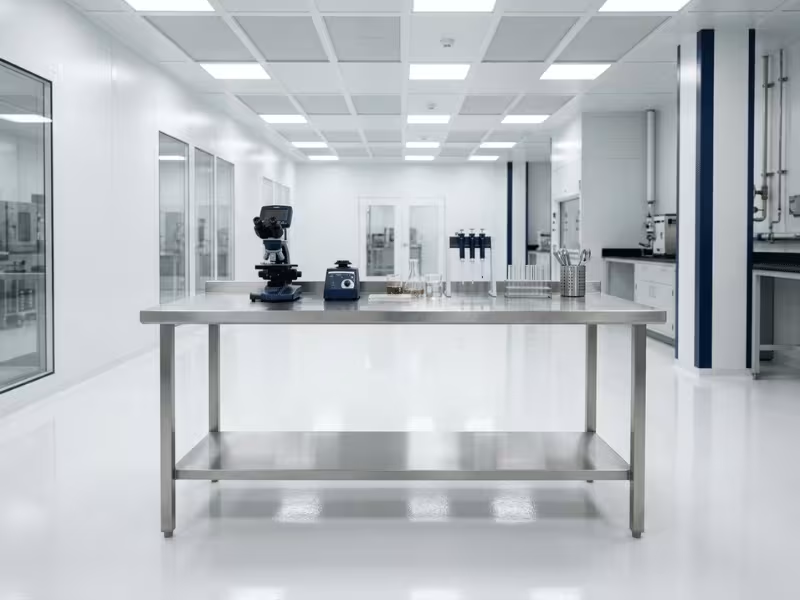
The 5 Critical Decisions
1. Steel Grade: 304 vs. 316 — Which Is Right for Your Application?
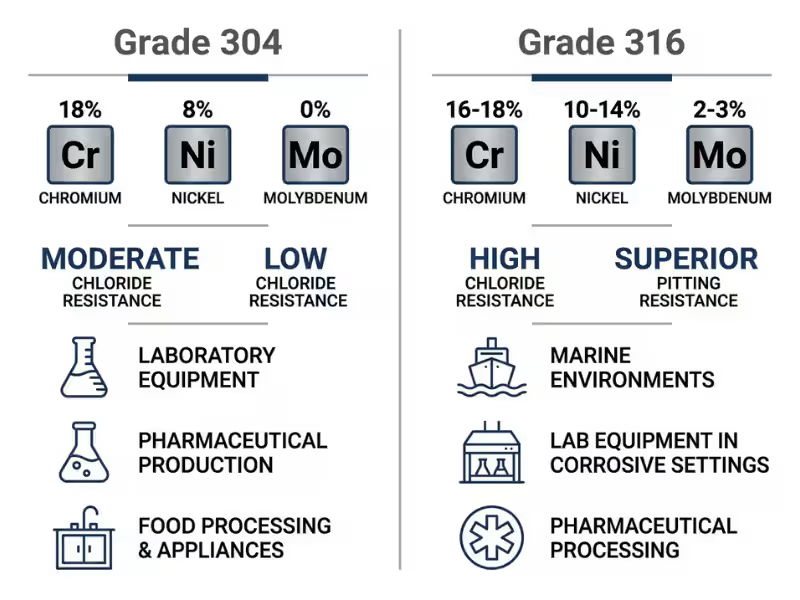
Grade 304 and Grade 316 are both austenitic stainless steels, but they perform differently in demanding environments. The key difference is molybdenum: Grade 316 contains 2–3% molybdenum, which significantly improves resistance to chloride-induced corrosion and pitting.
Grade 304 is the most widely specified material for general laboratory work tables, food preparation surfaces, and non-aggressive chemical environments. It performs well where cleaning agents are mild and chloride exposure is limited.
Grade 316 is typically recommended for marine environments, pharmaceutical manufacturing under GMP conditions, clinical settings where bleach-based disinfectants are used frequently, and applications involving acids, salts, or prolonged moisture exposure. The higher molybdenum content justifies the cost premium in these contexts.
A practical rule: if your cleaning protocol includes bleach, sodium hypochlorite, or saline solutions on a regular basis, 316 is worth specifying. For general-purpose lab benches in chemistry, biology, or education settings, 304 is commonly sufficient.
At Glorylab, we supply stainless steel lab benches in both 304 and 316, and we’ll advise on grade selection based on your stated application during the technical review stage.
2. Tabletop Gauge and Frame Thickness — Why Thickness Numbers Matter
Gauge numbers run inversely to thickness: a lower gauge number means thicker steel. This is a detail that’s easy to overlook in a quotation, but it directly determines how a table performs under load, how resistant it is to denting, and how long it maintains surface integrity under repeated cleaning.
For laboratory work tables under general use, 16-gauge tabletops (approximately 1.5 mm) are commonly specified as a minimum. 14-gauge (approximately 2.0 mm) is often preferred for heavy-duty lab tables where instrumentation loads or mechanical stress are factors. Frames are typically built from heavier structural sections—square or rectangular tubing—with wall thicknesses matched to the intended load category.
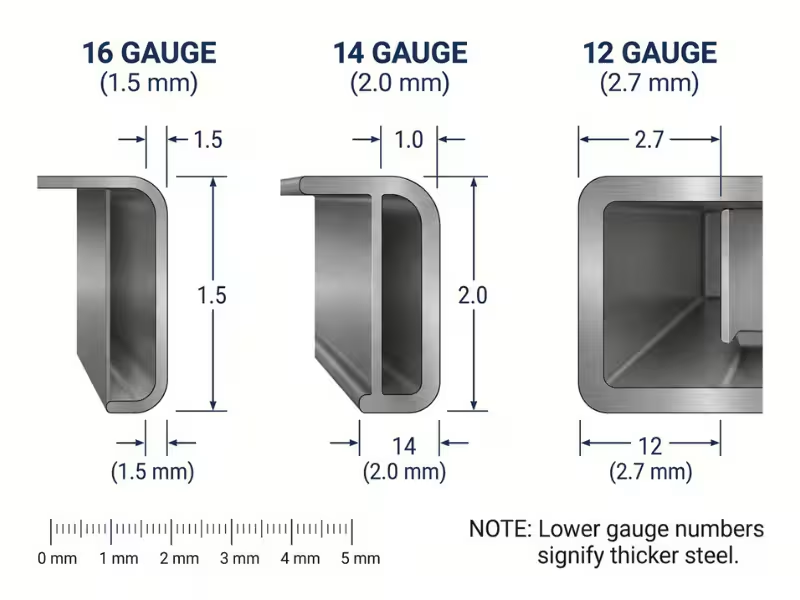
Be cautious of quotations that reference gauge without specifying the actual thickness in millimeters, particularly when sourcing internationally, where gauge standards can differ.
3. Welded vs. Knock-Down (KD) Construction — What the Difference Means in Practice
Welded construction means the tabletop, frame, and structural components are joined by continuous welds and ground smooth. The result is a monolithic structure with no fastener interfaces that can loosen, corrode, or trap contamination. Fully welded stainless steel lab benches are standard for cleanroom environments, GMP facilities, and anywhere that rigorous cleaning and decontamination are required.
Knock-down (KD) construction uses mechanical fasteners—bolts, brackets, and connectors—to assemble the table on-site. This has practical advantages: easier shipping, lower freight volume, and the ability to reconfigure or relocate the table. KD construction is often acceptable in general laboratory environments where cleaning standards are less stringent.
For pharmaceutical, biotech, and food-grade environments, welded construction is almost universally specified. For school labs, research environments, or facilities that may need to reconfigure layouts, KD construction can be a practical and cost-effective choice.
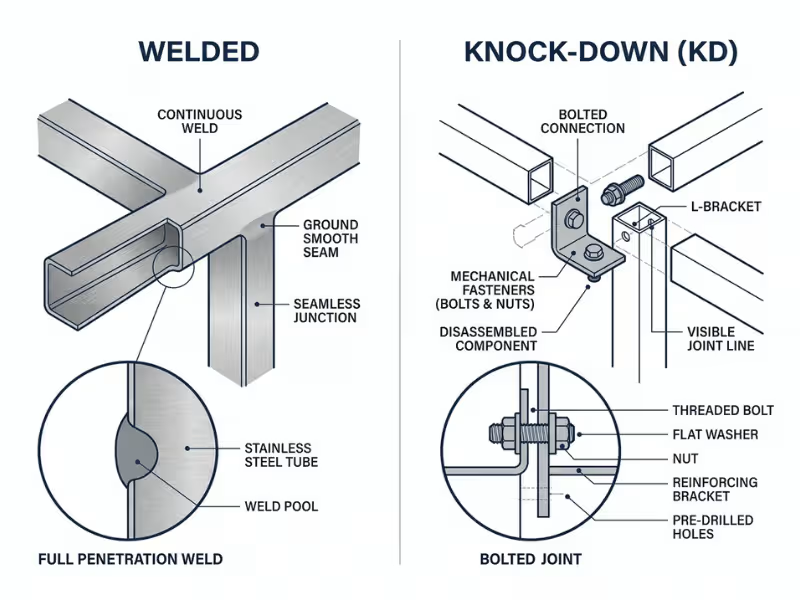
Glorylab’s stainless steel laboratory tables are available in both configurations. For cleanroom and GMP projects, we manufacture fully welded tables with continuously ground weld seams to eliminate surface voids.
4. Chemical and Corrosion Resistance by Application — Matching the Table to the Environment
Not all stainless steel lab tables face the same chemical exposure. The combination of steel grade, surface finish, and joint quality determines how a table holds up against specific agents.
Common exposure scenarios we see in project inquiries include:
- Strong acids (hydrochloric, sulfuric, nitric): 316 stainless is more resistant than 304, but neither grade should be considered universally acid-proof. For aggressive acid environments, a secondary protective surface or alternative material may be more appropriate.
- Alkalis and cleaning agents: Both 304 and 316 perform well against most alkaline cleaners. High-concentration bleach requires 316 and appropriate rinsing protocols.
- Solvents: Stainless steel is generally resistant to common organic solvents, but repeated pooling of certain solvents can affect surface finish over time.
- Saline and marine environments: 316 with an electropolished or passivated finish is typically recommended.
When submitting an inquiry, include a summary of the chemicals your tables will be regularly exposed to. This allows us to make a specific material recommendation rather than a generic one.
5. Load Capacity and Point Loading — Understanding the Difference
Distributed load capacity and point load capacity are different measurements, and confusing them leads to under-specified tables. A table rated for 200 kg of distributed load may develop surface deflection or frame deformation under a 50 kg centrifuge placed on a single corner.
When specifying heavy-duty lab tables for instrumentation, always ask the supplier to confirm:
- The distributed load rating (total weight spread evenly across the surface)
- The point load capacity (concentrated weight on a defined area)
- Whether the rating applies to the tabletop alone or the full table structure including legs and frame
Load capacity is a function of gauge, frame design, and span between support points. Longer tables with greater spans require heavier structural sections to maintain equivalent rigidity. We size frames and tabletop gauges against the stated load requirements during technical review—not as a post-order adjustment.
Secondary Considerations
6. Surface Finish — More Than an Aesthetic Choice
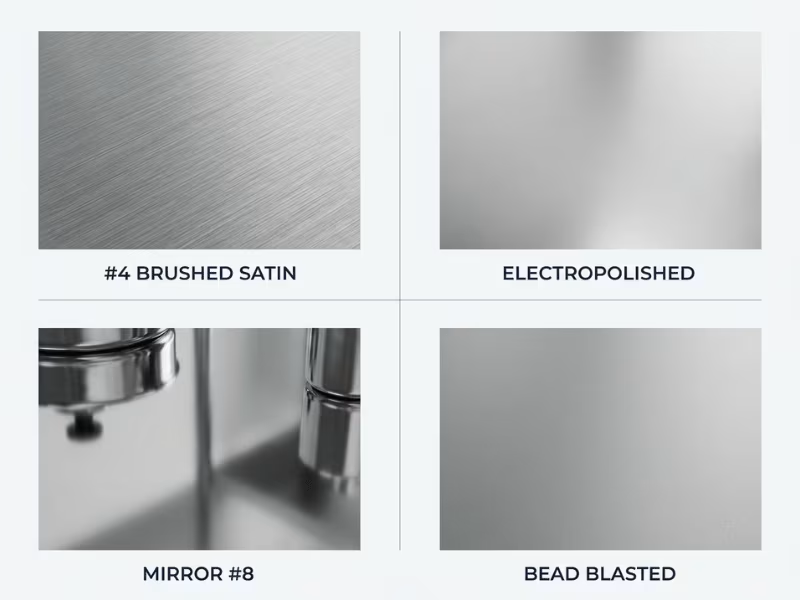
Surface finish affects cleanability, bacteria retention, reflectivity, and scratch visibility. The most common finishes for stainless steel laboratory tables are:
- #4 Brushed (Satin): The standard finish for most lab environments. Directional grain provides a clean appearance, is easy to maintain, and hides minor surface marks. Widely specified for food prep, pharmaceutical, and general lab use.
- Electropolished: An electrochemical process that removes surface imperfections and significantly reduces surface roughness (Ra value). Electropolished stainless steel lab benches are the preferred choice for cleanrooms, semiconductor environments, and applications requiring the highest level of hygienic performance.
- Mirror (#8): High specular reflectivity. Less common in laboratory environments due to the visibility of fingerprints and surface marks, but occasionally specified for specific aesthetic or functional requirements.
- Bead Blasted: A matte, non-directional finish sometimes specified for anti-glare environments.
For most laboratory work tables, a #4 brushed finish in 304 or 316 provides a practical balance of cleanability, durability, and visual neutrality.
7. Dimensions and Workspace Configuration
Standard stainless steel lab table dimensions range from 600 mm to 900 mm in depth and from 1200 mm to 2400 mm in length, with working heights typically between 850 mm and 900 mm for seated or standing configurations. However, “standard” rarely matches a specific room layout.
In project inquiries, we routinely fabricate to non-standard dimensions—including L-shapes, U-shapes, corner tables, and island configurations. Custom dimensions carry no additional charge at Glorylab, as manufacturing to specification is part of our standard process, not an upgrade.
Before finalizing dimensions, confirm:
- Column, door, window, and service run positions in the room layout
- Required aisle clearances between benches
- Whether wall-mounted, freestanding, or island configurations are appropriate
- Integration points for sinks, gas outlets, and electrical service
Submitting a room layout drawing at the inquiry stage allows us to review fit, flag conflicts, and suggest configuration adjustments before production begins.
8. Ergonomics and Height Adjustability
Fixed-height stainless steel lab benches are the norm in most environments, but ergonomic considerations are increasingly being built into lab furniture specifications—particularly for facilities where operators work extended shifts or where shared workstations serve users of varying height.
Height-adjustable stainless steel laboratory tables are available in manual (crank or pin-lock) and pneumatic configurations. For cleanroom environments, pneumatic or sealed manual mechanisms are typically specified to avoid particulate generation.
For standard fixed-height tables, confirm that the specified working height matches your primary task: seated microscopy work typically requires a lower bench height than standing prep or instrument operation.
9. Accessories and Utility Integrations
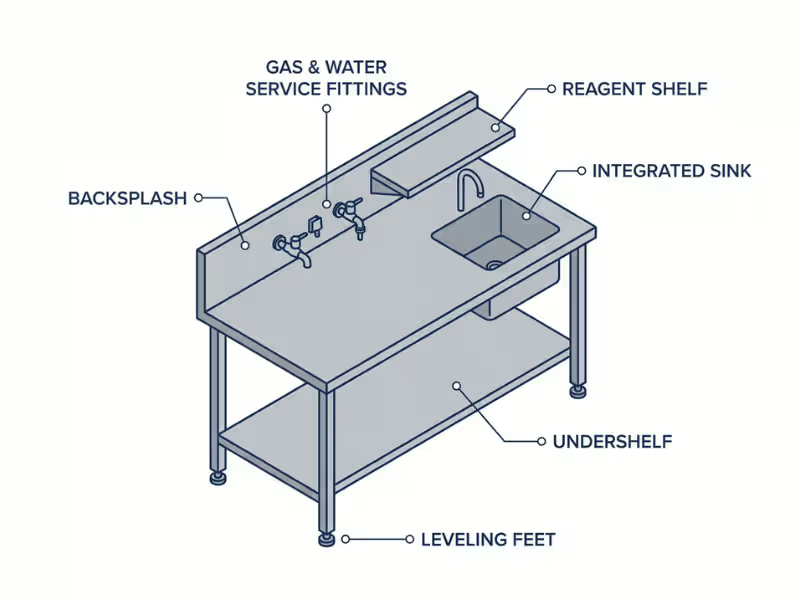
A stainless steel lab table’s functional value often depends on what’s integrated into or attached to it. Common accessories and utility integrations include:
- Integrated sinks: Single or double-bowl stainless steel sinks welded into the tabletop, supplied with appropriate drainage fittings. Glorylab manufactures tables with integrated sinks as a standard configuration option.
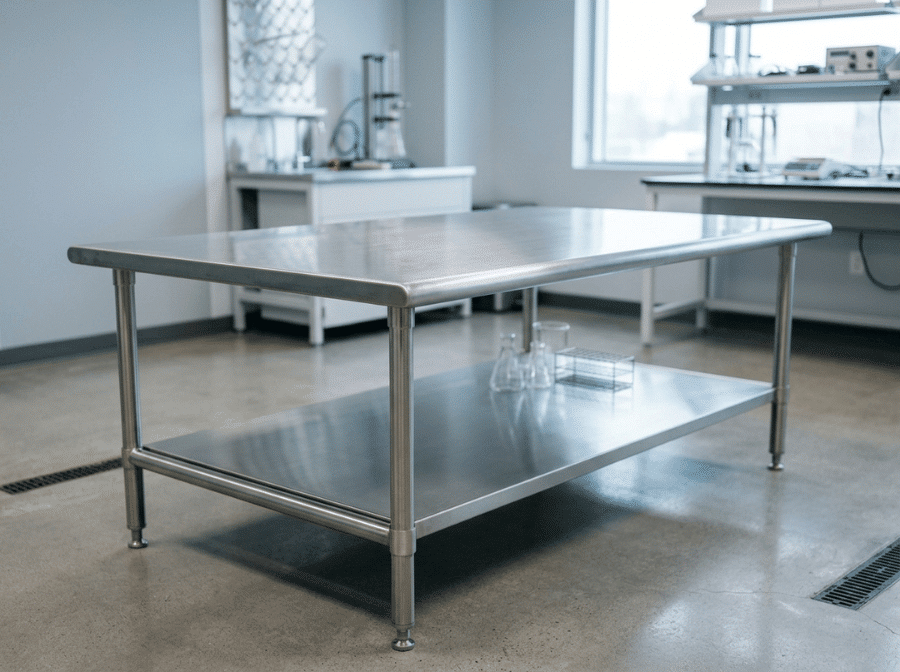
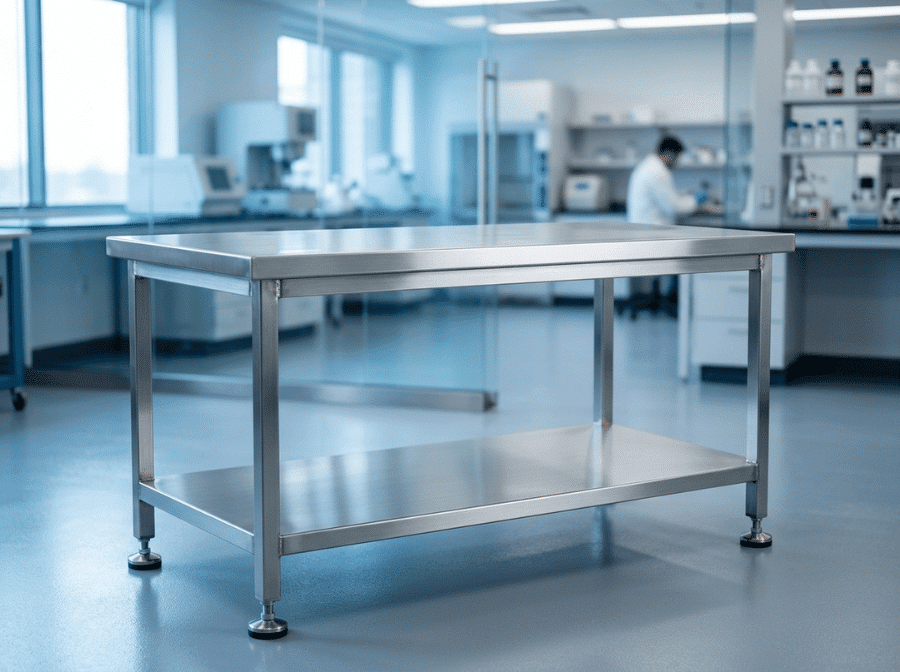
- Undershelves: Fixed or adjustable lower shelves for storage, reagent staging, or equipment placement.
- Backsplashes: Vertical panels welded to the rear of the tabletop to protect wall surfaces and contain splashes. Height typically ranges from 100 mm to 300 mm depending on the application.
- Reagent shelves: Elevated shelving above the work surface, typically in tubular or flat bar construction.
- Perforated panels and pegboards: For tool organization, glassware drying, and vertical storage.
- Casters and leveling feet: For mobile laboratory work tables or fixed installations on uneven floors.
- Gas, water, and electrical service fittings: Pre-drilled or fitted bench tops with color-coded gas taps, faucets, and electrical outlets.
Specify accessories at the design stage. Retrofitting integrations—particularly sinks and service fittings—into an existing welded table is substantially more complex than manufacturing with them included from the start.
Compliance Standards and Material Certifications
10. What Documentation Should You Request—and Why
Compliance requirements for stainless steel lab tables vary by project type, end-user, and jurisdiction. Understanding what documentation is meaningful—and what isn’t—prevents both over-specification and under-documentation.
Manufacturer Quality Documentation
The baseline for any reputable supplier includes ISO 9001 certification (quality management system), production inspection records, and outgoing quality control documentation. At Glorylab, full production traceability is maintained across all orders, and documentation packages can be prepared for procurement, compliance, and project handover.
Material Traceability
For pharmaceutical, food-grade, or regulated laboratory projects, mill test certificates (MTCs) for the stainless steel used in fabrication are commonly requested. An MTC confirms the material grade, heat number, and chemical composition, providing documented traceability from the steel source through to the finished product. We can provide MTCs on request.
Lab Furniture Performance Standards
The most relevant third-party performance standard for laboratory furniture is SEFA 8M (Scientific Equipment and Furniture Association), which covers mechanical performance including load, impact, and deflection testing. Glorylab holds SGS test reports for steel lab benches based on SEFA 8M, which can be provided as part of a procurement documentation package.
For fume hood performance, we hold ASHRAE 110 certification and relevant CE certifications for applicable product categories.
Cleanroom and GMP Project Documentation
For cleanroom or pharmaceutical projects, additional documentation may be required, including material certificates confirming non-outgassing properties, surface roughness (Ra) measurements for electropolished finishes, and weld continuity records. These are project-specific documents prepared during technical review. Contact us with your facility’s documentation requirements and we will confirm what can be provided.
Note: ANSI/BIFMA standards are primarily oriented toward office furniture and are not the applicable reference for laboratory furniture procurement.
Customization Options and Lead Times
11. What to Expect from a Manufacturer That Works to Specification
Most real-world laboratory projects don’t fit standard catalog dimensions. Room layouts have columns, service chases, drainage positions, and equipment clearances that make custom sizing the practical default rather than the exception.
At Glorylab, custom dimensions, material combinations, and configuration variants are handled within standard production workflows—not as special orders requiring extended lead times. Common customizations across our stainless steel laboratory table range include:
- Non-standard table lengths, widths, and heights
- Multi-tier configurations with integrated undershelves and reagent shelves
- Tables with pre-cut sink openings, service fittings, and cable management features
- Backsplash heights tailored to wall protection or splash containment requirements
- Mixed-grade specifications (e.g., 304 frame with 316 tabletop for aggressive surface exposure)
- OEM and private-label packaging for distributors
Lead times depend on order volume, configuration complexity, and material availability. For standard configurations, production lead times typically range from 3–6 weeks. Complex or large-volume projects are quoted with production scheduling confirmed after technical review. Submit your layout or specifications to receive a project-specific timeline.
Total Cost of Ownership: A Framework for Procurement Decisions
12. How to Compare Stainless Steel Lab Table Costs Beyond the Unit Price
Unit price is rarely the most meaningful cost metric for laboratory furniture. The following framework helps procurement officers evaluate total cost of ownership across a project lifecycle:
|
Cost Category |
Questions to Ask |
|---|---|
|
Initial purchase price |
Does the price reflect the stated gauge, grade, and construction method? |
|
Freight and import costs |
Is the order consolidated? Are export documents included? |
|
Installation costs |
Is KD or welded construction more appropriate for the installation context? |
|
Replacement and maintenance |
What is the expected service life under your operating conditions? |
|
Compliance and documentation |
Are MTCs, test reports, and project documents included or separately charged? |
|
Downtime risk |
What is the lead time, and does the supplier have production capacity to meet your timeline? |
A lower unit price on a lighter-gauge table with inadequate documentation may cost more in compliance delays, early replacement, or non-conformance findings than a correctly specified table from a manufacturer who provides full documentation support.
Supplier Evaluation Checklist
13. Questions to Ask Before Placing an Order
Before committing to a supplier for stainless steel laboratory tables, work through the following checklist:
Manufacturing and Quality
- Is the supplier a direct manufacturer or a trading company?
- Is fabrication done in-house, or is production subcontracted?
- Can they provide ISO 9001 certification?
- Do they conduct pre-dispatch quality inspection on every order?
Material Verification
- Can they provide mill test certificates (MTCs) for the stainless steel used?
- Will they confirm the actual gauge (in mm) in writing, not just the nominal gauge?
- Can they confirm the steel grade with documentation?
Technical and Customization Capability
- Will they review your layout drawings before production?
- Can they manufacture to non-standard dimensions at no extra charge?
- Do they offer both 304 and 316 grade options?
- Can they integrate sinks, gas taps, backsplashes, and undershelves in a single production run?
Documentation and Compliance
- Can they provide SEFA 8M test reports?
- Do they prepare export documentation for international shipments?
- Can they provide project documentation suitable for GMP or cleanroom handover?
Export and Lead Times
- Can they consolidate multi-category orders into a single shipment?
- Do they support OEM or private-label packaging?
- What is the confirmed production lead time for your order volume?
Common Specification Mistakes to Avoid
Across the project inquiries we receive at Glorylab, a few misspecification patterns recur consistently:
Specifying grade without gauge. Stating “304 stainless steel” without confirming the tabletop thickness in millimeters leaves significant room for variation in structural performance.
Assuming load ratings apply uniformly. A table’s distributed load rating doesn’t tell you how it will perform under a centrifuge, a press, or heavy instrumentation placed at a single point. Always ask for point load specifications.
Choosing KD construction for cleanroom environments. Knock-down tables are practical in many contexts, but the fastener interfaces and seams in KD construction are difficult to clean to cleanroom standards. Welded construction should be specified for ISO-classified or GMP environments.
Requesting documentation after delivery. MTCs, test reports, and material certificates need to be requested before production begins, as they require material traceability to be maintained through the manufacturing process.
Omitting accessories from the initial specification. Adding sinks, backsplashes, and service fittings to a welded table after fabrication is substantially more complex and costly than specifying them upfront.
How Glorylab Supports Your Lab Table Project
Glorylab is a factory-based laboratory furniture manufacturer located in Jiangsu Province, near Shanghai. Every stainless steel laboratory table we produce is designed, fabricated, surface-treated, and quality-inspected at our own facility. No subcontracting, no third-party assembly, no agents between you and the production team.
Our standard stainless steel lab bench range covers:
- Grade 304 and Grade 316 tabletop and frame options
- Welded and KD construction across standard and custom configurations
- Surface finishes including #4 brushed, electropolished, and mirror, depending on application
- Integrated accessories including sinks, undershelves, backsplashes, reagent shelves, and gas/water service fittings
- Custom dimensions fabricated to your layout drawings at no additional charge
- OEM and private-label support for distributors and branded project requirements
For export projects, we consolidate all product categories into a single shipment and prepare complete export documentation in-house. MTCs, SGS test reports (SEFA 8M), and project documentation packages are available on request.
We respond to initial inquiries within 12–24 hours.
Ready to Specify? Start Here.
If you’re in the early stages of specifying stainless steel laboratory tables for a new build, refurbishment, or procurement program, the fastest path to an accurate quote is a technical conversation.
Three ways to engage Glorylab:
- Request a Quote: Share your quantity, dimensions, steel grade preference, and application. We’ll confirm the specification and return a detailed quotation.
- Submit Your Layout: Send your room layout or CAD drawings and we’ll review dimensions, configuration fit, and accessory integration before production begins.
- Request Material Certificates: If your project requires MTCs, SGS test reports, or GMP/cleanroom documentation, contact us with your documentation requirements and we’ll confirm what’s available.
Send Your Inquiry to Glorylab →
Frequently Asked Questions
What is the difference between 304 and 316 stainless steel for lab tables?
Grade 304 stainless steel is suitable for most general laboratory environments and contains 18% chromium and 8% nickel. Grade 316 adds 2–3% molybdenum, which improves resistance to chloride corrosion and pitting. Grade 316 is typically specified for pharmaceutical, marine, food-processing, and clinical environments where bleach-based disinfectants or saline solutions are regularly used. For most general-purpose laboratory work tables, 304 is commonly sufficient and more cost-effective.
What gauge stainless steel should a lab table have?
For general laboratory work tables, 16-gauge (approximately 1.5 mm) is commonly specified as a minimum for the tabletop. 14-gauge (approximately 2.0 mm) is often preferred for heavy-duty lab tables supporting analytical instruments or mechanical loads. Confirm actual thickness in millimeters, as gauge standards vary by country.
What is the load capacity of a stainless steel lab table?
Load capacity depends on tabletop gauge, frame design, leg configuration, and span length. Distributed load capacity (weight spread across the whole surface) and point load capacity (concentrated weight in one area) are different measurements. Always request both figures from your supplier, along with the gauge and frame specification they’re based on. We provide load data as part of the technical review process for each project.
Should I specify welded or knock-down (KD) construction?
Welded construction is recommended for cleanrooms, GMP pharmaceutical environments, and any application requiring rigorous cleaning and decontamination. KD (knock-down) construction is appropriate for general laboratory environments where reconfigurability or reduced freight volume is a priority. KD tables are not typically specified for ISO-classified cleanrooms or GMP-regulated environments.
What certifications should I ask a stainless steel lab table manufacturer to provide?
For most projects, request: ISO 9001 quality management certification, mill test certificates (MTCs) for material traceability, and SEFA 8M-based performance test reports (via SGS or equivalent). For GMP or cleanroom projects, additional documentation may include surface roughness measurements (Ra values) and weld records. Note that ANSI/BIFMA standards apply to office furniture, not laboratory furniture.
Can stainless steel lab tables be custom-sized?
Yes. Most experienced laboratory furniture manufacturers, including Glorylab, fabricate to custom dimensions as standard practice. Standard catalog sizes rarely match real room layouts. Custom lengths, widths, heights, configurations (L-shape, U-shape, island), and integrated accessories should all be specified at the inquiry stage.
How long does it take to manufacture and deliver stainless steel lab tables?
Production lead times for standard configurations are typically 3–6 weeks. Complex or high-volume orders are scheduled after technical review, with confirmed timelines provided in the quotation. International shipping timelines depend on destination and freight method. At Glorylab, we consolidate multi-category orders into a single shipment to reduce total logistics time and cost.
What is the best surface finish for cleanroom stainless steel tables?
Electropolished stainless steel is the most commonly specified surface finish for cleanroom laboratory tables. The electropolishing process removes surface imperfections and reduces surface roughness (Ra value), making the surface easier to clean and less likely to harbor contamination. For general lab environments, a #4 brushed (satin) finish is the standard choice.