Selecting a cleanroom stainless steel table involves matching steel grade (304 vs. 316), surface finish (brushed vs. electropolished), top configuration (solid vs. perforated), and construction type to your ISO class, cleaning chemistry, and operational requirements. This guide walks through every decision point so you can specify with confidence.
Choosing a cleanroom stainless steel table is rarely straightforward. A table that works well in an ISO Class 7 pharmaceutical filling room may be entirely unsuitable for an ISO Class 5 semiconductor inspection station — even if both look identical at first glance. The differences that matter most are often invisible: the alloy composition, the surface finish, the weld profile, and how cleanly the understructure can be wiped down during routine decontamination.
This guide covers every specification decision you’ll face, from steel grade and surface finish through to storage configuration, mobility features, and documentation requirements — with a practical procurement framework at the end to help you move from requirements to purchase order.
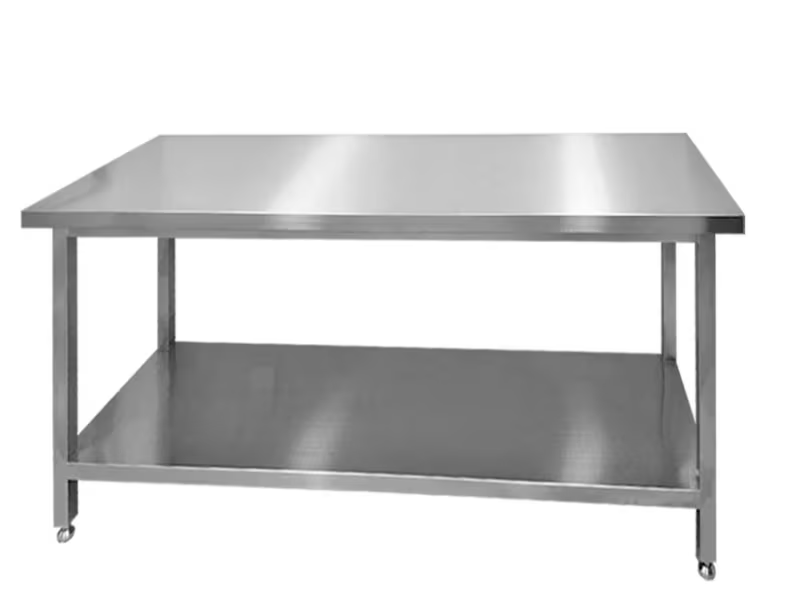
What Is a Cleanroom Stainless Steel Table?
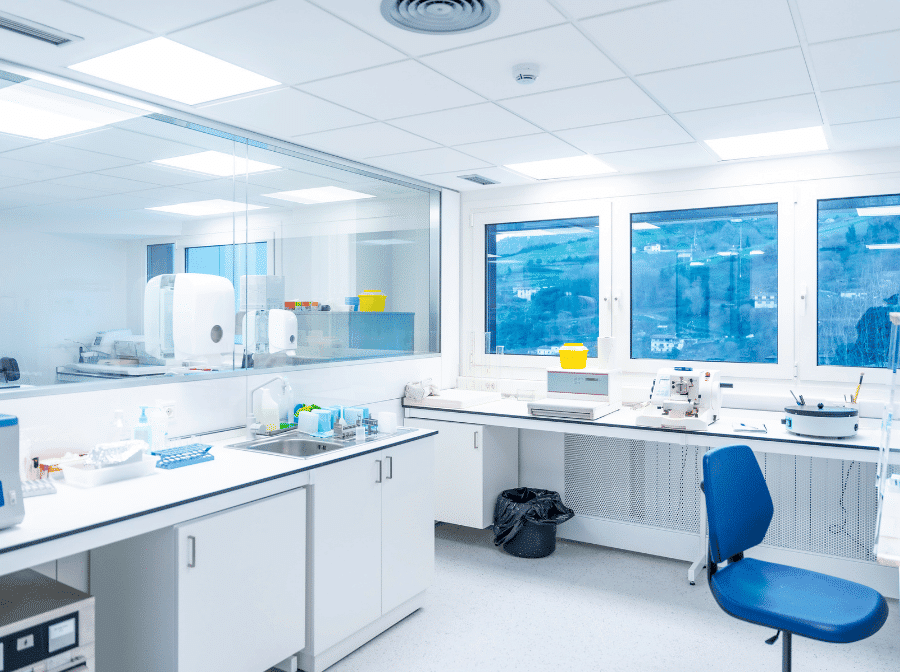
A cleanroom stainless steel table is a work surface engineered specifically for controlled environments where particulate contamination, microbial growth, and chemical residue must be minimized. Unlike standard laboratory benches or industrial worktables, cleanroom tables are designed around the principle that every surface — top, frame, welds, and understructure — must be cleanable without trapping particles or harboring contaminants.
They are used across pharmaceutical manufacturing, semiconductor fabrication, medical device assembly, biotechnology research, food safety testing, and aerospace component inspection. The defining feature is not just the material — stainless steel is standard across many lab environments — but the combination of alloy, finish, geometry, and construction method chosen to match a specific contamination control standard.
Why Cleanroom Applications Require Specialized Table Design
Standard stainless steel furniture tolerates surface scratches, exposed threads, horizontal ledges, and crevices at welds. In a cleanroom, each of those features becomes a particle trap or a site where cleaning agents pool and degrade the surface over time.
Cleanroom table design addresses this by eliminating horizontal ledges wherever possible, specifying continuous welds over bolted joints in critical zones, using smooth or electropolished surface finishes that resist particle adhesion, and sizing the table to minimize contact with the floor when mobile cleaning occurs. The ISO class of the room, the cleaning and disinfection chemistry in use, and the nature of work performed at the table all influence which combination of features is appropriate.
304 vs. 316 Stainless Steel for Cleanroom Tables
The two grades most commonly specified for cleanroom tables are AISI 304 and AISI 316. Both are austenitic stainless steels with strong corrosion resistance, but they differ in one significant way: 316 contains molybdenum (typically 2–3%), which improves its resistance to chloride-induced pitting and crevice corrosion.
304 stainless steel is widely used in general laboratory and cleanroom environments where cleaning protocols do not involve chloride-heavy disinfectants and where moisture exposure is moderate. It is typically the more cost-effective option and performs well across a broad range of controlled environments.
316 stainless steel is commonly preferred in pharmaceutical, biotech, and food processing cleanrooms where sodium hypochlorite (bleach), saline solutions, or other chloride-containing agents are used for routine disinfection. It is also often specified in coastal or high-humidity facilities where ambient chloride exposure is elevated.
The choice between 304 and 316 depends on your cleaning chemistry and facility environment — not on ISO class alone. A room operating at ISO Class 6 using alcohol-based disinfectants may be well-served by 304. A Class 7 pharmaceutical environment using bleach-based decontamination protocols may warrant 316 regardless of its less stringent particulate requirements.
Glorylab supplies both 304 and 316 stainless steel cleanroom tables, with material test certificates (MTC) available on request for procurement and compliance purposes.
Considering a cleanroom table project? Submit your specifications to Glorylab and our team will confirm which steel grade suits your cleaning chemistry and application.
Surface Finish: Brushed vs. Electropolished
Surface finish directly affects how a cleanroom table performs during cleaning, how it responds to disinfectants over time, and how well it resists particle adhesion.
Brushed finish (typically #4 finish, Ra 0.5–0.8 µm) is the most common surface treatment on cleanroom-grade stainless steel furniture. It provides a uniform directional grain that is easy to wipe down, offers good corrosion resistance, and is cost-effective to produce. Most ISO Class 7 and Class 8 cleanrooms specify brushed finish tables without issue, provided cleaning protocols are appropriate.
Electropolished finish removes a thin surface layer through an electrochemical process, reducing surface roughness to Ra 0.2–0.4 µm or lower. The result is a microscopically smoother surface with fewer crevices for particles and microorganisms to adhere to. Electropolishing also removes embedded surface iron and creates a chromium-enriched passive layer that resists pitting and discoloration more effectively than mechanical finishing alone.
Electropolished finish is commonly preferred in ISO Class 5 and Class 6 environments, in pharmaceutical filling and compounding areas, and in any application where the table surface is frequently subjected to aggressive disinfection cycles. It is also often specified where visual inspection of the surface cleanliness is part of standard operating procedure.
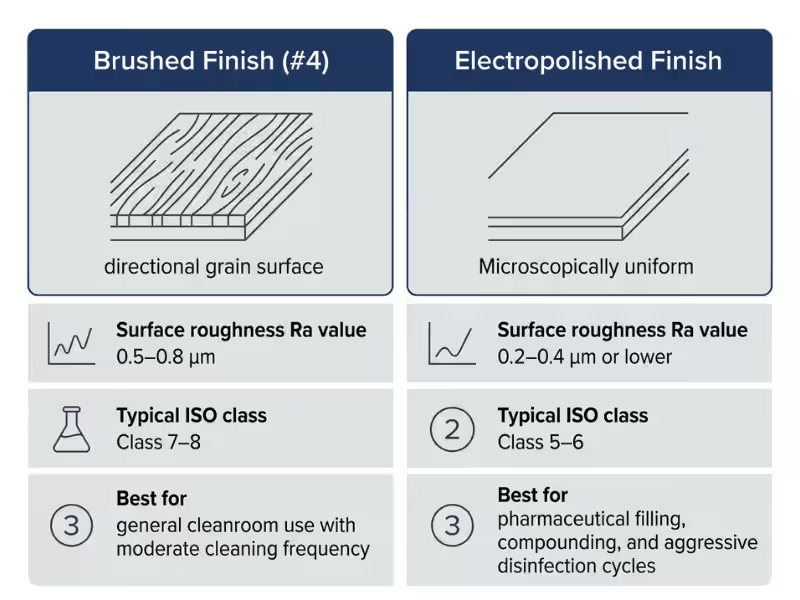
The tradeoff: electropolishing adds cost and, once applied, the surface is more difficult to repair if scratched in the field. For lower-classification environments with lower-frequency cleaning, a high-quality brushed finish often provides a comparable practical result at lower cost.
Glorylab produces cleanroom tables in both brushed and electropolished finishes. Both options are available across 304 and 316 steel grades, with SGS test documentation available for quality verification.
Solid Top vs. Perforated Top
The table surface configuration affects airflow, weight, and cleanability — and the right choice depends on what’s happening at the table.
Solid tops provide an uninterrupted work surface. They are preferred when the work involves liquids, small components, or instrumentation that would be compromised by gaps in the surface. Solid tops are easier to wipe clean and leave no apertures where spills can pass through to the understructure. The majority of cleanroom benches in pharmaceutical and medical device environments use solid tops.
Perforated tops allow vertical airflow to pass through the work surface, which can be valuable in laminar flow applications where the table sits within or beneath a unidirectional airflow zone. Perforated stainless steel tops are sometimes specified in semiconductor and electronics cleanrooms, and in biosafety cabinet work zones where airflow dynamics at the work surface matter. The tradeoff is that perforations create additional surface area to clean, and small particles or liquids can fall through.
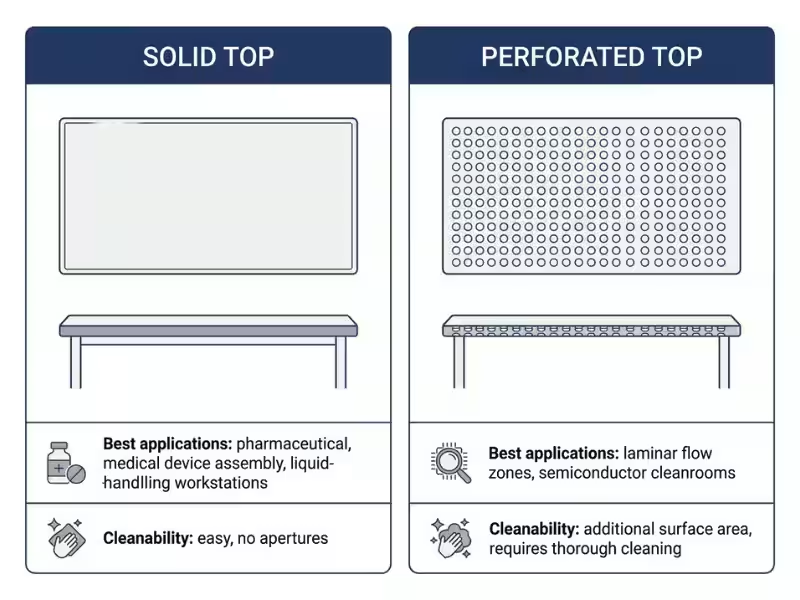
The decision is typically governed by the airflow design of the room and the nature of work at the table, not by ISO class alone. If your facility engineer or HVAC designer has specified vertical laminar flow in the work zone, the table top configuration may need to accommodate that airflow pattern.
Fully Welded vs. Knock-Down Construction
How a cleanroom table is assembled has meaningful implications for contamination control, field cleanability, and procurement logistics.
Fully welded construction means the frame is permanently joined, with continuous welds ground smooth and blended into the surface. There are no exposed threads, no bolt heads, and no mechanical joints that could trap particles or pool cleaning solutions. Fully welded cleanroom tables are the typical choice for ISO Class 5 and Class 6 environments, and for any application where surface hygiene at the frame is scrutinized during audits.
Knock-down (KD) construction uses mechanical fasteners — bolts, brackets, or threaded connectors — to join the frame components. This makes the table easier to ship flat-packed and reassemble on-site, and easier to reconfigure or replace individual components if damaged. However, the joint areas create sites where particles accumulate, and cleaning is more difficult. Knock-down construction is more commonly found in ISO Class 7 and Class 8 environments where cleanability requirements at the frame are less stringent.
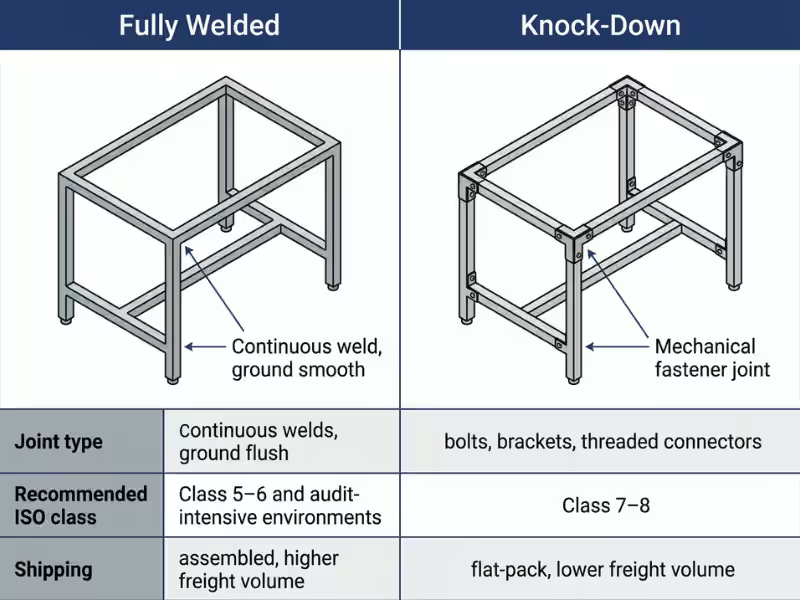
For projects shipping internationally, knock-down construction can reduce freight volume. Glorylab offers both configurations and can advise on the most appropriate choice based on your ISO classification, audit requirements, and site access constraints.
How ISO Class and Industry Application Affect Table Selection
ISO 14644-1 defines cleanroom classification by airborne particulate concentration, ranging from ISO Class 1 (the most stringent) to ISO Class 9. Table specifications generally align with class ranges rather than single classes, and end-user industry standards and SOPs often have more specific requirements than the ISO class alone would suggest.
ISO Class 5–6: These environments — common in aseptic pharmaceutical filling, semiconductor wafer handling, and critical medical device assembly — typically call for electropolished 316 stainless steel, fully welded construction, solid or perforated tops depending on airflow design, and open-frame or minimal-storage configurations that allow thorough surface access during cleaning.
ISO Class 7: A broad middle tier used in pharmaceutical secondary operations, medical device packaging, and biotechnology research. Either 304 or 316 stainless steel may be appropriate; a
brushed finish is common, and partially welded or knock-down construction with enclosed storage may be acceptable depending on facility protocols.
ISO Class 8: The least restrictive cleanroom classification, often used in compounding pharmacies, food testing labs, and electronics assembly. Standard 304 brushed finish tables with knock-down construction are frequently specified. Storage configurations, including enclosed cabinets, are generally compatible with cleaning requirements at this level.
These are typical patterns, not universal rules. Your facility’s Standard Operating Procedures, validation requirements, and cleaning chemistry should always inform the final specification — not ISO class alone.
Not sure which specification matches your cleanroom class? Contact Glorylab’s technical team with your ISO classification, cleaning protocol, and application details for a tailored material recommendation.
Mobility, Leveling Feet, and Cleanability Features
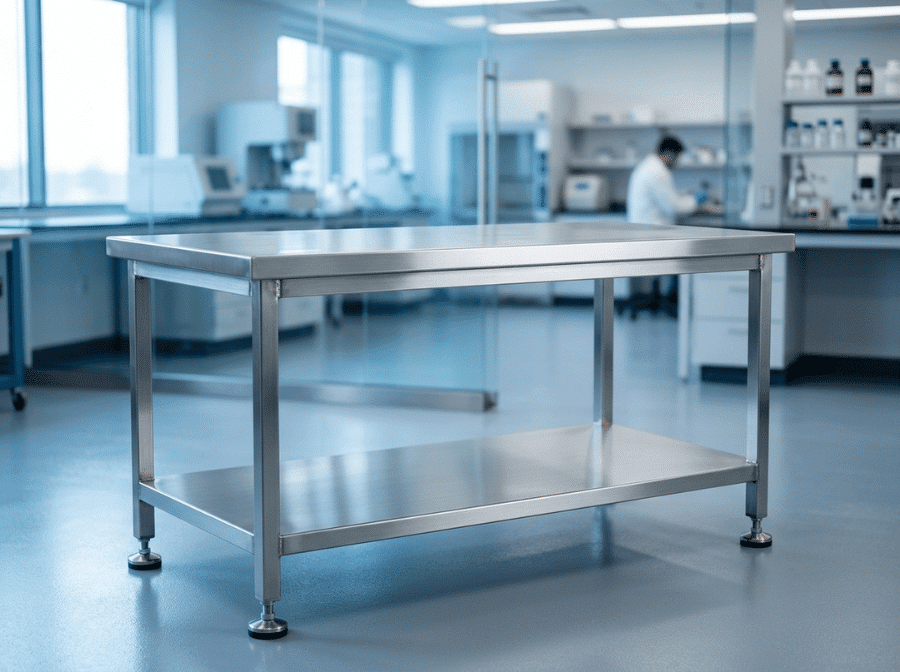
Leveling feet with large-diameter base pads are standard on most cleanroom tables. They allow the table to be adjusted to a level position on uneven floors and — importantly — can be specified with smooth, easy-clean profiles that don’t collect debris at the floor contact point. Stainless steel leveling feet with no sharp undercuts are preferred in higher-classification environments.
Casters enable table repositioning without lifting, which matters in flexible-use cleanroom areas. For cleanroom service, casters should be specified in cleanroom-compatible materials (typically stainless steel frames with polyurethane wheels), with lockable mechanisms that engage and release without requiring tools. Standard industrial casters — including those with rubber that outgasses or textured surfaces that trap particles — are generally not suitable inside the cleanroom envelope.
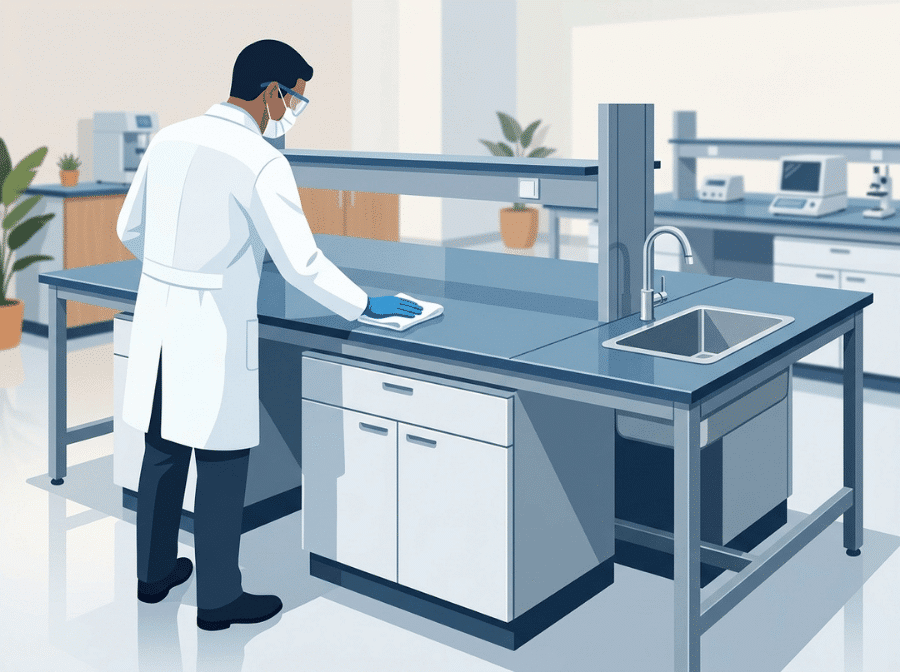
Frame geometry contributes to cleanability independently of material or finish. Tables designed with minimal horizontal ledges, rounded corners, and tubular rather than channel-section legs reduce particle accumulation and simplify wipe-down procedures. Open-frame understructures without enclosed cross-members are easier to clean than boxed or panel-sided designs.
Drawers, Shelves, or Open Frame: Storage Configuration by ISO Class
Storage needs vary by application, and the right configuration depends on your ISO classification, cleaning frequency, and the materials being handled at the table.
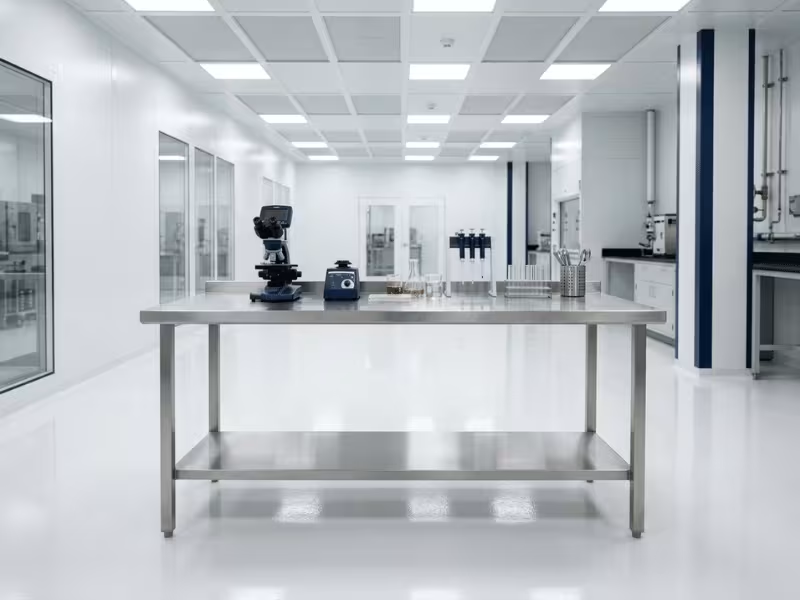
Open frame configurations — a top surface with a minimal structural frame and no enclosed storage — provide maximum access for cleaning. They are commonly preferred in ISO Class 5 and Class 6 environments where every surface within the cleanroom must be cleanable to a defined standard. Open frames also minimize outgassing risk in semiconductor and electronics environments.
Undershelf configurations offer a flat lower shelf for equipment or supplies without creating enclosed spaces. They are widely used in ISO Class 7 environments, particularly in pharmaceutical and biotech settings where some storage at the workstation is operationally necessary. Shelves should be smooth, stainless steel, and sloped or designed without raised edges that trap debris.
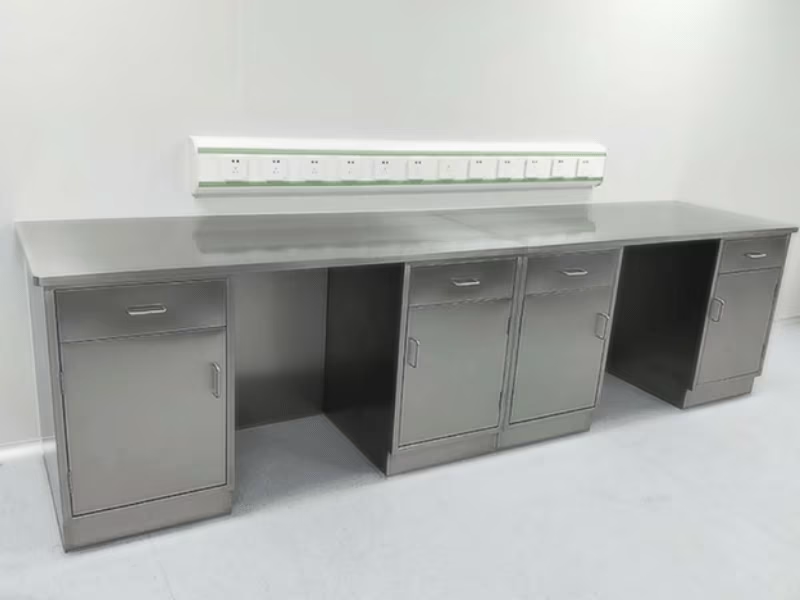
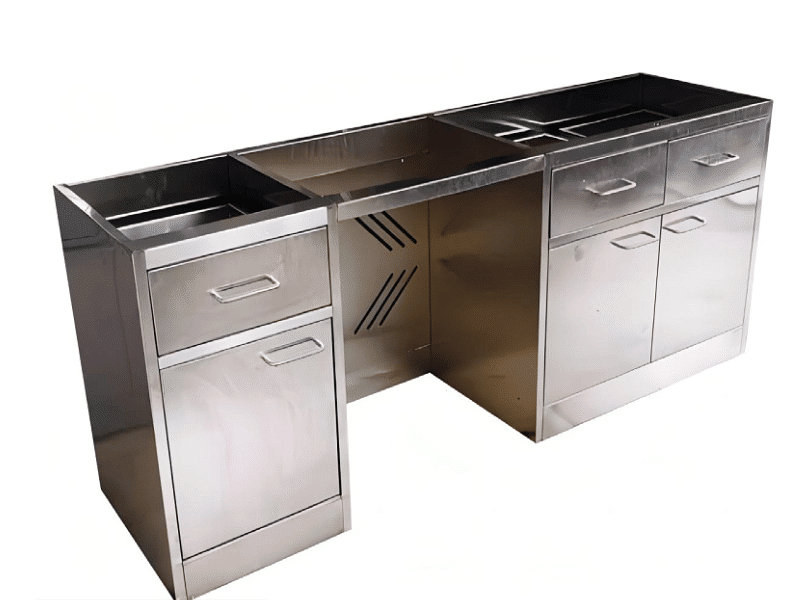
Drawers and enclosed cabinets are occasionally specified in ISO Class 7 and Class 8 environments where contained storage is required. In higher-classification rooms, enclosed storage is typically kept outside the ISO-controlled zone whenever possible. If drawers are included, they should use full-extension slides with no exposed plastic components, and the drawer bodies should be in matching stainless steel to maintain surface consistency.
Glorylab can configure cleanroom tables with open frame, undershelf, drawer, or enclosed cabinet options, and can combine configurations to meet specific operational requirements.
Key Specifications Checklist Before Placing an Order
Before requesting a quote for a cleanroom stainless steel table, confirm the following:
- ISO classification of the room where the table will be installed
- Steel grade: 304 or 316 (based on cleaning chemistry and facility environment)
- Surface finish: brushed (#4 or equivalent) or electropolished, with target Ra value if relevant
- Top configuration: solid or perforated
- Construction type: fully welded or knock-down
- Table dimensions: length × depth × height, and whether height adjustment is required
- Load capacity: maximum working load the table must support
- Mobility: fixed (leveling feet) or mobile (casters with locks)
- Storage configuration: open frame, undershelf, drawers, or enclosed cabinet
- Documentation required: MTC, SGS test report, CE declaration, quality management certificate
- Quantity and delivery destination
Having these details ready before contacting a supplier reduces back-and-forth, accelerates quotation, and helps ensure the table you receive matches what your cleanroom validation requires.
Common Procurement Mistakes to Avoid
Specifying by ISO class alone. ISO class defines particulate limits in air — it does not prescribe specific material grades or surface finishes. Two ISO Class 7 rooms with different cleaning protocols may need different steel grades and finishes.
Overlooking cleaning chemistry. The most common driver of stainless steel corrosion failure in cleanrooms is chemical incompatibility. Confirm what disinfectants and cleaning agents your facility uses before selecting between 304 and 316.
Choosing knock-down construction for high-classification environments. Bolted joints at the frame create particle traps that are difficult to clean consistently. In ISO Class 5 and Class 6 environments, fully welded construction is typically the more appropriate choice.
Ignoring documentation requirements until after order placement. Material test certificates, SGS reports, and quality management certifications take time to prepare. If your procurement or compliance team requires them, request documentation availability before finalizing the order.
Selecting standard industrial casters. Casters specified for warehouse or food service environments are not suitable for cleanroom use. Confirm caster material compatibility with your cleanroom certification requirements.
Not confirming custom dimension support. Cleanroom floor plans rarely accommodate standard furniture dimensions without compromise. Verify that your supplier can manufacture to custom dimensions before assuming it.
8-Step Decision Framework for Selecting a Cleanroom Stainless Steel Table
Use this sequence to move from requirements to specification:
Step 1 — Confirm your ISO classification. Identify the ISO class designation for the room in question. If the room has multiple zones, note the classification of the zone where the table will be installed.
Step 2 — Identify your cleaning and disinfection chemistry. List the specific agents used — alcohol, bleach, quaternary ammonium, hydrogen peroxide vapor, or others. Chloride-containing agents typically indicate a preference for 316 stainless steel.
Step 3 — Determine the surface finish requirement. Cross-reference your ISO class and cleaning frequency. ISO Class 5–6 environments and pharmaceutical applications commonly specify electropolished. ISO Class 7–8 environments with less aggressive cleaning schedules often use brushed finish.
Step 4 — Select top configuration. Confirm whether the workstation sits in a laminar flow zone. Perforated tops support vertical unidirectional airflow; solid tops are appropriate for the majority of cleanroom work applications.
Step 5 — Choose construction method. ISO Class 5–6 and audit-intensive pharmaceutical environments commonly specify fully welded construction. ISO Class 7–8 environments may be compatible with knock-down construction, particularly where site access or freight logistics favor flat-pack shipping.
Step 6 — Define storage configuration. Determine what, if anything, needs to be stored at the workstation. Open frame is the cleanest option; add shelves, drawers, or cabinets only where operationally necessary and compatible with your cleaning protocol.
Step 7 — Specify mobility and leveling requirements. Fixed tables with stainless steel leveling feet suit most configurations. Caster mobility is appropriate where the room layout requires periodic reconfiguration — confirm caster material compatibility before specifying.
Step 8 — Compile documentation requirements. Identify what certificates and test reports are needed for procurement, validation, or regulatory submission. Confirm availability with your supplier before placing the order.
How Glorylab Supports Cleanroom Table Projects
Glorylab is a factory-based laboratory furniture manufacturer in Jiangsu Province, near Shanghai, supplying directly to institutions, contractors, distributors, and procurement teams across 30+ countries. Every cleanroom table is designed, fabricated, and quality-inspected at Glorylab’s own facility — no subcontracting, no agents between the buyer and the production floor.
What Glorylab offers for cleanroom table projects:
- Steel grade selection: both AISI 304 and AISI 316 stainless steel available across the full cleanroom table range
- Surface finish options: brushed (#4) and electropolished finishes, with Ra values available on request
- Top configurations: solid and perforated tops in custom dimensions
- Construction: fully welded and knock-down configurations available by application
- Custom sizing: non-standard dimensions are part of the standard manufacturing process, with no additional tooling charge in most cases
- Storage configurations: open frame, undershelf, drawer, and enclosed cabinet options, individually specified per project
- Documentation: Material Test Certificates (MTC) and SGS test reports available; CE and ISO 9001 quality management certification held on file
- OEM support: private-label production and custom branding available for distributors and project contractors
Because Glorylab communicates factory-direct, technical questions — steel grade, weld profile, finish specification, documentation format — go directly to the people who build the product. Response time on initial inquiries is typically 12–24 hours.
Ready to specify your cleanroom table? Submit your project requirements to Glorylab and include your ISO class, steel grade preference, dimensions, and documentation needs. Our technical team will review your specifications and respond directly.
Start Your Cleanroom Table Procurement Right
Selecting a cleanroom stainless steel table is a decision with long downstream consequences. A surface that corrodes under your disinfection protocol, a weld profile that fails a cleaning validation audit, or a knock-down frame in an environment that requires fully welded construction — these are costly to fix after delivery. Getting the specification right at the outset, before the purchase order goes out, is the most effective way to avoid them.
The framework in this guide is designed to help procurement teams, lab designers, and facility managers ask the right questions before they engage suppliers. Once you know your ISO class, cleaning chemistry, finish requirement, and documentation needs, the rest of the specification falls into place relatively quickly.
If you have a cleanroom table project underway — whether a single unit or a multi-room fit-out — Glorylab’s team is available to review your specifications, confirm material suitability, and provide documentation-ready quotations.
Three ways to move forward with Glorylab:
- Submit your specifications and request a quote — include dimensions, ISO class, steel grade, and quantity
- Request material documentation — MTC, SGS test report, or quality management certificates for procurement and compliance
- Ask for a material recommendation — share your cleaning chemistry and application details, and our team will advise on grade and finish
Frequently Asked Questions
What is the difference between 304 and 316 stainless steel for cleanroom tables?
Both 304 and 316 are austenitic stainless steels widely used in cleanroom environments. The key difference is that 316 contains molybdenum, which improves resistance to chloride-induced corrosion. 316 is commonly preferred where cleaning protocols involve bleach, saline, or other chloride-containing disinfectants. 304 is generally appropriate for environments using alcohol or non-chloride cleaning agents. The right choice depends on your specific cleaning chemistry, not ISO class alone.
Is an electropolished finish always better than a brushed finish for cleanroom use?
Not necessarily. Electropolished stainless steel offers a lower surface roughness (Ra 0.2–0.4 µm vs. 0.5–0.8 µm for brushed #4 finish), which can reduce particle adhesion and improve corrosion resistance. It is commonly preferred in ISO Class 5–6 environments and pharmaceutical cleanrooms. For ISO Class 7–8 rooms with moderate cleaning frequency, high-quality brushed finish performs well and costs less. The appropriate choice depends on your ISO class, cleaning frequency, and whether surface cleanliness inspection is part of your validation protocol.
When should I specify a perforated top instead of a solid top?
Perforated tops are typically specified when the table sits within a vertical unidirectional airflow zone, and the cleanroom design requires airflow to pass through the work surface. This is more common in semiconductor and electronics cleanrooms. For the majority of cleanroom applications — including pharmaceutical, medical device, and biotech — solid tops are the standard choice, as they are easier to clean and do not allow spills or particles to pass through to the frame.
What documentation should I request when ordering a cleanroom stainless steel table?
Common documentation requirements for cleanroom table procurement include: Material Test Certificates (MTC) confirming steel grade and composition, SGS test reports for surface finish or structural performance, CE declarations where required by the destination market, and quality management system certificates (ISO 9001). If your facility is subject to FDA, GMP, or other regulatory frameworks, check whether additional traceability documents are needed before placing the order.
Can cleanroom tables be ordered in custom dimensions?
Yes. Most quality cleanroom table manufacturers can produce to custom dimensions. Non-standard sizes are often necessary because cleanroom floor plans are designed around airflow and spatial efficiency, not standard furniture footprints. When requesting a quote, always provide your precise dimensions, including height if adjustability or a specific working height is required.
What is the best storage configuration for an ISO Class 6 cleanroom?
Open-frame configurations are generally preferred in ISO Class 5–6 environments because they provide full surface access during cleaning and eliminate enclosed spaces where contamination could accumulate. If storage at the workstation is operationally necessary, a smooth stainless steel undershelf without raised edges is more compatible with high-classification cleaning protocols than enclosed drawers or cabinets.
How do I know whether to choose fully welded or knock-down construction?
Fully welded construction eliminates exposed threads and mechanical joints, which are sites where particles accumulate, and cleaning is more difficult. It is the common choice for ISO Class 5–6 environments and for pharmaceutical cleanrooms subject to cleaning validation audits. Knock-down construction is generally appropriate for ISO Class 7–8 environments where cleaning requirements at the frame are less stringent, or where flat-pack shipping and on-site assembly are operationally necessary.