Wood lab tables can be highly cleanable when specified with the right surface materials and design features. The key factors are surface finish, joint construction, and chemical resistance—not the substrate material alone. This guide covers surface options, design features, material comparisons, and a decision framework by lab type to help you choose the right table for your environment.
Procurement teams and lab planners searching for easy-to-clean lab tables often run into the same challenge: “wood” is a broad category. A wood-framed lab bench topped with an epoxy resin worktop behaves very differently from one finished in standard HPL—even if both are described as “wood lab tables” in a supplier’s catalog.
This guide cuts through that ambiguity. By the time you finish reading, you’ll know which surface materials perform best for cleanability, which design features reduce contamination risk, and where wood lab benches fit (and don’t fit) across different lab types.
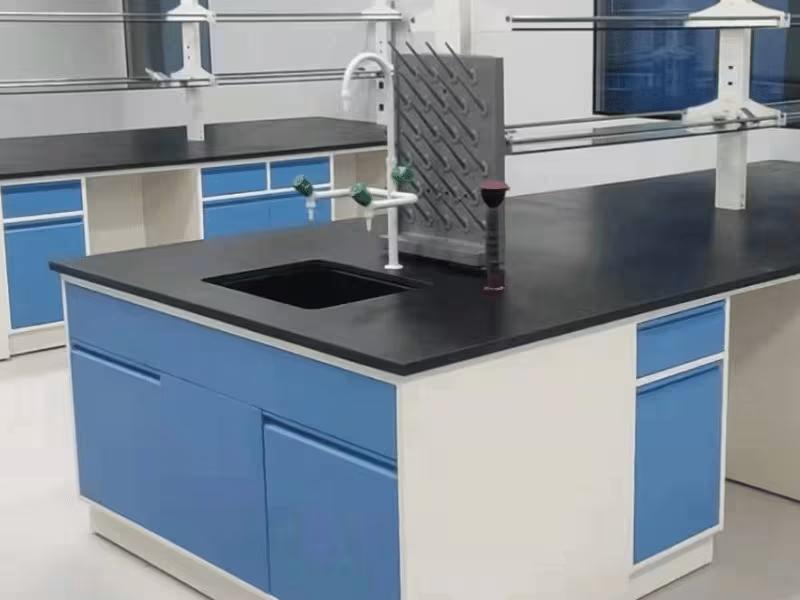
Why Does Cleanability Matter When Selecting Lab Furniture?
Surface hygiene affects more than routine tidiness. In lab environments, poor cleanability creates real operational problems: cross-contamination between experiments, chemical residue buildup that degrades surface integrity over time, and cleaning protocols that take longer than they should.
The cleanability of a lab table is determined by several factors:
- Surface porosity — porous materials absorb liquids and harbor residues
- Joint and seam density — more seams mean more places for contaminants to collect
- Chemical resistance — surfaces that degrade under cleaning agents become harder to clean over time
- Edge and corner geometry — sharp internal angles trap debris; rounded profiles do not
These factors apply across all lab furniture materials. However, they’re especially important for wood lab tables, where the choice of surface finish has a significant impact on cleanability.
Are Wood Lab Tables Suitable for Hygiene-Sensitive Labs?
Yes—in many lab environments, wood lab tables with the right surface specification perform well from a hygiene standpoint.
Wood-framed lab benches are widely used in school and university teaching labs, biology research labs, QC labs, electronics and instrumentation labs, and general-purpose research environments. When fitted with non-porous, chemical-resistant worktops—such as phenolic resin or epoxy resin—wood lab tables are practical, durable, and straightforward to clean.
When wood lab tables are NOT the right choice:
- Cleanrooms and controlled environments — wood-framed structures are generally not suitable for ISO-classified cleanrooms, GMP manufacturing areas, or any environment with particle count restrictions
- BSL-3+ biological containment labs — these environments typically require surfaces and structures that support validated decontamination protocols, which wood-framed construction does not readily accommodate
- Pharmaceutical manufacturing areas — GMP guidelines often require seamless, non-shedding surfaces and frames, which typically points to stainless steel
- Surgical or sterile processing areas — not an appropriate application for wood lab furniture
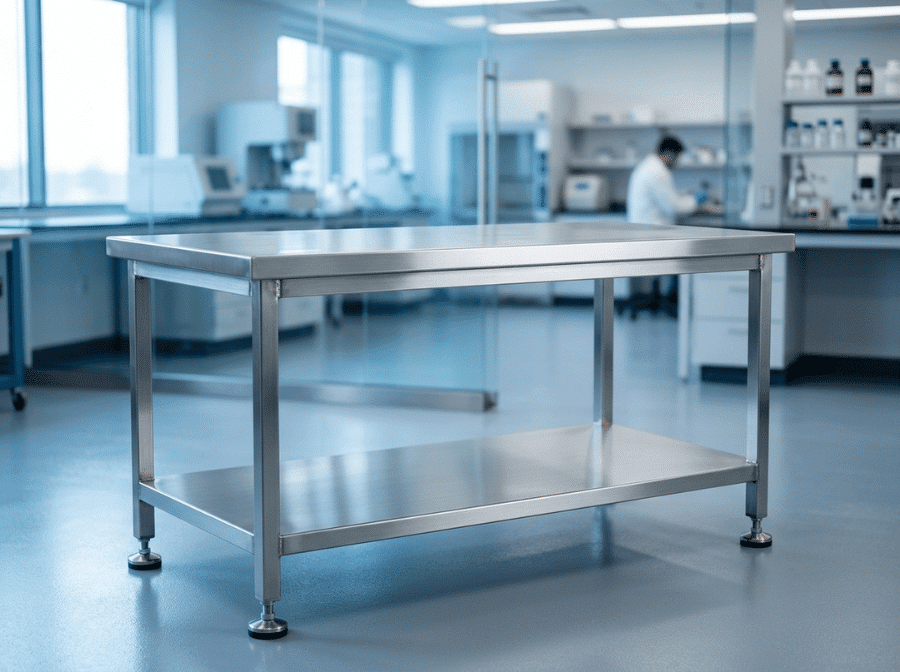
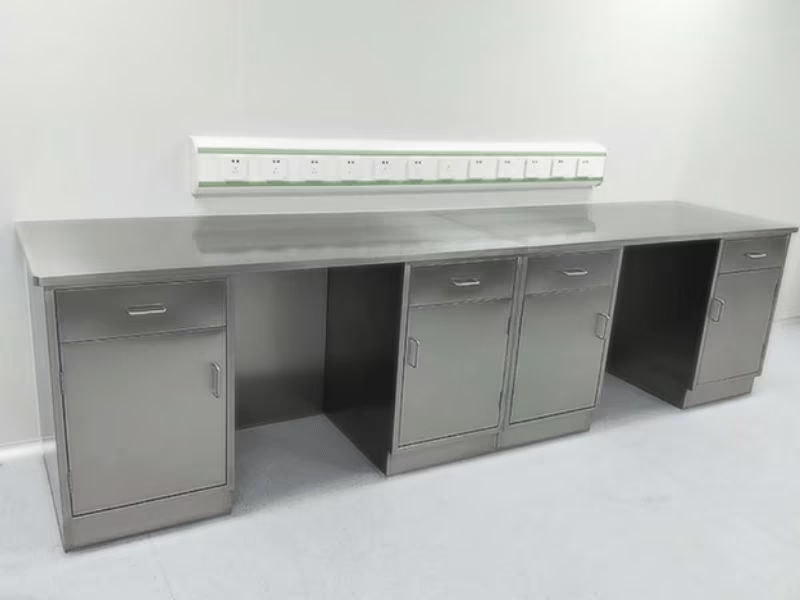
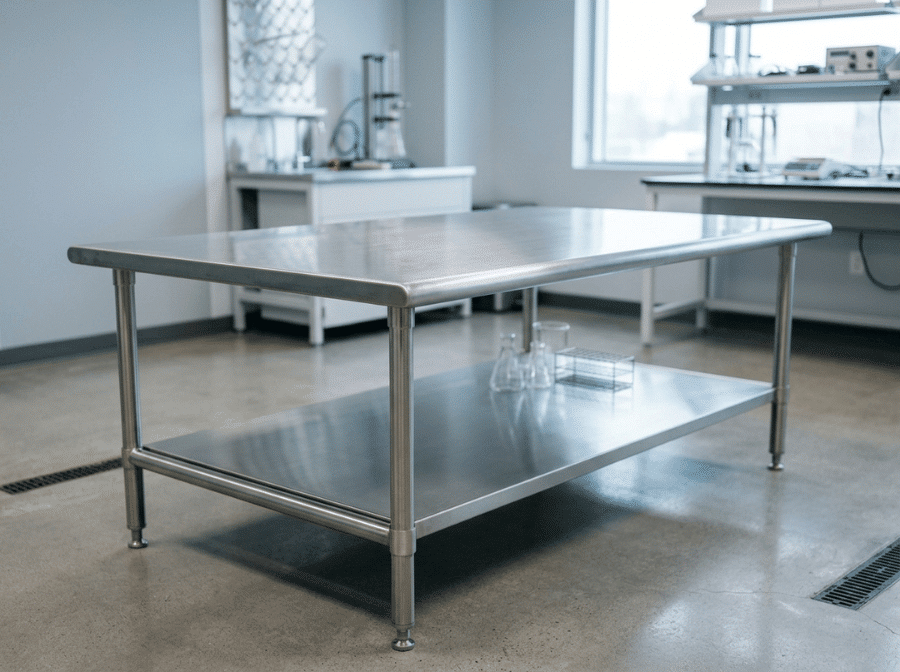
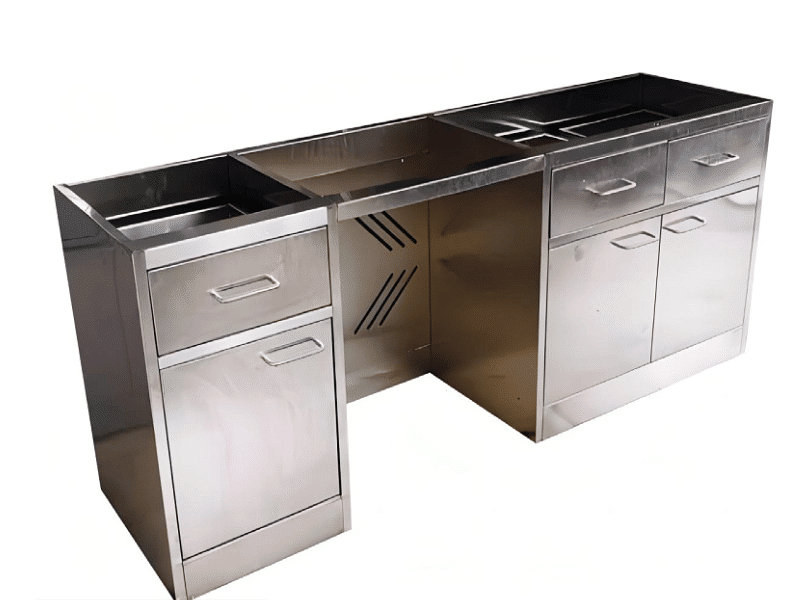
For these environments, Glorylab manufactures stainless steel lab tables and all-steel lab benches that meet the structural and surface requirements of higher-specification settings.
Cleanability vs. Cleanroom Compliance: What’s the Difference?
These two terms are often confused, and conflating them leads to poor procurement decisions.
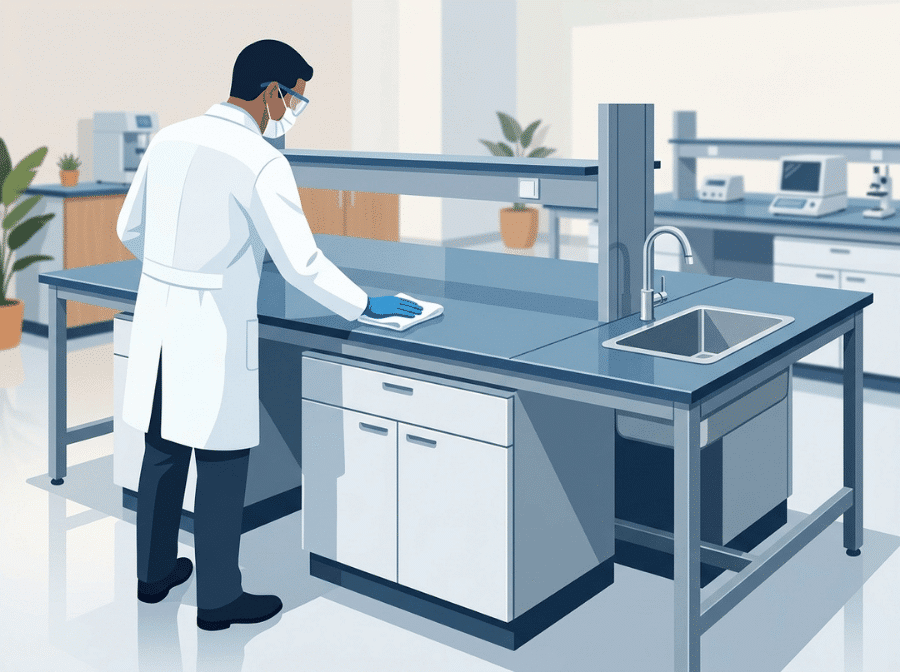
Cleanability refers to how easily a surface can be wiped down, disinfected, and kept free of contamination during routine lab operations. A phenolic resin worktop on a wood-framed bench can be highly cleanable—resistant to common disinfectants, non-porous, and easy to wipe.
Cleanroom compliance is a regulatory and engineering standard. It refers to whether a furniture system meets the requirements of a classified cleanroom environment—typically defined by ISO 14644-1 or equivalent standards—including particle shedding, surface outgassing, material compatibility with room decontamination procedures, and structural design that does not impede airflow.
A wood lab table can be easy to clean. It is not cleanroom-compliant.
If your specification includes ISO class requirements, GMP zoning, or validated decontamination cycles, the material selection discussion needs to start with stainless steel or specialist PP construction—not wood. Glorylab’s team can advise on material selection based on your specific lab classification and intended use.
Key Design Features That Make Wood Lab Tables Easier to Clean
Within standard and general research lab environments, the following design features directly affect how easy a wood lab table is to maintain.
Seamless or Minimal-Seam Construction
Every joint is a potential accumulation point for dirt, chemical residue, or biological material. Worktops fabricated as single continuous pieces—or with tightly sealed, coved joints at the wall interface—eliminate the gaps that make cleaning difficult. Look for worktops with integral or fully sealed edge profiles rather than exposed substrate edges.
Non-Porous Surface Finishes
The worktop surface is the primary hygiene interface. Non-porous materials—phenolic resin, epoxy resin, and high-density HPL—resist liquid absorption and do not allow residues to penetrate. Standard melamine-faced boards, by contrast, are susceptible to surface degradation under repeated liquid exposure.
Rounded Edges and Corners
Rounded worktop edges and external bench corners reduce debris accumulation and make wipe-down faster and more thorough. They also reduce mechanical damage risk at vulnerable points. Sharp internal corners—particularly where bench sections meet walls or base cabinets—should be avoided or sealed with coved profiles.
Chemical-Resistant Coatings
In labs where routine chemical use is expected, the worktop surface must resist the specific reagents in use—not just generic disinfectants. Chemical resistance ratings vary by material and formulation. Always request manufacturer-provided test data for the relevant chemical families before finalizing a specification.
Integrated Cable Management
Exposed cables on the bench surface create obstructions to effective cleaning. Integrated cable trays, channels, or through-bench cable ports route services away from the work surface, reducing clutter and eliminating hard-to-reach areas during routine cleaning.
Elevated or Suspended Frame Structures
Bench frames that sit on adjustable feet or are suspended from wall-mounted channels rather than full-perimeter base panels make floor cleaning significantly easier. Fully enclosed under-bench cavities collect dust and require more effort to maintain. Open-frame structures allow mops and cleaning equipment to reach the floor beneath the bench without furniture removal.
Modular and Easy-Disassembly Design
For periodic deep cleaning or reconfiguration, benches that can be partially disassembled—worktops lifted off, upright panels removed—allow access to surfaces that are otherwise inaccessible. This is particularly relevant in biology research settings where routine decontamination may go beyond surface wiping.
Best Surface Materials for Cleanability and Chemical Resistance
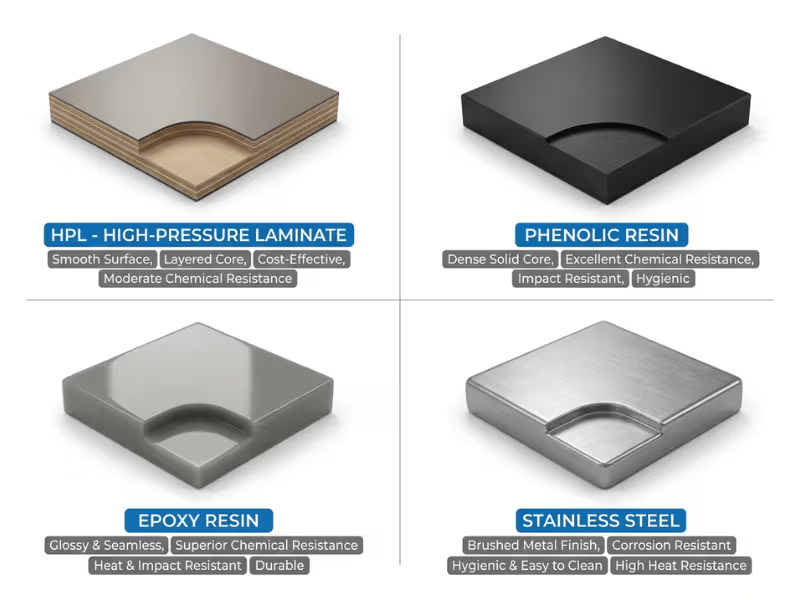
The worktop is the most hygiene-critical component of a wood lab bench. Here is a practical overview of the four most common surface materials used on wood lab tables.
High-Pressure Laminate (HPL)
Best for: School labs, university teaching labs, general-purpose light-use environments
Main advantage: Cost-effective, available in a wide range of finishes, suitable for dry or low-chemical environments. Modern high-density HPL grades offer reasonable resistance to common disinfectants and mild chemicals.
Main limitation: Surface can degrade with prolonged exposure to strong acids, alkalis, or solvents. Not recommended for heavy chemical use. Edge profiles are a weak point if not properly sealed.
Phenolic Resin
Best for: Teaching labs, biology research labs, QC labs, moderate chemical environments
Main advantage: Dense, non-porous, and resistant to a broad range of chemicals including most common lab disinfectants and cleaning agents. Resists moisture and bacterial adhesion. Widely specified for school and university lab furniture projects.
Main limitation: Less resistant to strong oxidizing acids compared to epoxy resin. Surface hardness means it can chip under sharp impact, though this is subject to the specific formulation and thickness.
Epoxy Resin
Best for: Chemistry labs, analytical labs, environments with frequent or varied chemical exposure
Main advantage: Offers the highest chemical resistance of any commonly used lab worktop material. Suitable for strong acids, bases, and solvents. Non-porous and easy to wipe clean. Often specified where chemical resistance is a primary requirement.
Main limitation: Typically higher cost than HPL or phenolic resin. Heavier per unit area. Color options are more limited. Actual performance is subject to manufacturer formulation—always verify against your specific chemical exposure profile.
Linoleum (Lab-Grade)
Best for: Instrument labs, electronics labs, ESD-sensitive environments
Main advantage: Naturally bacteriostatic, soft underfoot for standing work, and available in ESD variants. Used in environments where cushioning and anti-static properties matter more than chemical resistance.
Main limitation: Not suitable for chemical-intensive environments. Susceptible to damage from sharp instruments and some solvents. Less common in Asia-Pacific specifications than in European markets.
For a full range of lab countertops and worktops in epoxy resin, phenolic resin, stainless steel, HPL, and ceramic, Glorylab manufactures all options at its Jiangsu facility.
How to Choose the Right Lab Table Material by Application
The following framework maps lab type to the most appropriate furniture material combination. These are general guidance points—final selection should account for local standards, specific chemical profiles, and project budget.
|
Lab Type |
Recommended Frame |
Recommended Worktop |
Notes |
|---|---|---|---|
|
School science lab |
Wood/steel hybrid |
HPL or phenolic resin |
Budget-sensitive; moderate chemical use |
|
University teaching lab |
Wood/steel hybrid |
Phenolic resin |
Higher traffic; moderate cleaning frequency |
|
Biology research lab |
Wood frame |
Phenolic resin or epoxy resin |
Regular disinfection; non-porous surface essential |
|
Chemistry lab |
Steel or wood frame |
Epoxy resin |
Strong chemical resistance required |
|
Cleanroom / GMP |
Stainless steel |
Stainless steel |
Wood not appropriate |
|
Pharmaceutical QC lab |
Steel or stainless steel |
Epoxy resin or stainless steel |
Depends on GMP zoning |
|
QC / analytical lab |
Wood or steel frame |
Epoxy or phenolic resin |
Vibration isolation may also be needed |
|
Electronics / instrumentation lab |
Wood or steel frame |
ESD linoleum or HPL |
Anti-static properties may be required |
Wood vs. Stainless Steel vs. Phenolic Resin Lab Tables: Which Should You Choose?
|
Feature |
Wood Lab Tables |
Stainless Steel Lab Tables |
Phenolic Resin Lab Tables |
|---|---|---|---|
|
Cleanability |
Good with correct surface specification |
Excellent; smooth, non-porous |
Very good; dense and non-absorptive |
|
Chemical resistance |
Dependent on worktop material |
Resistant to most lab chemicals; subject to grade |
Good for most common lab chemicals |
|
Structural durability |
Good for standard lab use |
High; suited to heavy loads and wet environments |
Good for worktop surfaces; used with wood or steel frames |
|
Cleanroom suitability |
Not appropriate |
Suitable, subject to specification |
Not typically specified for cleanrooms |
|
Cost |
Typically lower upfront cost |
Typically higher |
Mid-range; subject to thickness and grade |
|
Aesthetic / acoustic |
Warmer appearance; quieter work surface |
Functional, clinical appearance |
Neutral; available in limited colors |
|
When to choose |
School, university, research, QC, and general labs where chemical exposure is moderate |
Wet labs, pharmaceutical areas, cleanrooms, and environments requiring regular aggressive disinfection |
As a worktop surface on either wood or steel-framed benches in moderate-to-high chemical use environments |
Common Mistakes When Selecting Lab Tables for Clean Environments
Specifying by frame material instead of surface material. The frame of a lab bench rarely contacts reagents directly. Cleanability is primarily determined by the worktop—not whether the base is wood or steel.
Treating all HPL as equivalent. HPL grades vary significantly in density, chemical resistance, and moisture tolerance. Standard decorative HPL is not the same as laboratory-grade HPL. Request product datasheets and test reports.
Overlooking joint sealing. An unsealed joint between a worktop and upstand, or between two bench sections, can undermine an otherwise well-specified surface. Specify sealed joints and coved upstand profiles in hygiene-sensitive areas.
Ignoring under-bench access. Benches with fully enclosed bases trap dust and debris and are harder to clean around. In labs with regular floor-level cleaning requirements, open-frame or elevated designs are considerably more practical.
Selecting material based on price alone. A lower-cost worktop that degrades quickly under the lab’s cleaning agents will cost more over its service life than a correctly specified alternative. Matching material to chemical exposure is a procurement efficiency question, not just a performance one.
Not requesting chemical resistance data. Suppliers should provide manufacturer test data covering the specific chemicals and disinfectants in use. Generic claims of “chemical resistance” are not a substitute for documented test results.
What to Ask Suppliers Before Purchasing
|
What to Ask |
Why It Matters |
|---|---|
|
What surface material is the worktop made from, and what is its grade or specification? |
“Phenolic resin” and “HPL” cover a wide range of products with different performance levels |
|
Can you provide manufacturer test data for chemical resistance against [specific reagents]? |
Generic claims are not a reliable basis for material selection in chemical-use environments |
|
How are joints and edge profiles finished on the worktop? |
Unsealed edges and joints are a contamination and durability risk |
|
What is the frame construction—solid wood, MDF, steel, or hybrid? |
Affects structural durability, moisture resistance, and load capacity |
|
Can dimensions be customized to match our lab layout? |
Standard sizes rarely fit complex lab floor plans without gaps or overhang |
|
Is disassembly of the bench possible for deep cleaning or relocation? |
Relevant for biology and research labs where periodic full decontamination may be required |
|
What are the lead time and export documentation capabilities? |
Critical for international procurement where customs clearance and project timelines are interdependent |
Buyer’s Checklist: What to Look for in a Hygienic Wood Lab Table
Use the following checklist when evaluating wood lab bench options for hygiene-sensitive environments:
- Worktop material specified by grade, not just type (e.g., 12mm compact phenolic resin, not just “phenolic”)
- Manufacturer-provided chemical resistance test data available for relevant reagents and disinfectants
- Non-porous surface confirmed by supplier documentation
- Worktop edges sealed or finished with a non-absorptive profile
- Coved or sealed upstand joint where bench meets the wall
- Rounded external corners on bench and worktop
- Integrated cable management or cable routing away from work surface
- Open-frame or elevated base for floor cleaning access
- Modular or disassembly-capable design (for research and biology labs)
- Custom dimensions available to match room layout
- Supplier can confirm frame construction material and load rating
Frequently Asked Questions About Wood Lab Tables and Cleanability
Are wood lab tables hygienic enough for biology or microbiology labs?
Wood-framed lab benches with non-porous worktops—such as phenolic resin or epoxy resin—are commonly used in biology and microbiology research labs. The key requirement is that the worktop surface be resistant to the disinfectants in regular use and free of absorptive seams. Wood frames are not in direct contact with lab surfaces during typical use. The frame material is less hygienically critical than the worktop specification.
What is the best worktop surface for easy cleaning on a wood lab bench?
Epoxy resin and phenolic resin are the most commonly specified worktop materials for labs where cleanability and chemical resistance are primary requirements. HPL is appropriate for lighter-use environments. The right choice depends on the specific chemicals and disinfectants in use—request manufacturer test data for the products relevant to your lab.
Can wood lab tables be used in cleanrooms?
No. Wood-framed lab tables are not appropriate for ISO-classified cleanrooms, GMP manufacturing areas, or other controlled environments where particle shedding, surface outgassing, or decontamination protocol requirements apply. Stainless steel is the standard material for these applications.
How do I prevent contamination buildup in wood lab bench joints and seams?
Specify worktops fabricated as single-piece units wherever possible. Where joints are unavoidable, confirm they are fully sealed with a chemically resistant sealant. Coved upstand profiles at the wall interface eliminate the internal right-angle joint that is most difficult to clean.
What is the difference between a wood lab table and a steel-wood hybrid lab bench?
A wood lab table typically uses a wood-based frame (MDF, particleboard, or solid wood) with a separate worktop surface. A steel-wood hybrid combines a steel structural frame with wood panels for aesthetic or acoustic purposes, and a separate worktop. The hybrid construction is often used when load capacity or frame moisture resistance is a concern, while retaining the visual character of a wood finish.
How long do wood lab tables typically last?
Service life is highly dependent on the worktop material, intensity of chemical use, and cleaning frequency. Well-specified phenolic resin or epoxy resin worktops in moderate-use environments typically perform for many years without significant surface degradation. Frame longevity depends on whether moisture can access wood-based structural components—sealed construction and correct installation reduce this risk. Ask your supplier for material-specific durability guidance relevant to your application.
Do wood lab bench suppliers offer custom dimensions?
Many suppliers accommodate custom dimensions, though practices vary. At Glorylab, custom dimensions are part of the standard manufacturing process with no additional charges for sizing adjustments. Submit your room layout or technical drawings and the team will advise on the optimal configuration.
Specify the Right Lab Table for Your Environment
Surface material, joint construction, and frame design are what determine whether a wood lab table is genuinely easy to clean—not the product category label. A well-specified wood lab bench with an epoxy or phenolic resin worktop is a practical, durable, and hygienic choice for a broad range of lab types. The same product in a cleanroom or GMP manufacturing facility is the wrong specification entirely.
Glorylab is a factory-based lab furniture manufacturer in Jiangsu Province, supplying directly to institutions, contractors, and distributors across 30+ countries—with no agents or intermediaries. Every product is fabricated and quality-inspected at Glorylab’s own facility before it ships.
Glorylab supplies across multiple material categories—including wood-framed, all-steel, stainless steel, phenolic resin, and PP lab furniture—which means the team can guide you toward the right material for your specific application rather than defaulting to a single option. Custom dimensions are available at no extra cost, and complete orders across all product categories ship in a single consolidated export.
From technical drawing review and material selection through to export documentation, Glorylab’s project support team is available from the first inquiry. Submit your project or browse the full range of lab benches and workstations to get started.