The fume hood on your bench has one job: keep hazardous air away from the people working near it. But two very different designs do that job in opposite ways, and the gap between them is wider than most buyers expect. A ducted hood throws contaminated air out of the building. A ductless hood filters the air and returns it to the room. That single difference ripples through your safety case, your building’s HVAC, your energy bill, and even which chemicals you’re allowed to run.
Get the choice right, and the hood will quietly protect your staff for years. Get it wrong, and you either overspend on ductwork you never needed or install a ductless unit that lets toxic vapor slip through a mismatched filter while everyone assumes the air is clean. This guide is built for the people who actually make that call — lab managers, procurement staff, and engineers. It walks through the one difference that drives everything, what really decides the choice, how that decision plays out in real labs, and a short checklist you can run before you request a single quote.
What’s the Real Difference Between Ducted and Ductless?
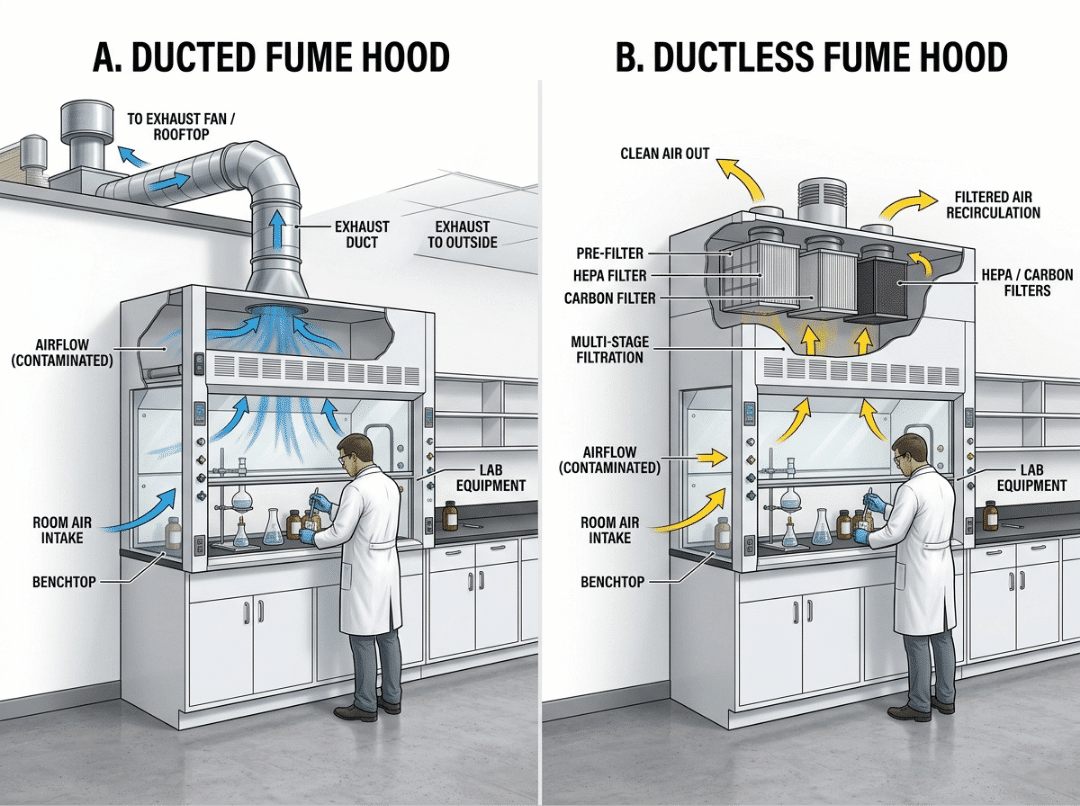
Both designs draw air across the work opening at a controlled face velocity, keeping the operator protected behind the sash. What separates them is what happens to that air once it enters the hood.
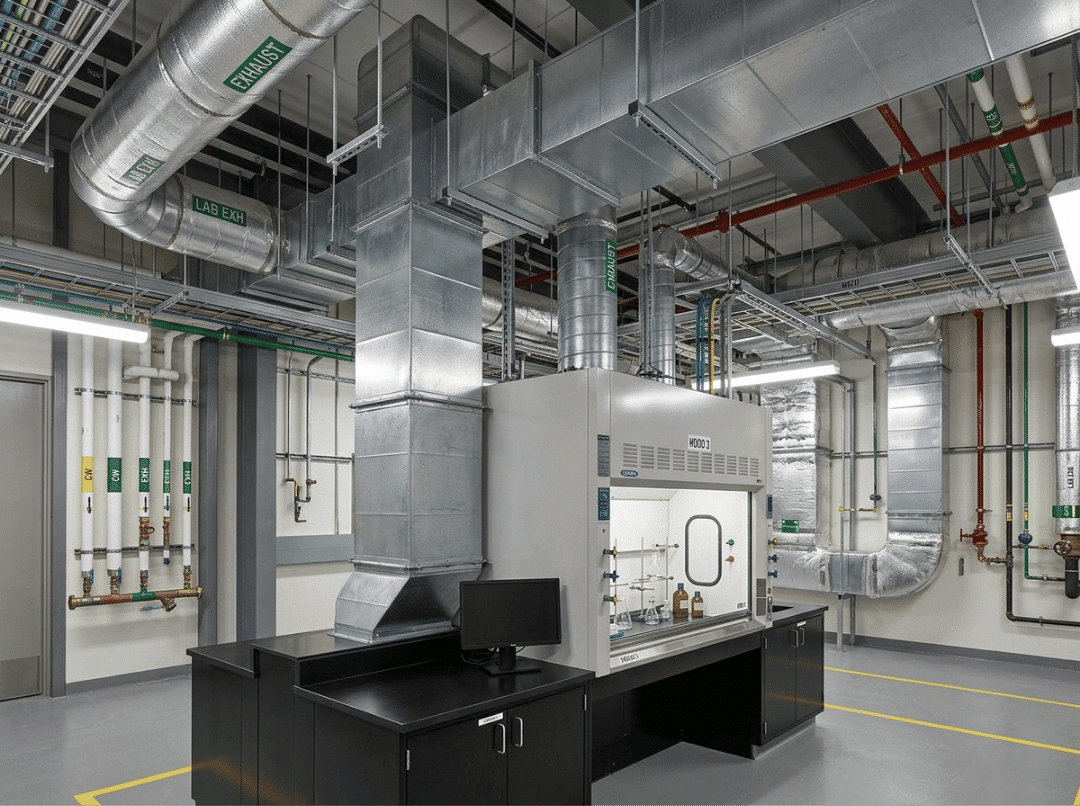
A ducted fume hood connects to permanent ductwork, a blower, and an exhaust stack. Everything it captures — vapors, gases, particulates — leaves the building and vents outside. Because the contaminated air never returns, a ducted hood handles a broad and changing chemical load without asking whether a filter can catch it. In exchange, it depends on your building supplying enough replacement air, called make-up air, to feed it.
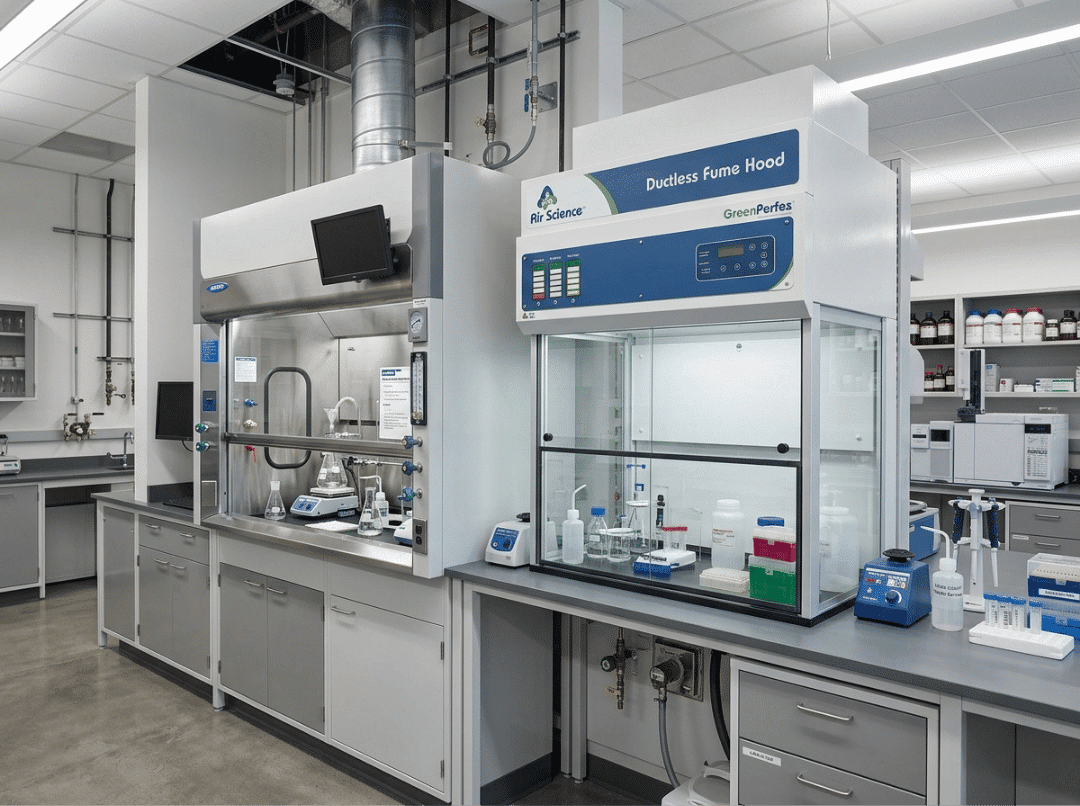
A ductless (recirculating) fume hood has no connection to the outside. Air passes through a filter stack inside the unit — usually a pre-filter plus a main filter matched to your chemistry, whether that’s activated carbon, a chemical-specific sorbent, or HEPA for particulates — and the cleaned air returns to the room. That self-contained design is both its greatest strength and its biggest liability. It goes anywhere there’s a power outlet, but it stays safe only as long as the filter genuinely captures what you’re producing.
Hold onto that one distinction — vented out versus filtered and returned. It drives nearly every trade-off that follows.
What Actually Decides the Choice
Plenty of small specs separate these two hoods. Only a handful decide the purchase, so those deserve your attention. Work through them roughly in this order, because the early ones can settle the question before you reach the rest.
Start With Your Chemistry
This is where most buyers get tripped up, so start here. A ducted hood exhausts everything outside, so it copes with a broad, shifting, or even partly unknown chemical load. A ductless hood is only as capable as its filter media — and filter media is chemical-specific. Carbon that adsorbs organic solvent vapor does little to remove many acid gases. A HEPA filter stops particulates and nothing else.
Ductless works in a narrow lane: a limited set of known chemicals, used in small volumes, with a proven filter rated to capture each one. The moment your chemistry turns varied, high-volume, or unpredictable, a ductless unit stops being a safe match. Ask one blunt question early — can I name every chemical this hood will ever see, and does a rated filter exist for each one? If the answer is no, you’re looking at a ducted hood.
The Ductless Failure Mode Nobody Sees Coming
This is the part that most comparisons gloss over, and it’s where a cheap-looking purchase can turn dangerous. With a ducted hood, contaminated air is simply gone. With a ductless hood, the filter is the entire safety barrier — and when it fails, nothing warns you.
Three failure modes matter, and all of them are invisible:
- Wrong media. Install a filter that doesn’t match your compounds, and the hood runs perfectly while venting toxic vapor straight back into the room. No smell, no alarm, no visible sign that anything is wrong.
- Breakthrough. Every sorbent filter has a finite capacity. Once it saturates, it stops capturing — and can begin releasing previously trapped contaminants back into the air. Saturation indicators help, but they aren’t reliable for every chemical.
- Heat-driven load. Warm processes drive off vapor faster and push more of it through the filter in less time. Heat accelerates breakthrough and shortens filter life well below what the spec sheet suggests, often without anyone noticing until the media is already spent.
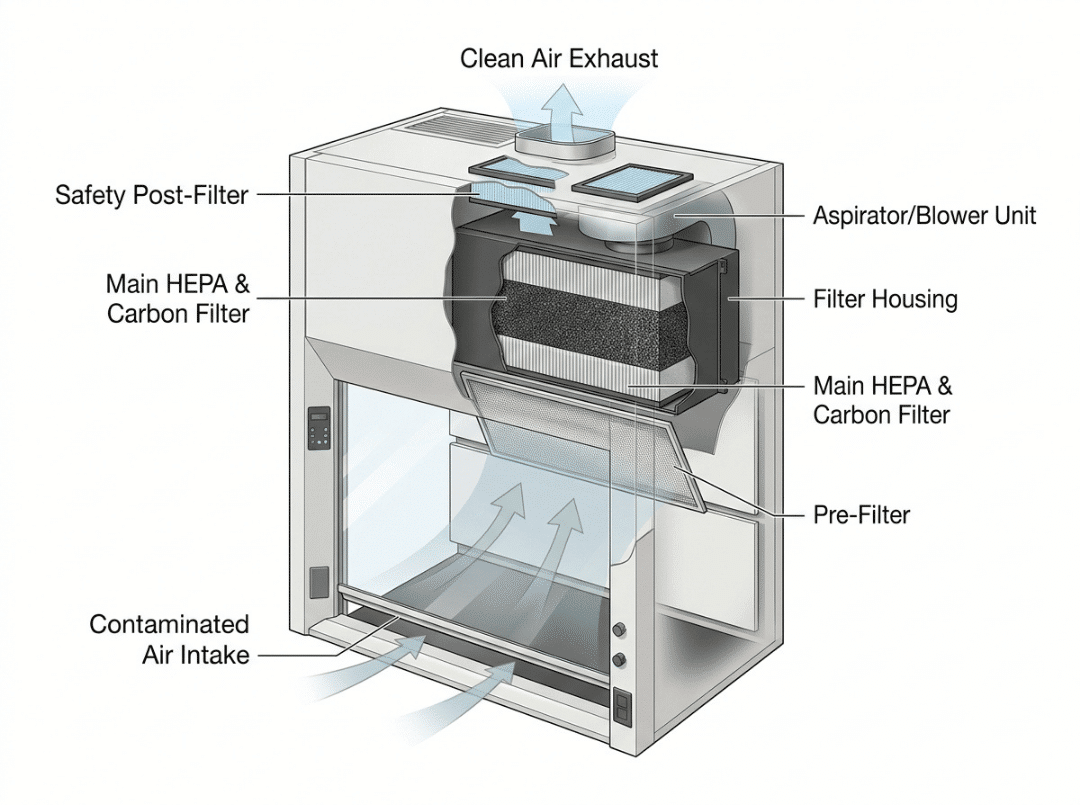
The practical consequence: a ductless hood only works with active management — correct media selection, disciplined change-out schedules, and one person genuinely accountable for tracking saturation. A ducted hood carries none of that ongoing safety burden because the hazard leaves the building rather than relying on a cartridge to contain it. If no one will own filter management, a ductless hood becomes unsafe the day its filter saturates, and no one will notice.
What Your Building Can Actually Support
A ducted hood is a building commitment, not just an equipment purchase. It needs duct routing, a properly sized blower, roof or wall penetrations, and — the piece buyers most often forget — adequate make-up air. A hood pulls a large volume of air out of the room, and your HVAC has to replace it. Without enough make-up air, the hood creates negative pressure that draws air from corridors, disrupts the building’s balance, and lowers the hood’s face velocity, undermining the protection you paid for.
Retrofitting all of this into a space that wasn’t designed for it can cost as much as the hood itself, sometimes more, once HVAC upgrades and structural work are added. That’s why “we can afford the hood” and “we can afford to install the hood” are two separate questions. A ductless hood sidesteps the whole issue — no ducts, no make-up air math, no roof work — which is often the deciding practical factor in leased or older buildings.
The Cost You Only See Later
Upfront, a ductless hood usually wins: it skips ductwork, blowers, and make-up air upgrades, and it runs on far less energy. A ducted hood continuously exhausts conditioned air, and every cubic foot it expels outside must be heated or cooled and replaced. A single busy hood can remove more conditioned air than an entire office floor does, month after month — a real line item in the operating budget.
But the ductless savings only hold if your chemistry fits its limits. Its recurring cost is filters, and replacement cartridges add up fast under heavy use. Push a ductless unit past its lane and the “cheaper” option quietly becomes the more expensive one — in consumables, and in risk. Weigh the five-year total, not the sticker price: ducted front-loads cost into installation and energy, while ductless spreads it across filters and management time.
How the Choice Lands in Real Labs
The trade-offs above sort themselves out quickly once you map them onto an actual room and workflow. Here’s how the decision tends to fall in practice.
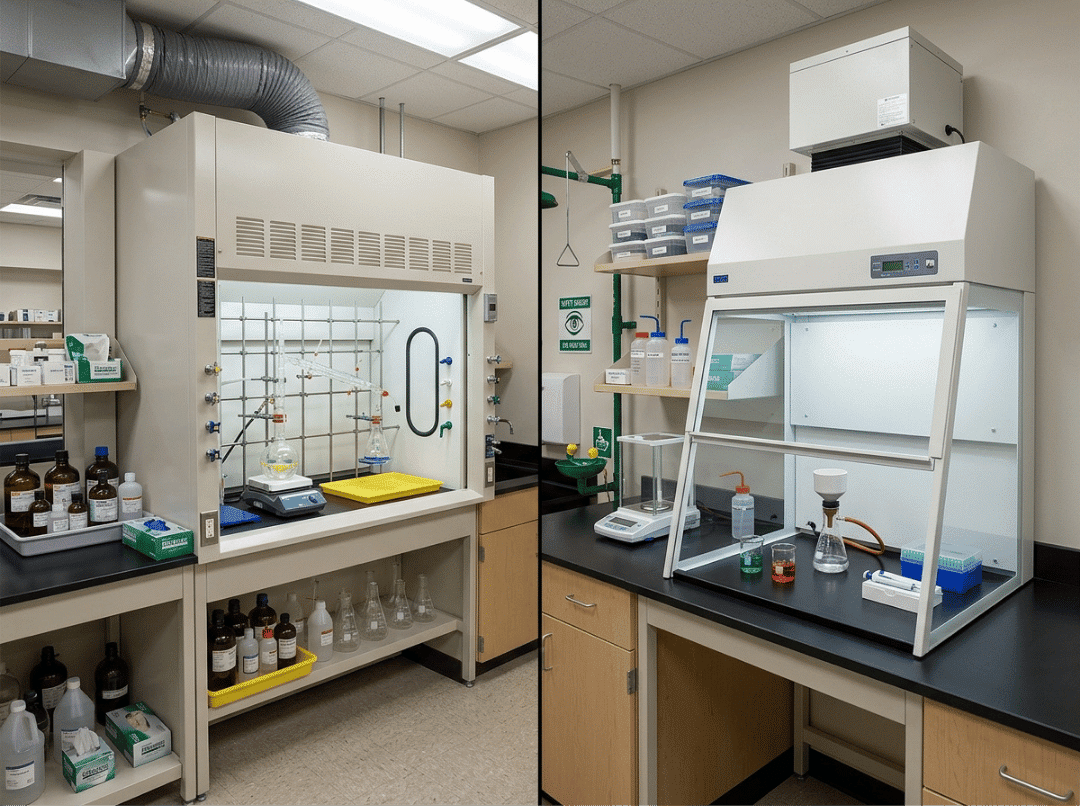
Teaching lab. If the curriculum uses a small, fixed, well-known set of low-hazard chemicals in small volumes, a ductless hood can work and save heavily on installation costs. The catch is that teaching labs drift — reagents change from term to term, and supervision varies. If the chemistry isn’t tightly controlled and documented, ducted is the safer long-term call.
Organic chemistry lab. Solvents, volatiles, and frequent heat make this a ducted environment almost by default. The vapor load is exactly what recirculating filters struggle to handle, and heated processes accelerate breakthrough. Ducted is the responsible baseline here, not a luxury.
Acid digestion bench. Corrosive vapors demand a hood built for them, typically a specialized ducted setup, sometimes with washdown. Recirculating corrosive gas through a filter and back into the room is the wrong risk to take. Because the surrounding surfaces face the same exposure, plan the hood alongside corrosion-appropriate lab benches and workstations and acid-resistant lab countertops and worktops rather than treating the hood as an isolated purchase.
Retrofitted or rented space. When ductwork isn’t an option and the landlord won’t allow roof penetrations, ductless is often the only feasible route — and that’s fine, as long as the chemistry genuinely fits a ductless unit’s limits. Don’t let a building constraint push you into running hazardous work through a filter it can’t handle. If the chemistry doesn’t fit, the honest fix is to change the space or the workflow, not to force a ductless hood into a job it can’t do safely.
Mixed chemical loads. Many labs run mostly benign, known reagents with the occasional aggressive or unpredictable compound. That gray zone rarely suits a single ductless unit. The cleaner answer is usually a hybrid setup: a ducted hood for the high-hazard, variable, or heated work, and a ductless unit reserved for the specific low-hazard tasks a rated filter fully covers. That split puts full exhaust protection exactly where the real risk lives and keeps you from running an energy-hungry ducted hood for jobs that don’t need it.
When a Ductless Hood Is Simply the Wrong Choice
To make the boundary unmistakable, rule out ductless whenever any of these are true:
- You can’t fully characterize your chemistry, or new compounds show up over time that you didn’t plan for.
- You work with highly volatile or highly toxic compounds, where the stakes of an invisible filter failure are too high.
- Your processes involve significant heat, which accelerates vapor load and filter breakthrough.
- No one will realistically own filter selection, saturation tracking, and scheduled change-outs.
- Your volumes are large or continuous, so filters saturate quickly while consumable costs climb.
A ductless hood that looks like a bargain becomes the most expensive mistake in the lab the first time it passes a toxic vapor back to the people it was meant to protect.
A Checklist to Run Before You Request Quotes
Four steps, in order. The answer usually reveals itself before you reach the last one.
- List every chemical the hood will ever see — with its volume, concentration, and toxicity. If that list is fixed, known, and low-hazard, ductless stays in play. If it’s varied, high-volume, highly toxic, or partly unknown, choose ducted and stop here.
- Confirm that a rated filter exists for each compound and that you can track its saturation. Any gap rules out ductless for that work.
- Check what your building can support — existing exhaust and, critically, enough make-up air. No infrastructure and no budget to add it points toward ductless, but only if steps 1 and 2 already cleared it.
- Estimate the five-year cost, not the sticker price. Add the purchase, installation, energy, filters, certification, and maintenance costs, then compare the totals.
Because a hood ties directly into the bench layout and the room’s airflow, plan its placement as part of the overall laboratory furniture design rather than bolting ventilation on at the end. The hood, the benches, and the make-up air all have to work together.
Frequently Asked Questions
Is a ductless fume hood as safe as a ducted one?
Only within strict limits. For a small, known, low-hazard chemical set with correctly matched and maintained filters, a ductless hood can effectively protect operators. But its safety depends entirely on filter selection and upkeep, and a failure gives no warning. For varied, volatile, highly toxic, or heated work, a ducted hood is safer because it removes the hazard from the building.
How do I know if a ductless hood can handle my chemicals?
Name every chemical the hood will ever see and confirm the manufacturer publishes a filter rated for each one. If you can’t list them all, or any compound lacks a rated filter, a ductless hood isn’t a safe match. Recirculating unknown or unfilterable chemistry back into the room is the core hazard to avoid.
Why does make-up air matter so much for a ducted hood?
A ducted hood removes a large volume of air from the room, and the building has to replace it. Without enough make-up air, the hood creates negative pressure that draws air from corridors, disrupts the HVAC, and lowers the hood’s face velocity — reducing the protection you installed it for. Adequate make-up air is part of the true cost of going ducted.
How often do ductless hood filters need to be changed?
It varies with chemical load and hours of use, from every couple of months to about once a year. Heat and heavy use shorten that interval. Many units include saturation indicators, but don’t rely on them alone for hazardous work — budget for filters as a recurring cost and assign someone clear responsibility for the schedule.
Is a ductless hood really cheaper than a ducted one?
Upfront, usually yes — it skips ductwork, blowers, and make-up air upgrades, and runs on far less energy. But recurring filter costs mount under heavy use, and a ductless hood is only cheaper if your chemistry genuinely fits its limits. Forcing hazardous work into a ductless unit isn’t a saving; it’s a deferred risk.
Can I use one ducted hood and one ductless hood in the same lab?
Yes, and for many labs that hybrid setup is the smartest option. Put the ducted hood where the high-hazard, variable, or heated chemistry happens, and reserve the ductless unit for specific low-hazard tasks its filter fully covers. You get full exhaust protection where the risk is real, without running an energy-hungry hood on jobs that don’t need it.
The Bottom Line
Two things settle the choice: the chemistry you actually run and what your building can support. A ducted hood removes hazards from the building entirely, which makes it the safe baseline for varied, volatile, toxic, or heated work — provided you have the exhaust and make-up air to feed it. A ductless hood offers placement flexibility and lower energy cost, but only inside a narrow, well-managed lane of known, low-hazard, low-volume chemistry with correctly matched and maintained filters. Push it past those limits and its silent failure mode turns a bargain into a serious hazard.
Before you buy, run the short audit that prevents costly mistakes. Write down every chemical the hood will handle, with its volume and toxicity. Confirm a rated filter exists for each one if you’re weighing ductless. Check whether your building has the exhaust and make-up air a ducted hood needs. Then match the hood to what you found — not to the lowest quote. That afternoon of work is what keeps a rushed decision from becoming an expensive retrofit, or a safety incident, a year down the line.