


The certifier lowers the sash to test height and runs a smoke stick along the opening. The plume curls back into the room. Then she asks for last year’s alarm calibration record. Nobody can find it. The hood fails.
I see this pattern often. Many labs expect trouble only from a weak airflow reading. But inspectors rarely stop at face velocity. They look at containment, documentation, and system performance together. A hood can hit its airflow target and still leak fumes. A clean test result loses its value the moment your records have gaps.
In this guide, I answer three practical questions:
- What do inspectors usually check first?
- Which problems cause the most failures?
- How can your lab prepare right now?
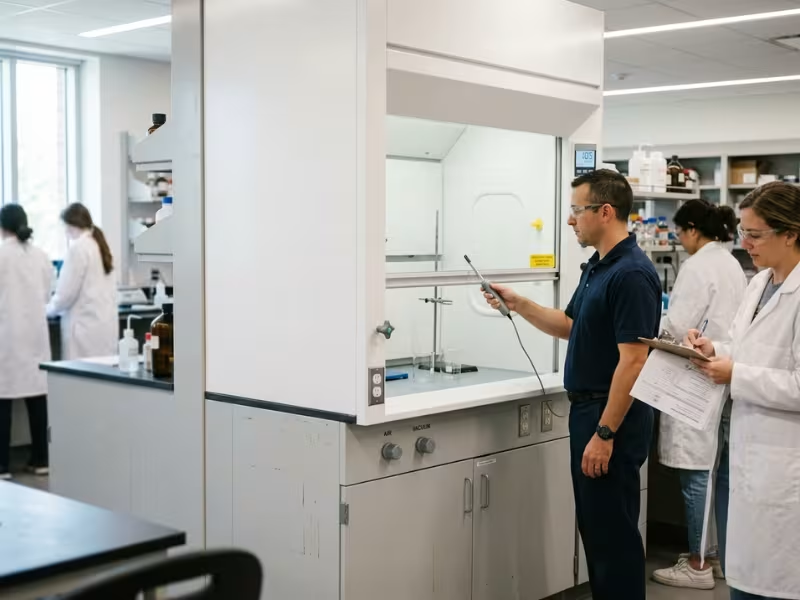
What Fume Hood Compliance Really Means in 2026
When I walk into a lab for a pre-inspection review, I rarely reach for the airflow meter first. I start with one question: “Can you show me this hood works every day, not just on test day?”
That question changes everything. For years, many teams treated compliance as a single number. If the face velocity landed in range, the job was done. That mindset no longer holds up. Inspectors now see your hood as one component in a larger system — one that includes the room, the exhaust, and the laboratory furniture system that shapes how people work at the sash.
Here is what that system includes:
- Containment performance. The hood must keep fumes inside under real working conditions, with people moving and equipment running.
- Stable exhaust. Your fan and ductwork need to deliver steady airflow — not readings that swing between morning and afternoon.
- Room air balance. Supply air, makeup air, and room pressure all shape how well the hood captures vapors.
- Alarm function. The monitor should warn users the moment airflow drops. A silent or uncalibrated alarm creates false confidence.
- Records and training logs. Certification reports, repair notes, and training sign-offs prove the system stays under control.
I often compare a fume hood to a smoke detector. Owning one means little. What counts is proof that it works and that someone checks it on schedule.
Most failures don’t come from missing equipment. The lab has the hood, the alarm, and the exhaust fan. What it lacks is ongoing verification. Someone moved a supply diffuser last spring. A technician skipped the alarm calibration. Nobody trained the new hire on proper sash use. Each gap looks small on its own. Together, they tell the inspector your system runs on assumption, not evidence.
The First Things Inspectors and Certifiers Look At
Most inspectors follow a predictable path. Once you know it, you can walk the same route before they arrive.
Face Velocity Readings
They start with the number everyone expects. The certifier checks whether your average face velocity falls within your organization’s target range — and then asks how you got that number.
I always check three details:
- Sash height. Did the tester use the same marked height your team works at daily? A reading at a lower sash looks better but proves little.
- Sampling points. Did they take readings across a grid covering the full opening, not just the center?
- Averaging. Did they average all points and flag any single low spot?
If last year’s report used a different sash height, the two readings can’t be compared.
Hood Condition and Airflow Alarms
Next, they look at the hood itself. They press the alarm test button, check whether the display shows a live reading or a frozen value, and ask when someone last calibrated the monitor.
Walk each hood with fresh eyes before an inspector arrives. Does the sash glide smoothly and hold its position? Do the baffles sit in place? Does the fan run steadily? Small mechanical faults often explain slow airflow drift.
Documentation
Finally, inspectors ask for paperwork. Expect requests for:
- The latest annual certification report
- Corrective action and retest records for any past failure
- Training records for every regular hood user
- A current hood inventory with locations and ID numbers
The retest record trips up many labs. A failed hood with a repair ticket but no retest leaves the loop open. To the inspector, that hood still counts as a failure. Keep these files in one place. If you can hand them over in two minutes, you set a confident tone for everything that follows.
Airflow Compliance: What Labs Often Get Wrong
Many labs treat face velocity as the finish line. It’s the starting point. Here’s why a hood with a perfect average can still let fumes escape.
Face Velocity Is Important, but Not the Whole Story
Most programs use 80 to 100 fpm as a reference range for standard bypass and conventional hoods. But this isn’t a universal rule. Your target depends on hood design, working conditions, and your institution’s standard.
More airflow isn’t always safer. I’ve seen labs push hoods to 150 fpm in the name of safety, only to find the fast air swirled around the user’s body and pulled vapors toward the breathing zone. What matters most is stable, repeatable containment — not a single impressive reading on test day.
High-performance and low-flow hoods can contain well at 60 fpm or less, but only if testing proves it under your actual conditions.
How Face Velocity Is Actually Measured
A face velocity number is only as good as the method behind it. A proper test follows four basics:
- A fixed sash height matching your daily operating position
- A traverse grid dividing the opening into equal sections, with readings at each center point
- Averaging with limits, flagging any single point that strays more than 20% from the average
- Steady conditions with doors in their normal position and HVAC running normally
Test condition also matters. An as-built test in an empty, quiet room shows what the hood can do. An as-used test adds real equipment. An as-operated test adds people, open doors, and normal activity. An as-built pass doesn’t prove much about an as-operated workday.
Why Containment Failures Happen Even When Velocity Looks Fine
Containment depends on what happens around the hood, not just inside it. Even a small disturbance can overpower a gentle inflow of 100 fpm.
The most common culprits I find:
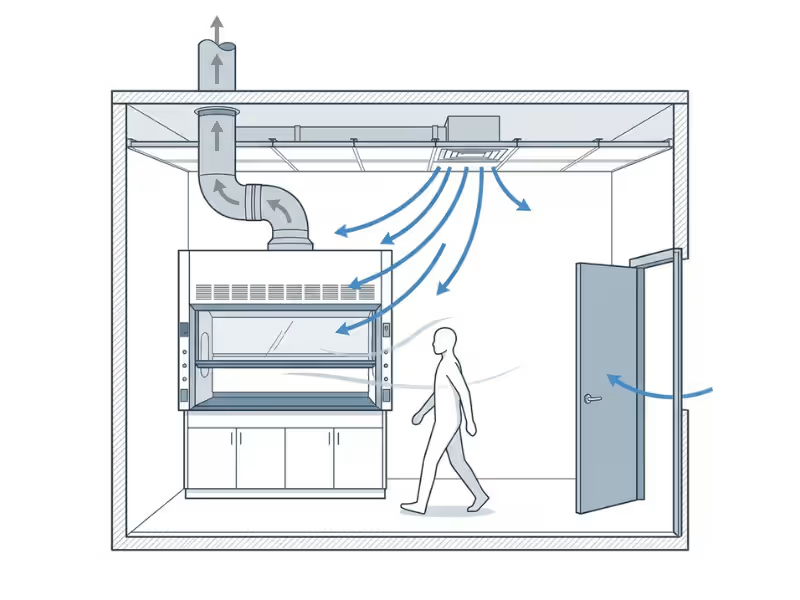
- Cross-drafts — air moving sideways across the sash pulls vapors out at the edges
- Foot traffic — a person walking past at normal speed creates enough of a wake to draw fumes out
- Diffuser placement — a supply diffuser above or beside the hood can blast air straight at the opening
- Open doors — a door swinging open changes room pressure in seconds
- Cluttered interiors — bottles and equipment block baffle slots, create dead zones, and cause swirling eddies near the front
- A raised sash or arms inside the enclosure — lifting the sash above its marked height lowers face velocity immediately and removes the physical barrier between the user and the work. Reaching past the sash to adjust a water cock does the same. That’s why remote water control for fume hoods is worth specifying — users can manage utilities from the front panel and keep their arms clear of the work zone.
One example stays with me. A lab passed velocity testing three years in a row, yet users kept smelling solvent. The cause turned out to be a ceiling diffuser installed during a renovation — less than three feet from the sash. The numbers looked fine because the test never accounted for that downdraft.
Smoke Visualization and Tracer Gas Testing
When velocity data and real-world experience don’t match, you need tests that show actual air movement.
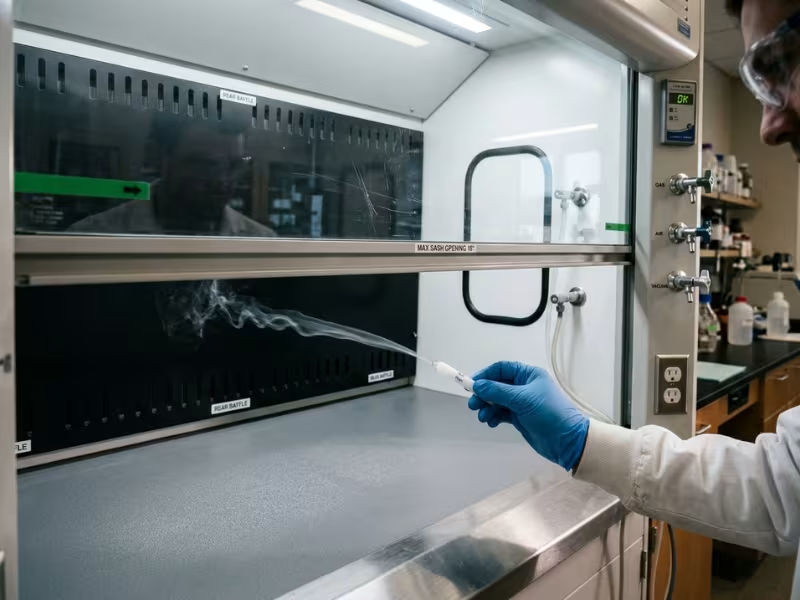
Smoke visualization makes airflow visible. The tester releases smoke along sash edges, the work surface, and the baffles, and you watch where it goes. It quickly reveals reverse flow at the opening, smoke rolling out along the sides, or dead zones and slow clearing inside the hood. It’s fast and inexpensive, but qualitative — it shows a problem without measuring its severity.
Tracer gas testing adds hard numbers. A tracer gas, usually sulfur hexafluoride, is released inside the hood. A sensor at a mannequin’s breathing zone records how much escapes. Many programs set an acceptance level of 0.05 to 0.1 ppm.
I always recommend containment testing when:
- Users report odors despite passing velocity numbers
- You run low-flow or VAV hoods at reduced velocity
- The lab has gone through a renovation, HVAC change, or layout reconfiguration
- The hood handles highly toxic materials
Velocity measures how much air moves through the opening. Containment measures whether the hood actually protects the person standing in front of it.
Room Air and Makeup Air Issues That Quietly Cause Failures
When a hood keeps failing after repairs, I stop looking at the hood and start looking at the room. These problems build slowly and rarely show up on a work order.
How Negative Pressure and Makeup Air Affect Hood Performance
Every cubic foot your hood exhausts needs a replacement — makeup air. When the room can’t supply enough, the hood struggles to pull air through the sash opening.
The three patterns I see most often:
- Insufficient makeup air. Someone adds two hoods during a renovation but never upgrades the supply system. The room starves, face velocity drops, and doors become hard to open.
- Unstable room pressure. Labs should stay slightly negative to nearby corridors, often targeting about a 10% offset between exhaust and supply. If that offset swings during the day, hood performance swings with it.
- Supply and exhaust out of balance. A stuck supply valve or a lagging VAV controller means the room is fighting the hood.
A quick field check: if a door whistles or slams on its own, your pressure balance needs attention.
Common Cross-Draft Sources
Even a well-balanced room fails if air moves the wrong way near the sash. Keep cross-drafts at the hood face below half of your face velocity — below one-third is better. The most common sources:
- Door traffic near a busy entrance
- HVAC supply diffusers that throw air down or sideways toward the opening
- Operable windows that can overpower a hood on a breezy day
- Large equipment like centrifuges, ovens, and cooling fans that push air unpredictably
Practical Fixes That Actually Work
Most of these fixes cost far less than a new hood:
- Adjust or replace diffusers. Swap high-throw models for low-velocity perforated or radial types, turned away from the sash.
- Rebalance the VAV and HVAC system. Verify supply and exhaust volumes at every hood and room valve, and confirm controls respond within a few seconds when sash positions change.
- Add dedicated makeup air. In labs with several hoods, a dedicated makeup air unit provides steady, conditioned supply without starving other zones.
- Manage doors and traffic. Install door closers, keep lab doors shut during hood use, and reroute walkways away from the hood face.
I’ve watched hoods that failed consistently pass easily after nothing more than a diffuser change and a proper rebalance.
Ducted vs. Ductless Fume Hoods: When Each One Is Actually Compliant
Neither type is compliant by default. Each one passes or fails based on how well it fits your chemistry and how well you can prove that fit.
Where Ducted Hoods Remain the Default Choice
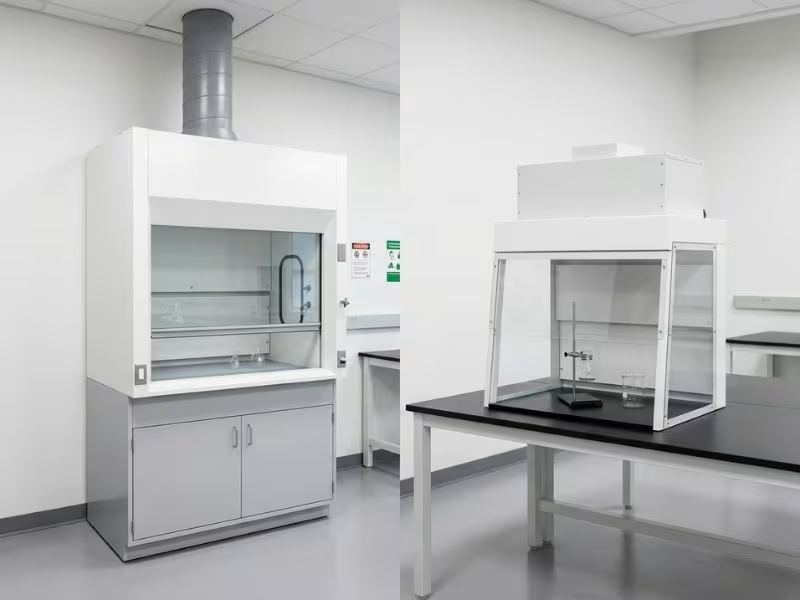
A ducted hood sends contaminated air outside through the exhaust system. It doesn’t need to “know” what you’re working with — and that’s its biggest strength.
I recommend ducted hoods for:
- General chemistry labs where many people run different procedures
- Volatile solvents in more than trace amounts
- Corrosives like strong acids, which can attack filter housings
- Unknown or changing mixtures, including reaction byproducts
- Research labs where protocols change often
My rule is simple. If you can’t write a complete list of what goes into the hood, you need a ducted hood. With ducted units, the compliance risk sits mostly outside the hood — in exhaust performance, room balance, and certification records.
Where Ductless Hoods May Be Acceptable
A ductless hood pulls air through filters — usually activated carbon or HEPA — and returns it to the room. It only protects you from what those filters can capture.
Ductless hoods can work well when four conditions hold:
- Known chemicals — a short, stable list used in small amounts
- Confirmed filter compatibility — manufacturer sign-off on each chemical, in writing
- Defined use boundaries — limited volumes, procedures, and users
- Stricter monitoring — tracked filter life, breakthrough checks, and logged changes
Good fits include weighing powders, small-scale staining, and teaching labs with a fixed curriculum. Trouble starts when the work drifts and a new solvent enters the hood without a filter review.
The Documentation Burden Most Buyers Underestimate
Ductless hoods often look cheaper on the quote. The paperwork tells a different story. Inspectors will expect:
- A signed approved-chemicals list with maximum quantities and filter type, updated as work changes
- Filter tracking logs with install dates, serial numbers, hours of use, and saturation readings
- A defined breakthrough and change-out plan — “when it starts to smell” is not acceptable
- Manufacturer guidance plus an internal SOP, with user training on both
Many clients find that a ducted hood costs less over five years once filter replacements and staff time are factored in.
|
Type |
Best Fit |
Main Compliance Risk |
What Must Be Documented |
Maintenance Burden |
|---|---|---|---|---|
|
Ducted |
General chemistry, solvents, corrosives, unknown or changing mixtures |
Weak exhaust, room imbalance, or lapsed certification |
Annual certification, alarm calibration, retest records, user training |
Moderate: annual testing plus fan and duct upkeep |
|
Ductless |
Small amounts of a known, stable chemical list |
Filter saturation or an unreviewed chemical |
Approved chemical list, filter log, breakthrough plan, SOP, user training |
High: filter monitoring, scheduled changes, ongoing compatibility reviews |
If your chemical list fits on one page and stays that way, a ductless hood may serve you well. If it grows or changes, go ducted.
Exhaust Design Problems That Can Undermine an Otherwise Good Hood
Sometimes the hood passes every test, the room is balanced, and people still smell chemicals. When that happens, I go to the roof. If the exhaust design is wrong, fumes leave the lab and come right back.
Stack Height and Discharge Velocity
Your stack must push exhaust high enough to clear the building’s wind wake — the zone of recirculating air that forms as wind flows over a roof. A short stack releases fumes straight into it.
Standard guidance calls for a stack at least 10 feet above the adjacent roof line, taller near parapets, penthouses, or taller neighboring structures. Many designers target about 3,000 fpm at the outlet to throw the plume upward. Watch for two common mistakes:
- Rain caps that deflect air downward push exhaust back onto the roof. Use a straight vertical stack or drain-style design instead.
- Oversized fans running at low speed allow exit velocity to quietly drop below what the plume needs.
Re-Entrainment: When Your Exhaust Comes Back Inside
Re-entrainment happens when exhaust gets pulled back in through air intakes, operable windows, or entry doors. Users notice odors in offices far from the lab and nobody connects it to the roof.
I check three things on any site:
- Distance between stacks and the nearest intake or operable window
- Prevailing wind direction, since seasonal shifts can create problems that appear only part of the year
- Architecture — screens, parapets, and taller wings trap exhaust in wake zones
For new builds or major retrofits, a dispersion study or wind tunnel model is worth the cost. It’s far cheaper than relocating an air handler after occupancy.
What to Verify on Shared Exhaust Manifolds
Many buildings connect several hoods to one manifold and a shared fan. This works well, but adds its own risks. Incompatible vapors can react inside ductwork — perchloric acid and radioisotope work should never share a manifold with general hoods.
Pressure stability matters too. When one lab opens all its sashes, the extra flow can starve hoods farther down the line. Good systems hold steady static pressure using bypass dampers or variable-speed fans.
Before sign-off, confirm:
- Static pressure stays stable as sash positions change across the system
- Each hood holds its target flow with neighboring hoods fully open
- Redundant fans switch over without a gap in exhaust
- Alarms alert users if manifold pressure drops
Low-Flow and VAV Hoods: Energy Savings Only Work If Containment Is Verified
Facility teams love the energy math on low-flow and VAV hoods. Safety officers worry about what happens at the sash. Both have a fair point.
Why Low-Flow Designs Are Gaining Attention
A constant-volume hood can exhaust 1,000 cfm or more around the clock — and the building must condition every cubic foot before it leaves. Low-flow and VAV designs cut that cost significantly:
- Low-flow hoods use better aerodynamics to contain fumes at reduced velocities, often around 60 fpm.
- VAV hoods reduce total exhaust as the sash closes while holding face velocity steady.
Pair either design with good sash habits and labs often cut hood exhaust by 30–50%, reducing fan size, makeup air demand, and utility costs.
Where Low-Flow Projects Go Wrong
Trouble starts when the energy target drives the project and nobody owns containment. The four weak spots I see most often:
- Velocity set too low without proof. A rating from an as-built test in a quiet room doesn’t transfer to a busy lab.
- Sash sensors that drift. Stretched cables and slipping magnets cause the controller to misread sash position, keeping exhaust low when it shouldn’t be.
- Slow control response. Valves need to stabilize within about three seconds of a sash movement. Poorly tuned systems can take ten or more — and face velocity collapses right when users lean in.
- Alarms that can’t keep up. At low velocity, the gap between normal and unsafe narrows. An alarm set too close to the operating point sounds constantly until someone silences it. A delayed alarm misses short dips entirely.
Teams often verify the savings on the utility bill. They never verify containment at all.
What Needs to Be Verified Before Calling Them Compliant
Before I sign off on a low-flow or VAV hood, I require evidence on four fronts:
- Containment at the real operating point — tracer gas testing under as-used or as-operated conditions, including a sash-movement test
- Control response timing — measured from sash fully closed to fully open, with flow stabilization time recorded
- Sensor accuracy — controller-reported sash position verified against measured positions at several heights, including horizontal panels
- Alarm setpoints and function — confirmed against the reduced operating velocity, tested, and logged with a calibration date
Document all of it: the approved setpoint, test results, and who signed off. Any future change to the setpoint should trigger retesting.
Special Hood Cases That Need Their Own Rules
Some setups look routine but carry risks a general chemical hood was never built to handle. These are the cases I check first in any audit.
Perchloric acid hoods require a dedicated unit with a built-in wash-down system, an interior free of organic materials, and its own straight vertical exhaust duct. Heated perchloric acid releases vapor that condenses as perchlorate salts — salts that can explode from friction during maintenance. Run the wash-down after every use and log it. If perchloric acid has been heated in a standard hood “just once,” treat that ductwork as suspect.
Radioisotope hoods focus on contamination control. Look for seamless stainless steel interiors with coved corners, reinforced work surfaces to carry lead shielding, and a dedicated exhaust path — never a shared manifold. Involve your radiation safety officer in every change.
In both cases, the surfaces around the hood deserve the same scrutiny. Work surfaces that pit, swell, or delaminate trap residue and make decontamination harder to prove. Specify chemical-resistant lab worktops matched to the acids, solvents, and temperatures your team actually works with — both inside the hood and on the benches beside it.
Biosafety cabinets are not fume hoods. They use HEPA filtration to protect people, samples, and the room from biological agents, following their own certification standard. Most Class II cabinets return filtered air to the room, so volatile chemicals have nowhere safe to go. Don’t let anyone substitute one for the other.
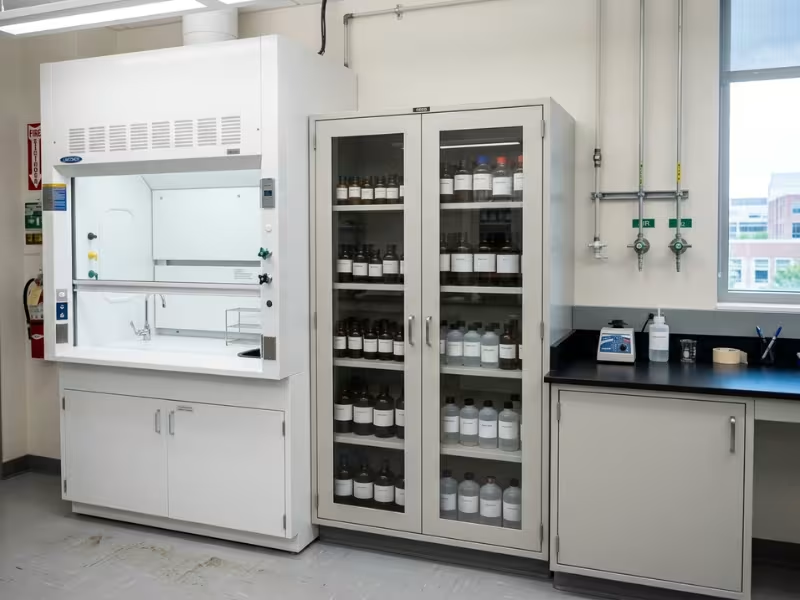
Storing chemicals inside a fume hood looks harmless but isn’t. Bottles block baffles, disrupt airflow, shrink working space, and add fuel to any spill or fire. Inspectors flag this immediately. Move stored chemicals to dedicated lab storage cabinets near the work area and keep the hood for active procedures only.
The Most Common Compliance Failures and How to Prevent Them
After enough site visits, the failures become familiar. The labs change. The five problems don’t. None requires an expensive fix — most come down to a habit, a reminder on a calendar, or one person who owns the task.
Walk your hoods with the table below and mark every row that applies.
|
Failure |
What Usually Causes It |
Why It Matters |
Best Preventive Action |
|---|---|---|---|
|
Face velocity drift |
Worn fan belts, bumped dampers, HVAC changes nobody retested |
Containment weakens slowly; users rarely notice until odors appear or a test fails |
Log monitor readings weekly. Retest after any fan, damper, or HVAC work. |
|
Alarm not functioning or not calibrated |
Sensor drift, alarms silenced after nuisance trips, no calibration schedule |
Users lose their only real-time warning; a silent alarm creates false confidence |
Press the test button monthly. Calibrate at every certification. Fix the cause of nuisance alarms instead of silencing them. |
|
Poor housekeeping and clutter |
Hood used for storage, large equipment at the front edge, blocked baffle slots |
Clutter creates dead zones and eddies that push vapor out; it also adds fuel to any fire |
Work at least 6 inches behind the sash. Clear stored items every week. |
|
Sash misuse |
Sash raised above the marked height, left open when unattended, horizontal panels removed |
Face velocity drops, the physical barrier disappears, and VAV hoods waste energy |
Install sash stops and clear height labels. Set a “close it when you walk away” rule. |
|
Missed certification or incomplete records |
No central tracker, staff turnover, retests never scheduled after repairs |
Inspectors treat the hood as unverified, even if it performs fine |
Assign one owner and a backup. Keep a file per hood ID. Close every repair with a retest date. |
A few patterns are worth expanding:
Drift hides in slow change. A hood rarely drops from 100 fpm to 70 overnight — it loses a few fpm per month. Trend data matters more than any single reading. A steady six-week slide is a call to your balancing contractor before the certifier finds it.
Nuisance alarms lead to dead alarms. When I find a muted monitor, a frustrated user is almost always the explanation. The alarm triggered every time someone opened the lab door, so they unplugged it. Find the real cause — setpoint, delay, room pressure — and fix it.
Housekeeping is a daily job. A two-minute end-of-day sweep covers it: remove anything not in active use, wipe the work surface, confirm nothing blocks the bottom baffle slot.
Records fail when nobody owns them. Shared responsibility usually means no responsibility. Name one person and a backup. Give them a simple tracker with each hood’s ID, location, last certification date, alarm calibration date, and any open corrective actions.
A Practical Pre-Inspection Checklist for 2026
The week before an inspection tells me more about a lab than the inspection itself. Teams that prepare early fix small problems quietly. Teams that wait end up explaining those problems to the inspector.
What to Check This Week
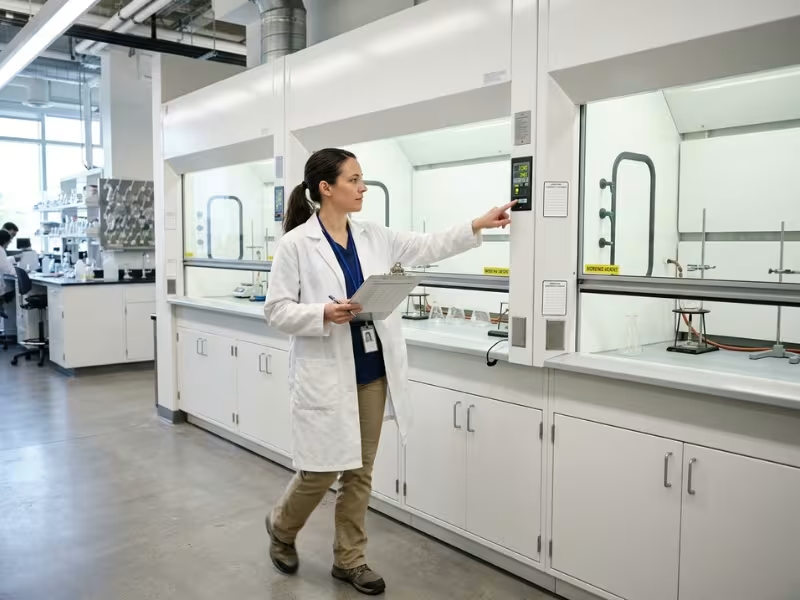
Walk every hood with a clipboard. Five minutes per unit catches most of what inspectors spot on sight.
- Certification date. Read the sticker. If it expires within 60 days, book your certifier now.
- Alarm function. Press the test button on each monitor. If the reading looks frozen or the alarm stays silent, tag the hood and call for service.
- Sash condition. Raise and lower the sash fully. It should glide smoothly and hold its position. Confirm the operating height label is visible and the sash stop works.
- Visible clutter. Look for stored bottles, blocked baffle slots, and equipment pushed against the front edge. Clear anything not in active use.
- Labels and inventory. Match each hood’s ID tag to your inventory list. Inspectors notice when a hood sits in the room but not in your records.
What to Gather Before the Inspector Arrives
Once the hoods look right, turn to the paper trail. Organize everything in one binder or shared folder, sorted by hood ID.
- Annual certification reports for at least the past two cycles
- Training logs for every regular hood user, including new hires and students
- Alarm and monitor calibration records with dates and technician names
- Maintenance history, including fan, damper, and HVAC work
- Corrective action records, each closed with a passing retest
A repair without a retest is the gap I find most often. Look for it as you sort.
What to Ask Your Testing Vendor
Your certifier’s report is your strongest evidence. Before the test date, call your vendor and confirm:
- Test method. Which standard or protocol do they follow? How many traverse points do they take?
- Sash configuration. At what height will they test? It should match your marked operating height and last year’s report.
- Smoke or tracer gas scope. Does the visit include smoke visualization? For low-flow, VAV, or high-hazard hoods, ask whether tracer gas testing is included or needs a separate quote.
- Retest timing. If a hood fails, how soon can they return after repairs? Get that turnaround in writing.
Clear answers up front protect you from a report that passes the hood but still leaves you exposed during the inspection.
FAQs
What face velocity is typically considered acceptable?
Most programs use 80 to 100 fpm as a working reference for conventional and bypass hoods. High-performance and low-flow hoods may contain well at 60 fpm, but only if containment testing proves it at your actual conditions. Readings well above 120 fpm can cause turbulence and pull vapors outward. Always check your institution’s standard first — that number matters more than any general guideline.
How often should a fume hood be certified?
At least once a year. Also schedule a retest after fan, motor, or damper repairs; HVAC rebalancing or controls changes; room renovations or new diffuser locations; relocation of the hood; or any change to the VAV setpoint. Think of it like a vehicle inspection with one extra rule: any major repair resets the clock.
Are ductless fume hoods compliant?
They can be, but only under narrow conditions. To defend one during an inspection, you need a written list of approved chemicals and quantities, manufacturer confirmation that filter media matches each chemical, a filter log with install dates and saturation checks, and a clear breakthrough detection and change-out plan. If your chemical list changes often or includes unknown mixtures, choose a ducted unit.
What happens after a hood fails testing?
Take the hood out of service and post a clear “Do Not Use” tag. Find the real cause rather than simply turning up the fan — failures often point to the room, such as a new diffuser, weak makeup air, or a stuck valve. After the repair, schedule a retest and file the failure report, repair record, and passing retest report together. Until that loop closes, the hood still counts as an open failure.
What is the difference between face velocity and containment testing?
Face velocity testing measures how fast air moves into the sash opening. Containment testing shows whether fumes actually stay inside — either visually with smoke or by measuring tracer gas concentration at a mannequin’s breathing zone. Velocity measures the effort. Containment measures the result. I recommend containment testing for low-flow and VAV hoods, high-hazard work, and any hood where users report odors.
Do all labs need the same type of hood?
No. General chemistry and research labs usually need ducted hoods for changing chemicals and procedures. Teaching labs with a fixed curriculum may use ductless hoods if the chemical list stays short and stable. Perchloric acid work requires a dedicated wash-down hood. Radioisotope work needs a hood built for cleanup and shielding with its own exhaust path. Biological work belongs in a biosafety cabinet — which is not a fume hood. Match the hood to the hazard, then document why you made that choice.
How do VAV hoods affect operating costs?
VAV hoods reduce exhaust when the sash closes, so the building conditions less outside air. Many labs see hood exhaust drop by 30–50% when users close sashes consistently. Those savings depend on good sash habits and regular upkeep of sensors, valves, controllers, and alarms. Budget for that maintenance from the start — a VAV system that drifts out of tune costs you both energy and containment.
Can chemicals be stored inside a fume hood?
Keep only what you need for the current procedure inside the hood, and move everything else to ventilated storage. If your lab truly needs a hood dedicated to storing odorous or volatile materials, label it clearly as a storage hood, remove it from active work, and keep it on your certification schedule like any other unit.
Compliance Holds Up When the Whole System Does
Real compliance doesn’t come from one good airflow reading on one good day. It comes from a hood, a room, an exhaust system, and a paper trail that all hold up together when someone checks. If one fails, the other three can’t carry you.
You don’t need a large project to start. Pick one hood today and pull its file. Look at the date on the last certification report — if it’s close to a year old, book your certifier this week. Then check two records: confirm someone calibrated the alarm on schedule, and make sure every corrective action closes with a passing retest. If those items check out, you’re on solid ground. If not, you know exactly where to begin.
Planning a new lab or upgrading an existing hood area? Look beyond the hood itself. The benches around it, the worktop material, how users reach water and gas controls, and where chemicals are stored all shape daily compliance. When you specify those elements as one coordinated system from the start, your hoods have an easier time passing on inspection day — and on every ordinary workday after it.
