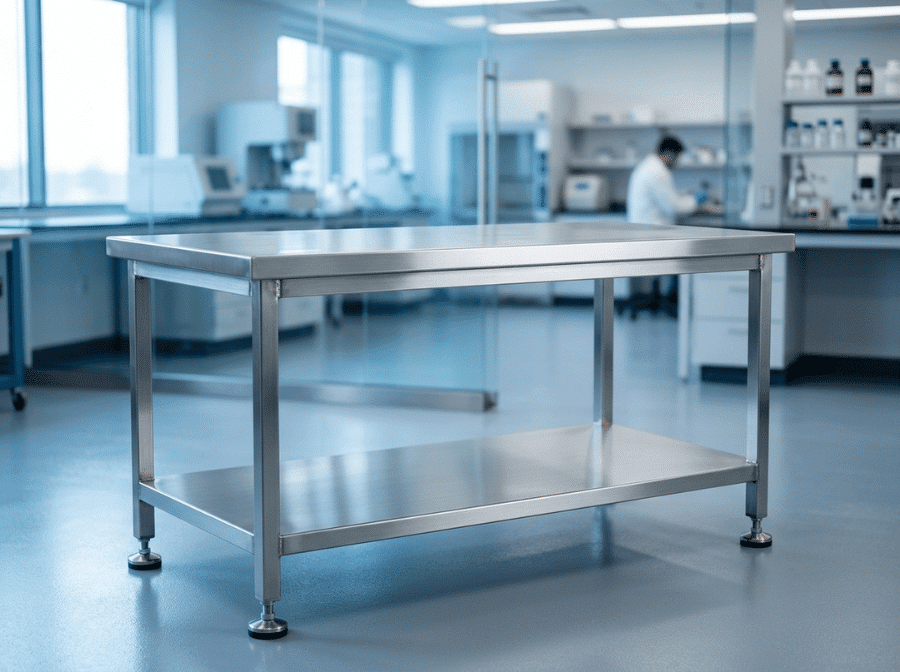
Choosing the wrong stainless steel lab table is a surprisingly common and costly mistake — and it rarely comes down to looks or budget. The wrong type can introduce contamination risks in a cleanroom, buckle under heavy equipment loads, or transmit vibration into sensitive analytical workflows. Those errors routinely cause delays, re-orders, and avoidable expense.
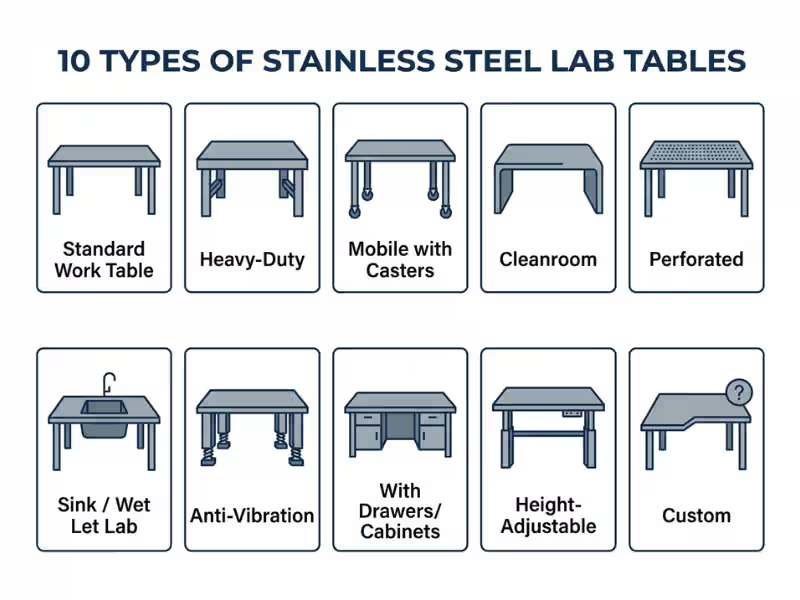
This guide breaks stainless steel lab tables into 10 practical categories, from standard work tables and heavy-duty platforms to cleanroom, anti-vibration, and fully custom builds. Drawing on Glorylab’s experience supplying lab furniture to pharmaceutical manufacturers, food testing facilities, research centers, and hospital labs worldwide, it offers a buyer-oriented decision framework — not an abstract taxonomy — to help you match the right table to your environment, load, mobility, and chemical exposure needs.
Why Grade Matters Before Anything Else: 304 vs. 316 Stainless Steel
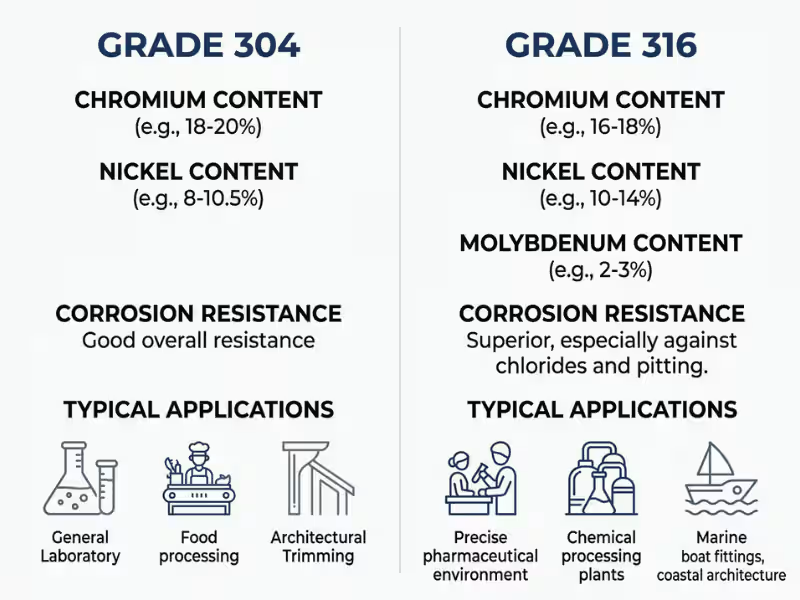
Before comparing table types, you need to settle one foundational question: Grade 304 or Grade 316 stainless steel?
Both grades are austenitic, non-magnetic, and corrosion-resistant. The difference is molybdenum. Grade 316 contains approximately 2–3% molybdenum, which significantly improves resistance to chlorides, saltwater, and many acidic chemical compounds. Grade 304 contains no molybdenum and offers strong general-purpose corrosion resistance at a lower cost.
When to specify Grade 304: General laboratory use, teaching labs, dry analytical environments, and applications where chloride exposure is minimal. Grade 304 is the most widely used option and covers the majority of lab environments well.
When to specify Grade 316: Pharmaceutical manufacturing areas subject to frequent CIP (clean-in-place) procedures, wet labs working with halide-containing reagents, food processing environments with salt-heavy solutions, and marine or coastal facilities. The additional molybdenum content provides better protection in these conditions meaningfully—though it does come at a higher material cost.
At Glorylab, we manufacture in both Grade 304 and Grade 316. If you’re unsure which applies to your project, our team can review your chemical exposure profile and environmental conditions before production begins.
The 10 Types of Stainless Steel Lab Tables
Type 1: Standard Stainless Steel Work Tables
Best for: General-purpose laboratory use, teaching labs, preparation areas, QC benches
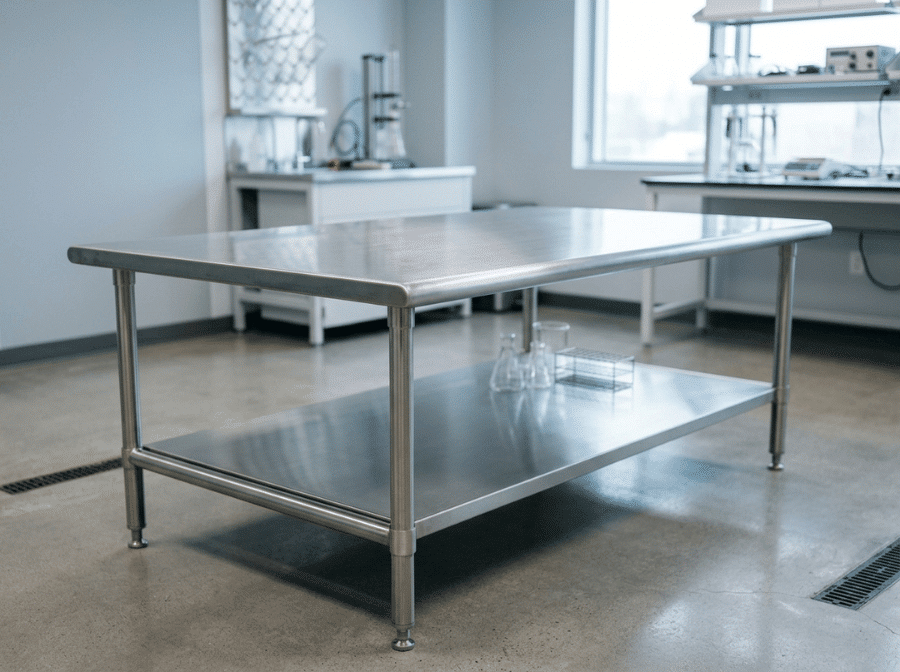
Standard stainless steel work tables are the foundational unit in most laboratory environments. They typically feature a flat tabletop—commonly 14- or 16-gauge—with a welded or bolt-together frame, adjustable leveling feet, and optional undershelves.
These tables cover a wide range of non-specialized tasks: sample preparation, instrument staging, documentation, and general bench work. Grade 304 is the typical material specification for this category.
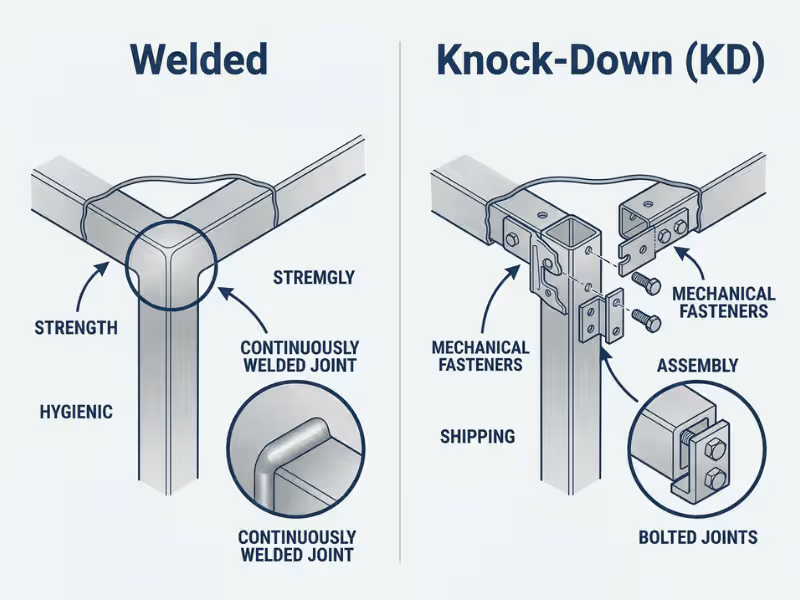
Construction options include fully welded frames (better for environments requiring cleanability) and knock-down (KD) frames (preferred where flat-pack shipping or on-site reconfiguration is needed). Both options are available from Glorylab, with SGS-tested bench performance documentation available on request.
Type 2: Heavy-Duty Stainless Steel Lab Tables
Best for: Industrial labs, manufacturing QC, equipment staging, heavy instrument platforms
Heavy-duty stainless steel lab tables are engineered for static loads that standard work tables aren’t rated for. They typically feature 12- or 14-gauge tabletops, reinforced welded frames with heavier-gauge legs, and cross-bracing configurations that resist racking under off-center loads.
Applications include staging autoclaves, centrifuges, analytical balances with heavy sample loads, and production-line QC stations. Load ratings typically range from 500 kg to over 1,000 kg per table depending on configuration.
For buyers specifying these tables for pharmaceutical or GMP-regulated manufacturing areas, surface finish and weld treatment become significant factors. Fully welded construction with ground and polished seams is commonly specified to eliminate bacterial trapping zones.
Type 3: Mobile Stainless Steel Lab Tables with Casters
Best for: Flexible-layout labs, prep-to-process workflows, hospital service areas, pilot plants
Mobile stainless steel lab tables are mounted on lockable casters, making them repositionable without floor anchoring. This makes them well-suited to environments where workflows change regularly, where equipment needs to be moved between zones, or where cleaning protocols require tables to be relocated.
Caster specifications matter. Swivel casters with locking mechanisms are standard. For cleanroom or controlled environments, consider sealed or non-particle-shedding caster materials to prevent floor contamination.
Glorylab builds mobile tables with integrated lower shelves, drawer units, and backsplashes depending on the application. If your project involves hospital preparation areas or pilot-scale pharmaceutical processing, mobile table configurations are worth reviewing carefully.
Type 4: Stainless Steel Cleanroom Tables
Best for: ISO-classified cleanrooms, semiconductor facilities, sterile compounding, biotech manufacturing
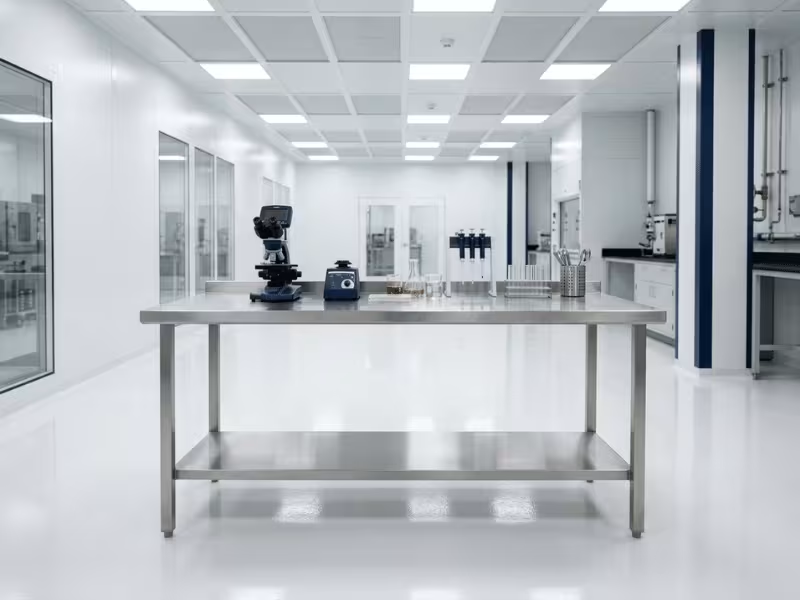
Cleanroom-rated stainless steel lab tables are designed to minimize particulate generation and support rigorous cleaning protocols. Key construction features include continuously welded seams (no crevices), electropolished or bead-blasted surface finishes, sealed leg-to-tabletop joints, and perforated or louvered designs that do not trap particles or impede unidirectional airflow.
Grade 316 is commonly specified for cleanroom tables in pharmaceutical and biotech environments, particularly where sanitizing agents containing chlorine are used in routine wipe-down protocols. The electropolished finish—common in ISO Class 5–7 environments—reduces surface roughness to Ra ≤ 0.5 µm, improving cleanability and resisting microbial adhesion.
Buyers in North America may reference SEFA 8M guidelines for laboratory furniture performance, which include load, deflection, and surface resistance benchmarks. Glorylab can provide SGS test documentation for steel lab benches tested against SEFA 8M B criteria upon request.
Type 5: Perforated Stainless Steel Lab Tables
Best for: Under-hood work, fume hood staging, laminar flow workstations, airflow-sensitive applications
Perforated stainless steel lab tables feature a tabletop punched with a regular hole pattern—typically 6–12 mm diameter perforations across the work surface. This design serves two purposes: it allows vertical airflow to pass through the work surface unobstructed (critical for laminar flow cabinets and certain fume hood configurations), and it reduces the surface area available for liquid pooling.
These tables are often paired with biological safety cabinets, cleanroom laminar flow hoods, or spray-drying and drying oven stations. The perforation pattern must be specified carefully—too coarse and small items fall through; too fine and the airflow benefit is reduced.
Perforated tables are typically built in Grade 304 for general use, but Grade 316 can be specified for environments with persistent chemical mist or saline cleaning agents.
Type 6: Stainless Steel Sink Tables and Wet Lab Tables
Best for: Wet chemistry labs, microbiology prep, glassware washing stations, food testing labs
Stainless steel sink tables integrate one or more bowls directly into the tabletop, with or without drainboards, backsplashes, and faucet drilling. The sink bowl and tabletop are typically formed from a single sheet or continuously welded to eliminate the joint gap that collects contamination.
Single-bowl and double-bowl configurations are most common. Cup sink options are available for bench-top drain points separate from the main washing station. Integral backsplashes protect wall surfaces and are standard on most wet lab configurations.
For food testing environments subject to food-grade hygiene audits, smooth internal corners with a minimum bend radius and full drainage slope are important specification points—not blanket regulatory claims, but practical construction details that auditors commonly review.
At Glorylab, we build integrated sink tables with 304 or 316 stainless, configurable drainboard positions, optional pegboard sections above the sink area, and custom faucet drilling patterns to match your water and gas service layout.
Ready to spec your sink table configuration? Submit your layout to Glorylab →
Type 7: Anti-Vibration Stainless Steel Lab Tables
Best for: Analytical balances, optical microscopes, laser equipment, precision measurement instruments
Anti-vibration lab tables use passive isolation systems to attenuate floor-transmitted micro-vibrations that degrade the performance of sensitive instruments. The isolation mechanism typically consists of pneumatic or elastomeric isolators integrated into the table legs, decoupling the tabletop from floor movement.
These tables are not the right choice for every lab—they add cost and are unnecessary unless the instrument in use is demonstrably sensitive to vibration. Analytical balances, scanning electron microscopes, interferometers, and laser systems are the most common applications.
Glorylab manufactures anti-vibration tables across a range of load capacities and surface dimensions. No external power supply is required—the passive isolation system operates without any utility connection. Stainless steel tabletop options allow these tables to be used in cleanroom and controlled-environment contexts where steel surfaces are preferred over granite.
Type 8: Stainless Steel Lab Tables with Drawers or Cabinets
Best for: Instrument-adjacent workstations, reagent organization, GLP-compliant documentation areas, hospital lab benches
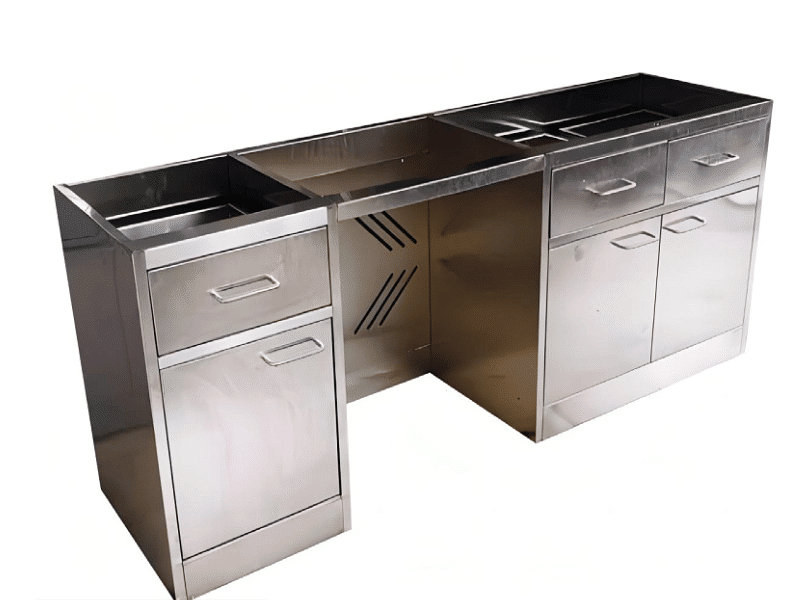
Storage-integrated stainless steel lab tables combine a flat working surface with one or more drawer units, door panels, or shelving modules mounted below the tabletop. The storage components may be fabricated in stainless steel throughout or use stainless surfaces with internal structural steel.
These configurations reduce the clutter of supplementary storage furniture and improve workflow efficiency by keeping reagents, tools, or documentation within reach of the primary work surface. In GLP and GMP contexts, having dedicated and labeled storage adjacent to the workstation also supports traceability and audit compliance.
Drawer sizes and internal configurations—including divider systems, lock provisions, and drawer liner materials—can be customized. Glorylab builds drawer and cabinet sub-assemblies as integrated components of the table structure, not as afterthought add-ons, which means the finished unit has consistent construction quality throughout.
Type 9: Height-Adjustable Stainless Steel Lab Tables
Best for: Multi-user labs, sit-stand workflows, ergonomics-focused institutions, teaching hospitals
Height-adjustable stainless steel lab tables allow the work surface to be repositioned across a vertical range—typically 650–900 mm—to accommodate different user heights, sitting versus standing tasks, or shared workstations used by multiple staff on different shifts.
Adjustment mechanisms include manual crank, pneumatic column, and electric actuator systems. For laboratory environments, manual and pneumatic options are generally preferred in areas where electrical connections near liquids are a concern.
These tables are increasingly specified in teaching hospitals, university labs, and any environment with strong ergonomic standards. When combined with mobile caster bases, height-adjustable stainless tables offer considerable flexibility in multi-function spaces.
Type 10: Custom Stainless Steel Lab Tables
Best for: Non-standard room geometries, multi-function workstations, OEM project supply, unusual load or finish requirements
Custom stainless steel lab tables are purpose-built to dimensions, configurations, or specifications that fall outside standard catalog ranges. This category covers corner-format tables designed to fit irregular room geometries, combination units that integrate multiple functions (sink + storage + anti-vibration zone, for example), tables built to project-specific material certifications, and OEM supply for distributors who supply under their own brand.
Custom builds are not necessarily more expensive than assumed. At Glorylab, custom dimensions and configurations are a standard part of our manufacturing process—we don’t treat non-standard requests as exceptions that require a premium surcharge. If you have technical drawings or a room layout, our team will review them and advise on feasibility and material selection before production starts.
We support OEM and private-label production for distributors and can provide MTC (mill test certificates) and SGS documentation for material verification and compliance purposes.
Application-to-Table-Type Matching Guide by Lab Environment
|
Lab Environment |
Recommended Table Type(s) |
Key Specification Priorities |
|---|---|---|
|
ISO-classified cleanroom |
Type 4, Type 5 |
Electropolished finish, Grade 316, continuous welds |
|
Wet chemistry/microbiology |
Type 6, Type 1 |
Integrated sink, backsplash, Grade 304 or 316 |
|
Pharmaceutical manufacturing |
Type 4, Type 8 |
GMP-compatible finish, Grade 316, fully welded |
|
Food testing lab |
Type 6, Type 2 |
Drainage slope, food-grade surface quality, Grade 304 |
|
Analytical instrumentation |
Type 7, Type 1 |
Passive isolation, stable frame, vibration attenuation |
|
Teaching / multi-user lab |
Type 9, Type 1 |
Height adjustment, durable surface, KD construction |
|
Hospital prep/service |
Type 3, Type 8 |
Mobile casters, integrated storage, easy cleanability |
|
Pilot plant / industrial QC |
Type 2, Type 3 |
Heavy load rating, reinforced frame, mobile option |
|
Distributor / OEM project |
Type 10 |
Custom dimensions, private label, MTC documentation |
Master Comparison Table: All 10 Types
|
# |
Type |
Typical Grade |
Construction |
Best Load Range |
Mobility |
Key Differentiator |
|---|---|---|---|---|---|---|
|
1 |
Standard Work Table |
304 |
Welded or KD |
Light–medium |
Fixed |
Versatile, cost-effective baseline |
|
2 |
Heavy-Duty |
304 or 316 |
Welded |
Heavy–very heavy |
Fixed |
Reinforced frame, high load rating |
|
3 |
Mobile with Casters |
304 |
Welded or KD |
Light–medium |
Mobile |
Repositionable, lockable casters |
|
4 |
Cleanroom |
316 |
Fully welded |
Medium |
Fixed |
Electropolished, airflow-compatible |
|
5 |
Perforated |
304 or 316 |
Welded |
Light–medium |
Either |
Through-surface airflow |
|
6 |
Sink / Wet Lab |
304 or 316 |
Welded |
Medium |
Fixed |
Integrated bowl, full drainage |
|
7 |
Anti-Vibration |
304 or 316 |
Welded |
Medium |
Fixed |
Passive isolation system |
|
8 |
With Drawers / Cabinets |
304 |
Welded or KD |
Medium |
Fixed |
Integrated storage, workflow support |
|
9 |
Height-Adjustable |
304 |
Welded |
Light–medium |
Either |
Variable height, ergonomic |
|
10 |
Custom |
304 or 316 |
Any |
Any |
Any |
Built to project specification |
How to Choose the Right Stainless Steel Lab Table: 8-Step Decision Framework
This framework is designed for procurement officers, lab planners, and distributors working through a specification process. Work through each step in order.
- Step 1: Define the primary function. Is the table for general bench work, wet processing, instrument support, or storage-adjacent work? This eliminates most irrelevant types immediately.
- Step 2: Assess the chemical environment. What substances will contact the surface regularly? If chloride-bearing reagents, CIP agents, or saline solutions are involved, Grade 316 is typically the better choice. For dry or low-chemical environments, Grade 304 is usually sufficient.
- Step 3: Determine the load requirement. Will the table support equipment over 200 kg? If yes, standard tables are unlikely to be appropriate—move toward heavy-duty specifications and confirm the frame construction and load rating.
- Step 4: Consider the cleanability standard. Is this a cleanroom, GMP space, or food-grade area with defined hygiene protocols? If yes, fully welded construction, crevice-free joints, and specific surface finishes become important requirements rather than optional upgrades.
- Step 5: Evaluate mobility needs. Does the workflow require repositioning? If yes, caster-equipped tables are the answer. If the table supports heavy equipment or needs to remain precisely positioned, fixed leveling feet are preferable.
- Step 6: Review room geometry and dimensions. Do standard catalog sizes fit the space? Non-standard dimensions are common in lab refurbishment projects, and custom builds should be requested with technical drawings rather than verbal descriptions.
- Step 7: Confirm documentation requirements. Does your project require MTC, SGS test reports, CE, or SEFA 8M compliance documentation? Establish this before requesting a quote, not after production starts.
- Step 8: Request a quote with your full specification. Providing complete information—material grade, dimensions, finish, accessories, and compliance requirements—up front results in more accurate pricing and fewer revisions during the production cycle.
Common Mistakes to Avoid When Specifying Stainless Steel Lab Tables
- Defaulting to Grade 304 in chloride-heavy environments. Grade 304 performs well in most general lab conditions, but in environments with regular exposure to salt solutions, CIP chemicals, or halide reagents, it can pit and stain over time. Grade 316 costs more upfront, but the performance difference is real in these specific contexts.
- Assuming “fully welded” is always better. Fully welded construction offers superior cleanability and structural integrity in many environments—but KD (knock-down) construction is the right choice for projects where flat-pack shipping reduces cost significantly, or where the table will need to be reconfigured during the facility’s lifetime. The right choice depends on context.
- Specifying gauge without confirming frame construction. A 16-gauge tabletop on a lightweight KD frame behaves differently from the same tabletop on a heavy welded frame. Gauge and frame specification need to be reviewed together.
- Overlooking accessory compatibility. Integrated sinks, backsplashes, reagent shelves, and service fittings need to be coordinated with the table structure at the design stage—retrofitting these after fabrication is either impossible or significantly more expensive.
- Sending a purchase order without technical drawings. Verbal dimension descriptions lead to interpretation errors. Always share a drawing or room layout, even a rough one, before production begins.
- Treating SEFA references as globally applicable. SEFA 8M is a well-regarded benchmark for laboratory furniture in North American markets. For projects in other regions, the relevant performance standards may differ, and buyers should confirm which benchmarks apply to their procurement or compliance context.
How Glorylab Supports Your Stainless Steel Lab Table Project
Glorylab is a factory-based laboratory furniture manufacturer located in Jiangsu Province, near Shanghai. Every stainless steel lab table we produce is designed, fabricated, and quality-inspected at our own facility. We don’t work through agents or trading companies—when you contact us, you’re speaking directly with the people who build your furniture.
For stainless steel lab table projects specifically, here’s what we bring to the table:
- Material options: Grade 304 and Grade 316 stainless steel across all product types, with mill test certificates (MTC) available for material verification. SGS test reports for steel lab benches tested against SEFA 8M B criteria are available upon request.
- Construction: Both fully welded and knock-down (KD) construction options. We advise on which is appropriate based on your environment, shipping destination, and installation logistics.
- Integrated features: Sinks, drainboards, backsplashes, undershelves, reagent shelves, and gas/water service fittings are all manufactured in-house and can be integrated into the table structure at the design stage.
- OEM support: We manufacture for distributors and branded project supply worldwide. Private-label packaging and OEM documentation are part of our standard service offering.
- Documentation: Full production traceability, SGS and MTC documentation, and export paperwork are handled internally. You won’t need to chase multiple vendors to complete your compliance file.
- Project scale: We coordinate across all nine of our product categories and consolidate production into a single export shipment—reducing your freight costs and simplifying import logistics.
If your project involves a cleanroom fit-out, pharmaceutical facility, food testing lab, hospital, or teaching institution, we’ve supplied similar environments and can share relevant project experience when you reach out.
Request a quote or submit your layout →
Ask about material certifications →
Frequently Asked Questions
What is the difference between Grade 304 and Grade 316 stainless steel lab tables?
Grade 304 and Grade 316 are both austenitic stainless steels with strong general corrosion resistance. The key difference is that Grade 316 contains 2–3% molybdenum, which improves its resistance to chlorides and acidic chemical compounds. Grade 304 is typically specified for general laboratory use; Grade 316 is commonly recommended for pharmaceutical manufacturing, wet labs with halide-bearing reagents, and environments where sanitizing agents contain chlorine or salt.
What construction type should I specify—welded or knock-down (KD)?
Fully welded construction is generally preferred in environments where cleanability, structural rigidity, and crevice-free joints matter—cleanrooms, GMP areas, and wet labs. Knock-down construction is often the better choice for international shipments where freight cost is a significant factor, or for facilities that need to reconfigure tables over time. The right answer depends on your environment and operational requirements.
What surface finish should I specify for a pharmaceutical or cleanroom environment?
Electropolished finishes (Ra ≤ 0.5 µm) are commonly specified for ISO Class 5–7 cleanrooms and pharmaceutical manufacturing areas. The electropolished surface reduces roughness, minimizes microbial adhesion, and withstands repeated chemical sanitization. For less controlled environments, a standard #4 brushed satin finish is usually adequate and more cost-effective.
Do I need anti-vibration tables for analytical balances?
Not necessarily for every balance. Most modern analytical balances can tolerate moderate floor vibration. Anti-vibration tables are most justified when instruments are demonstrably sensitive to floor-transmitted micro-vibrations—particularly high-resolution balances, scanning electron microscopes, interferometers, and precision optical systems. If your balance is located above a busy corridor or near HVAC equipment, a passive isolation table is worth evaluating.
Can Glorylab produce stainless steel lab tables to custom dimensions?
Yes. Custom dimensions, configurations, and accessory integrations are a standard part of Glorylab’s manufacturing process. There is no exceptional surcharge for non-standard sizes. Submitting a technical drawing or room layout when requesting a quote ensures accurate pricing and prevents production revisions.
What documentation can Glorylab provide for compliance or procurement purposes?
Glorylab can provide mill test certificates (MTC) for material verification, SGS test reports for steel lab benches tested against SEFA 8M B criteria, CE certificates for relevant products, and full export documentation for customs clearance. If your project requires specific compliance documentation, state this requirement clearly when submitting your inquiry.
What is the typical lead time for stainless steel lab tables from Glorylab?
Lead times vary depending on order volume, configuration complexity, and current production scheduling. Standard configurations typically ship faster than heavily customized builds. Contact Glorylab directly with your project specifications and required delivery timeline to receive an accurate production estimate.
What’s the minimum order quantity for stainless steel lab tables?
Glorylab manufactures for projects of varying scale, from single-room fits to multi-building campus orders. There is no fixed minimum order quantity applied universally—contact us with your project scope and we’ll confirm what applies to your specific inquiry.