


Many labs choose a biosafety cabinet by price or by what the last lab used. Then the trouble starts. The exhaust can’t keep up, certification fails, or the team can’t run the work it planned.
A2 and B2 cabinets look alike, but they split on one key point. An A2 recirculates most of its air. A B2 sends 100% of it outside through a hard duct. That one choice shapes your safety limits, your building needs, and your total cost.
I help labs make this call every year. In this guide, I show you when an A2 fits and when you must seriously consider a B2.
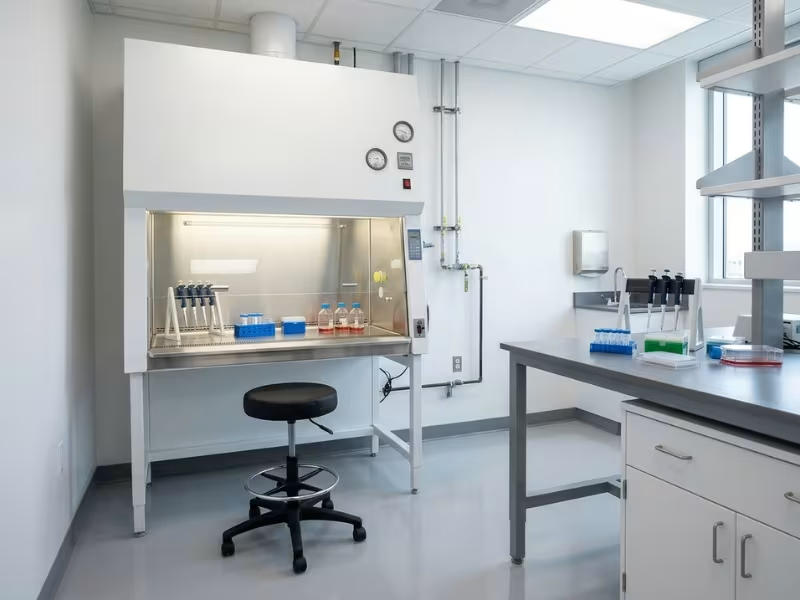
Class II BSCs in One Minute
Before we compare A2 and B2, we need a shared baseline. Every Class II cabinet does the same core job. The real differences come later.
It protects three things at once. A Class II cabinet shields the person at the bench, the sample on the work surface, and the room around it. A chemical fume hood protects only the user. A clean bench protects only the sample. This triple role is why so many biology labs use Class II units.
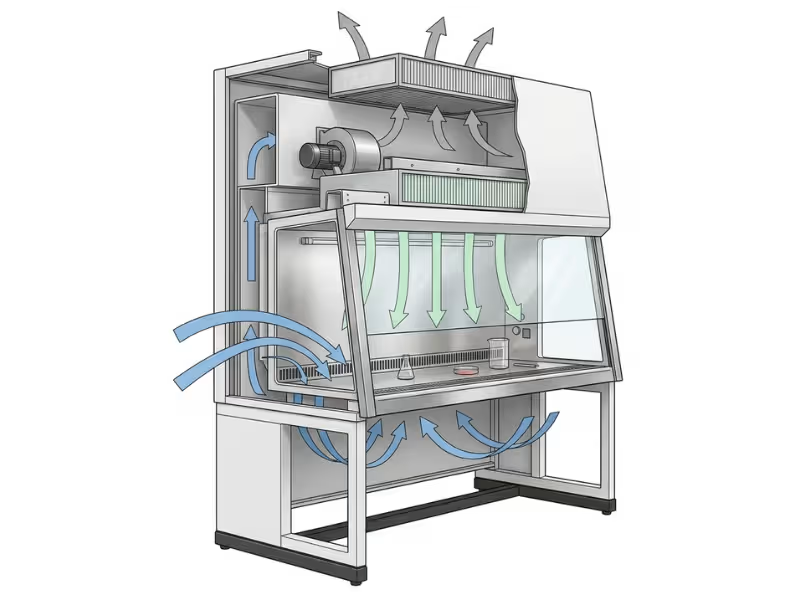
It does that with three airflows.
- Inflow: Room air moves into the front grille at about 100 feet per minute. This air curtain keeps aerosols inside the cabinet and away from your face.
- Downflow: HEPA-filtered air falls straight down across the work zone. It carries particles away from your samples and cuts cross-contamination between them.
- Exhaust: Air passes through a second HEPA filter before it leaves the cabinet. Only filtered air reaches the room or the building duct.
If even one airflow drifts out of balance, protection drops. That’s why certifiers test all three at every visit.
It comes in several types. NSF/ANSI 49 lists A1, A2, B1, B2, and C1. When labs actually buy, most end up comparing just two: A2 and B2. The others rarely make the shortlist, so this guide sets them aside.
The difference between A2 and B2 comes down to where the exhaust air goes.
The One Difference That Changes Everything: Recirculated Air vs 100% Exhaust
Most comparisons list A2 and B2 specs side by side. I start with one question instead: where does the air go after it leaves the work zone? Answer that, and the rest of this guide makes sense.
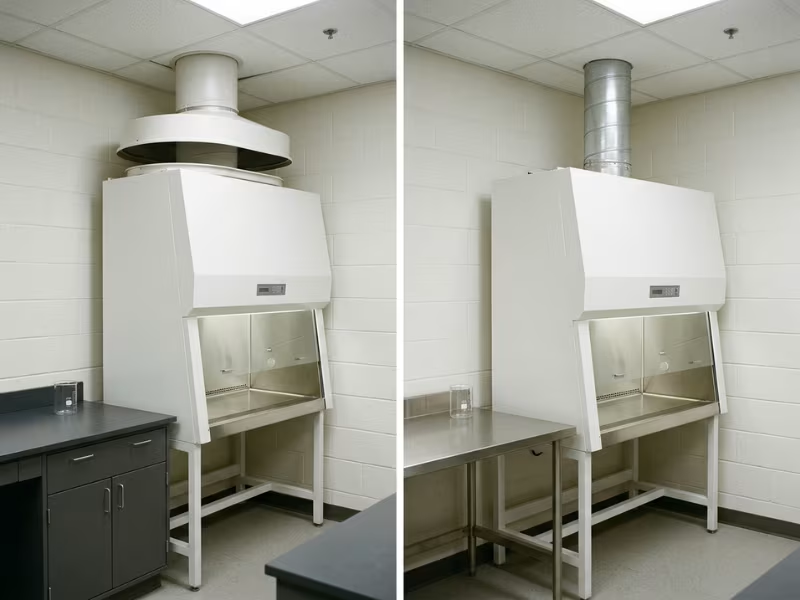
A Type A2 reuses most of its air. About 70% of the air goes back into the cabinet as HEPA-filtered downflow. The other 30% exits through the exhaust HEPA filter. That exhaust can return to the room, or it can leave through a canopy (thimble) connection to the building exhaust. The canopy leaves a small air gap, so the cabinet does not depend completely on the building fan.
A Type B2 reuses none of its air. It pulls all inflow and downflow air through the work zone and sends 100% of it outside. A sealed hard duct carries that air to a dedicated exhaust fan. Nothing recirculates.
That single split creates six practical differences:
- Chemical limits. HEPA filters trap particles, not vapors. In an A2, any volatile chemical you release travels back into the work zone with the recirculated air. A B2 removes vapors on the first pass.
- Ductwork. An A2 can run with no duct at all. A B2 always needs a sealed duct, a dedicated fan, and space to run it to the roof.
- HVAC load. A B2 throws away a large volume of heated or cooled room air every minute. Your HVAC system must replace all of it with make-up air.
- Energy use. Conditioning that replacement air runs all day. That cost often outweighs the price of the cabinet over its lifetime.
- Maintenance. A B2 adds fans, dampers, airflow monitors, and interlocks that all need testing and service.
- Downtime risk. If building exhaust fails, a canopy-connected A2 alarms but can still contain the work safely. A B2 must stop work immediately.
Keep this split in mind as you read on. Every recommendation that follows traces back to it.
What a Type A2 Cabinet Is Best For
Walk into most biology labs, and you’ll find an A2 at the bench. It handles the most common work with the fewest building demands. It also has firm limits, so know them before you order.
How an A2 Handles Air
An A2 sends about 70% of its HEPA-filtered air back down as downflow. The other 30% leaves through a second HEPA filter. Inflow at the front grille runs at 100 feet per minute or more.
You can set it up two ways:
- Room exhaust. Filtered air returns to the lab. You need no ductwork, so the cabinet fits almost anywhere with power and clearance.
- Canopy (thimble) connection. A canopy over the exhaust pulls air into the building system through a small air gap. It removes heat and odors. If building exhaust dips, the cabinet alarms but keeps containing your work.
Either way, leave about 12 inches above the cabinet for service. Keep it away from doors, supply vents, and busy walkways. Plan nearby lab benches and workstations at the same time, so the cabinet keeps the clearance and workflow space it needs.
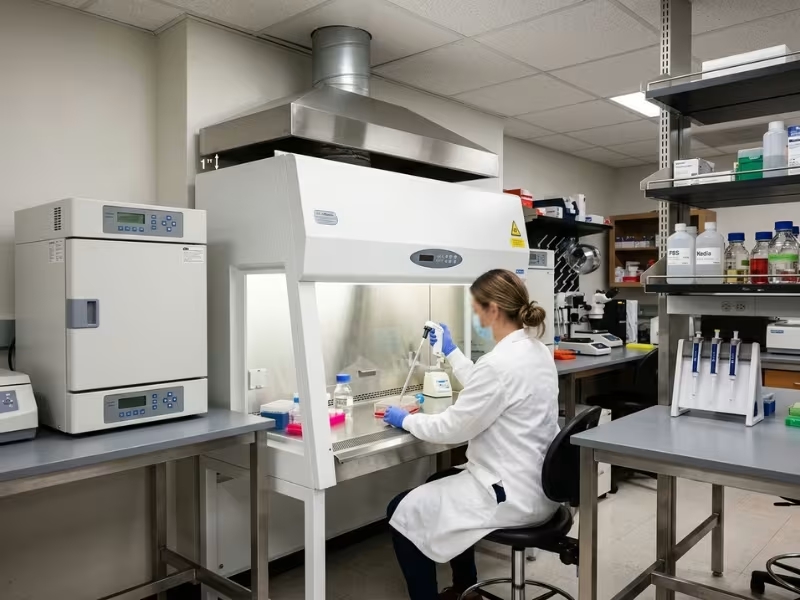
Where an A2 Fits Best
I treat the A2 as the starting point for:
- Cell and tissue culture
- Routine microbiology, such as plating, pipetting, and media prep
- BSL-2 agents, including most clinical samples
- Work with only trace amounts of non-volatile chemicals, such as stains or buffers
For these jobs, an A2 gives you full protection at a lower price and lower energy cost than a B2. It also installs far more simply. That mix of protection and simplicity makes it the default.
Where the A2 Choice Breaks Down
HEPA filters trap particles, not vapors. Because an A2 recirculates air, volatile chemicals can build up inside the work zone and reach your breathing area.
Do not use an A2 for volatile toxic chemicals or radionuclides in any working quantity. A canopy connection may allow minute amounts, but only with written approval from your EHS team. If your protocol regularly uses solvents, volatile drugs, or radioactive tracers, move the discussion to a B2.
What a Type B2 Cabinet Is Best For
A B2 earns its place in a small set of labs. In those labs, nothing else does the job as well. Outside them, it adds cost and risk without adding protection.
How a B2 Handles Air
A B2 never reuses air. It pulls room air through the front grille, filters it, and sends it across the work zone. Then it pushes 100% of that air outside. Any vapor you release leaves on the first pass, so it can’t build up near your face.
This setup ties the cabinet to your building. A sealed hard duct runs from the cabinet to a dedicated exhaust fan, usually on the roof. A 6-foot B2 can pull well over 1,000 cubic feet of air per minute. Your HVAC system must replace every cubic foot with conditioned make-up air.
The building fan now protects the user as much as the cabinet does. If exhaust drops, a B2 can lose containment within seconds. That’s why it needs an exhaust alarm and an interlock that shuts down the cabinet blower.
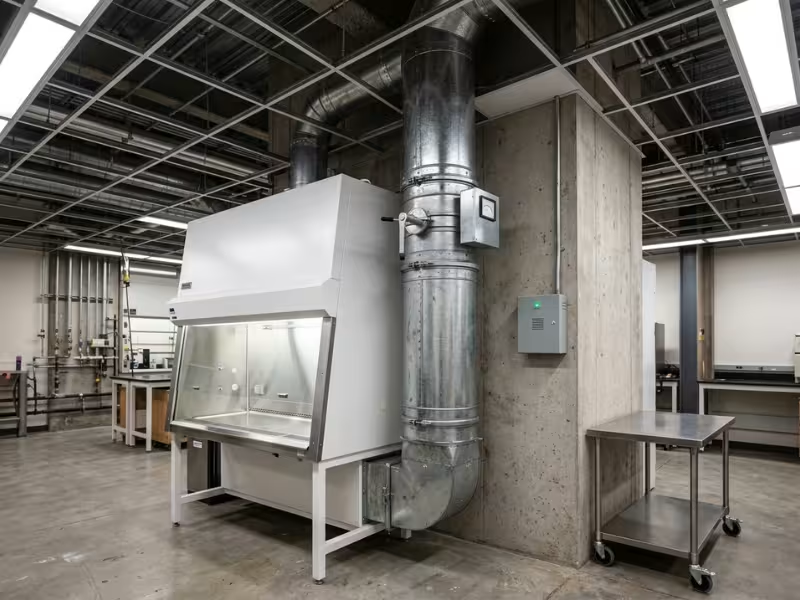
Where a B2 Makes Sense
I recommend a B2 when a protocol regularly combines biological agents with:
- Volatile toxic chemicals, such as solvents or fixatives used in working amounts
- Volatile radionuclides, such as radioiodine tracers
- Hazardous drug compounding, where USP <800> requires external venting. Many oncology pharmacies choose a B2, especially when they handle volatile drugs.
Why a B2 Is Not an Automatic Upgrade
Buyers often see B2 as the premium version of an A2. It isn’t. It’s a specialized tool.
For cell culture or routine BSL-2 work, a B2 gives you the same biological protection as an A2. You still pay more for the cabinet, the ductwork, and the energy every month. A B2 is also more sensitive to swings in building pressure, and it stops work every time exhaust fails.
Choose a B2 because your chemistry demands it, not because it sounds safer.
A2 vs B2: Side-by-Side Comparison
You already know the core split: an A2 recirculates air, and a B2 exhausts all of it. Here I put the two cabinets next to each other on the four points that decide most purchases. Read them in order, because each one builds on the last.
Airflow and Exhaust Design
Both cabinets pull room air through the front grille at 100 feet per minute or more. Both push HEPA-filtered downflow across the work zone. What happens next sets them apart.
An A2 sends about 70% of its air back into the cabinet and exhausts about 30% through a HEPA filter. That exhaust can return to the room, or it can enter the building system through a canopy (thimble) connection. The canopy leaves a small open gap, so the cabinet’s own blower still controls airflow.
A B2 sends 100% of its air out through a sealed hard duct. The cabinet has no open gap, and the building’s exhaust fan does much of the work.
In practice, an A2 behaves like a self-contained instrument. A B2 behaves like part of the building. When I walk a site with a client, that difference tells me right away how much planning each option needs.
Chemical and Hazard Compatibility
HEPA filters stop particles. They do not stop vapors. Every chemical decision comes back to that fact.
In an A2, vapors ride the recirculated air back into the work zone. That makes it fine for trace amounts of non-volatile chemicals, such as stains, buffers, and dilute disinfectants. With a canopy connection, CDC/NIH guidance allows minute amounts of volatile chemicals or tracer radionuclides, as long as they don’t affect the work. I always ask clients to get that “minute amount” in writing from EHS.
A B2 removes vapors on the first pass, so they never build up near the user. That’s why labs choose it for volatile toxic chemicals, volatile radionuclides, and many hazardous drugs. Keep one limit in mind for both types: neither cabinet suits flammable vapors near explosive levels. Their motors and lights are not explosion-proof.
Facility and HVAC Requirements
This is where many B2 projects stall.
An A2 needs power, clearance, and a good spot in the room. A canopy-connected A2 also needs a modest exhaust line and an alarm for low airflow. Many existing labs can support one with little or no building work.
A B2 needs a dedicated exhaust fan, usually on the roof, plus a sealed duct route to reach it. A 6-foot unit often exhausts well over 1,000 CFM, and your HVAC system must supply the same volume as conditioned make-up air. You also need an exhaust alarm and an interlock that shuts down the cabinet blower if exhaust fails. Without it, the cabinet can push contaminated air into the room. The building must also hold steady pressure, because door swings and wind can upset a B2’s balance.
Energy, Maintenance, and Downtime
An A2 has the lower operating cost. It exhausts less air, and a room-exhaust model adds almost no HVAC load. Annual certification is fairly simple: the certifier tests inflow, downflow, filter integrity, and alarms.
A B2 costs more every hour it runs. Heating or cooling that make-up air can add thousands of dollars per year, depending on your climate. Certification takes longer, because the certifier must also verify duct airflow, the alarm, and the interlock. You also maintain the roof fan, dampers, and controls, often with facilities staff.
The biggest gap shows up when exhaust fails. A canopy-connected A2 alarms, but it keeps containing the work, so you can finish and close down safely. A B2 must stop work immediately, and it stays down until the building fan comes back. If your exhaust system has a history of outages, factor that into your decision.
Quick Comparison Table
|
Factor |
Type A2 |
Type B2 |
|---|---|---|
|
Air recirculated |
About 70% |
None |
|
Air exhausted |
About 30% |
100% |
|
Exhaust connection |
Room exhaust or canopy (thimble) |
Sealed hard duct |
|
Volatile toxic chemicals |
Minute amounts only, canopy-connected, with EHS approval |
Suitable in working amounts |
|
Radionuclides |
Tracer amounts only, canopy-connected |
Suitable for volatile radionuclides |
|
Dedicated exhaust fan |
Not required |
Required |
|
Make-up air demand |
Low |
High (often 1,000+ CFM for a 6-ft unit) |
|
Alarm and interlock |
Alarm for canopy models |
Alarm and blower interlock required |
|
Operating cost |
Lower |
Much higher |
|
Certification |
Standard annual tests |
Annual tests plus duct, alarm, and interlock checks |
|
If building exhaust fails |
Alarms, but still contains the work |
Stop work at once |
|
Best fit |
Cell culture, microbiology, BSL-2 samples |
Bio work mixed with volatile chemicals, radionuclides, or hazardous drugs |
Use this table as a screening tool. If your work sits in the A2 column on every row, a B2 only adds cost.
Which Type Fits Which Lab Scenario?
Specs only take you so far. The real answer depends on what your team does at the bench each day. Here are five situations I see often and how I usually guide each one.
Academic Microbiology or Tissue Culture Lab
This is classic A2 territory. Your team passages cells, plates bacteria, and preps media. The main hazard is biological, and the chemicals are mostly buffers, stains, and 70% ethanol in small amounts.
An A2 covers all of that. It installs without ductwork and costs less to run. It also keeps working when the building exhaust has a bad day. Most universities buy A2s by the dozen for this reason. A B2 here adds cost, not protection.
Clinical or Hospital Lab Handling Biological Samples
For routine BSL-2 work, an A2 is usually enough. That includes blood, urine, swabs, and most cultures.
Dig deeper in three cases:
- Your team handles suspected TB or other BSL-3 agents. The cabinet type matters less than the room, practices, and containment level. Involve your biosafety officer early.
- Staff use fixatives or solvents inside the cabinet. Move that step to a fume hood if you can.
- Your institution has stricter internal rules. Some hospitals require canopy-connected A2s for every unit.
Ask these questions before you assume a standard A2 fits.
Hazardous Drug Compounding or Oncology Pharmacy
Here, the discussion often moves past a basic A2. USP <800> requires the primary engineering control to be externally vented. That rules out a room-exhaust A2 from the start.
Pharmacies then compare a canopy-connected A2, a B2, or a compounding aseptic containment isolator (CACI). Many oncology pharmacies lean toward a B2 when they handle volatile drugs. Your state board, the pharmacy’s drug list, and your cleanroom design all shape the final pick. I always ask for the full hazardous drug list before I suggest anything.
In pharmacy and cleanroom projects, review the cabinet together with the surrounding stainless steel laboratory furniture for pharmaceutical labs. That way, the full workspace supports cleaning, workflow, and compliance.
Work With Volatile Toxic Chemicals or Radionuclides
This is where a B2 becomes your primary candidate. Think of protocols that use working amounts of solvents or volatile fixatives. Radioiodine labeling is another common example.
An A2 sends vapors back into the work zone. A B2 removes them on the first pass. If your protocol needs both biological containment and real chemical volumes, a B2 is often the only Class II option that fits. Confirm the exact chemicals and quantities with EHS first.
Existing Lab Retrofit With Limited Exhaust Capacity
Here, wanting a B2 and installing one are two different things. A 6-foot B2 can pull well over 1,000 CFM. Many older buildings can’t spare that air or replace it with conditioned make-up air. They may also lack a route for a sealed duct to the roof.
Before you commit, ask your facility engineer three questions:
- Is there spare exhaust capacity, or does this need a new roof fan?
- Can the HVAC system supply matching make-up air all year?
- Can the building hold steady pressure?
If the answers come back “no,” look at other paths. You can move volatile steps to a fume hood or reduce chemical use. A canopy-connected A2 may also work with EHS approval. Choose the cabinet your building can support safely, not the one that looks best on paper.
How to Choose: A Practical Decision Framework
When a lab asks me “A2 or B2?”, I don’t answer right away. I walk them through five steps in a set order. Each step removes guesswork, and by the end the right cabinet usually picks itself.
Step 1: Define Exactly What Your Team Will Handle
Start with the protocol, not the catalog. List every material that will enter the cabinet, then sort it into one of four groups:
- Biologicals only
- Biologicals with trace non-volatile chemicals
- Biologicals with volatile toxic chemicals
- Work with radionuclides
Write down quantities too. “A little solvent” means nothing to a certifier. “5 mL of xylene per run, three times a week” tells them everything. If your list stays in the first two groups, you are almost certainly looking at an A2. If it reaches the last two, a B2 belongs on the table.
Step 2: Check What Your Building Can Actually Support
Many teams fall in love with a B2 before anyone looks at the roof. Don’t assume your facility can run one. Ask your facility engineer for hard numbers:
- How much spare exhaust capacity does the building have?
- Can the HVAC system supply over 1,000 CFM of conditioned make-up air all year, in summer heat and winter cold?
- Is there a clear route for a sealed duct to a dedicated fan?
- Will room pressure stay steady when doors open?
If any answer is “no” or “not sure,” you need to plan a building project, not just a cabinet purchase.
Step 3: Compare Total Ownership Cost, Not the Cabinet Price
The sticker price is the smallest number you’ll see. I ask clients to build a simple 10-year cost sheet with six lines:
- Cabinet price
- Installation and ductwork
- Energy for exhaust and make-up air
- Annual certification
- Routine maintenance
- The cost of downtime
That last line often surprises people. A B2 stops work every time building exhaust fails. If your team runs long cell cultures or time-sensitive drug compounding, each outage costs real money. When you add it all up, a B2 often costs several times more than an A2 over its lifetime.
Step 4: Confirm the Standards and Rules That Apply to You
Make sure any cabinet you consider carries NSF/ANSI 49 certification, and that a qualified field certifier can test it on site. Then check the guidance that fits your work:
- CDC/NIH biosafety manual: sets limits on chemical and radionuclide use in each cabinet type.
- USP <800>: requires external venting for hazardous drug compounding in pharmacies.
- Institutional policies: some universities and hospitals ban room-exhaust A2s entirely, while others require radiation safety approval for any isotope work.
Internal rules can rule out an option faster than any standard.
Step 5: Review the Decision With EHS and Facility Engineering Before You Buy
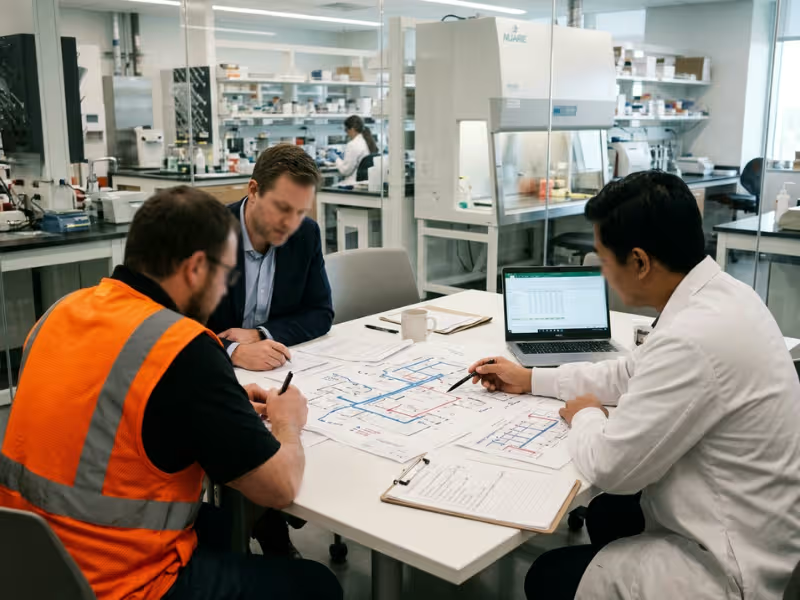
Put your material list, building data, cost sheet, and compliance notes in one short document. Cabinet selection should not happen in isolation, so include how the unit fits your broader laboratory furniture plan, including layout, utilities, and service access.
Then sit down with your EHS officer and facility engineer together. EHS confirms the hazard limits. Facilities confirm the building can deliver. I also like to invite the certifier who will test the unit, because they often spot installation problems early. Get sign-off from all of them in writing.
This meeting takes an hour. Skipping it can cost you a cabinet that sits idle, fails certification, or forces a rushed retrofit. Make the call as a team, and you’ll buy the cabinet your work and your building can both support.
Common Mistakes and Misunderstandings
Most bad BSC purchases start with a belief that sounds reasonable. I hear the same five in almost every project. Here is each one, along with the correction I give clients.
“B2 must be safer, so it must be better.”
A B2 removes vapors better. It does not protect you better from biological agents. For cell culture or routine BSL-2 work, an A2 and a B2 give the same biological protection. A B2 also adds a new risk, because it loses containment fast when building exhaust drops. Choose a B2 for your chemistry, not for peace of mind.
“If a little chemical use is possible, A2 should be fine for anything.”
“A little” needs a real number. An A2 handles trace amounts of non-volatile chemicals, like stains and buffers. Volatile chemicals tell a different story. An A2 recirculates its air, so vapors build up in the work zone. Even a canopy-connected A2 allows only minute amounts, and only with EHS approval. Write down the exact chemical, volume, and frequency. Then check that list against your cabinet’s limits.
“We can decide on the cabinet first and figure out exhaust later.”
This mistake costs labs the most. A team orders a B2, then learns the roof has no spare fan capacity. Or the HVAC system can’t supply enough make-up air. The cabinet then sits in its crate for months while facilities scrambles. Ask your facility engineer for exhaust and make-up air numbers before you request a single quote.
“Purchase price is the main cost.”
The cabinet price is often the smallest line on the bill. Ductwork, a dedicated fan, conditioned make-up air, and longer certification visits all add up. So does lost work every time exhaust fails. Over 10 years, a B2 can cost several times more than an A2. Compare total ownership cost, line by line, before you compare sticker prices.
“Any Class II cabinet will satisfy the same operational need.”
Class II covers several types, and you can’t swap them freely. A room-exhaust A2 can’t meet USP <800> external venting rules for hazardous drugs. A B2 may not run safely in a building with weak exhaust. Some institutions ban certain types outright. Match the cabinet to your materials first, your building second, and your rules third.
One habit prevents all five mistakes. Put your material list and building data on paper before you look at any cabinet.
Questions to Answer Before Requesting Quotes
Suppliers can only quote what you show them. Answer these six questions first, and your quotes will come back accurate and easy to compare.
- What materials will your team handle? List every agent, sample type, and chemical, with volumes and how often you use them. Note the biosafety level for each agent.
- Will any volatile toxic chemicals or radionuclides enter the cabinet? A clear “yes” puts a B2 on the table. A clear “no” usually points you to an A2.
- Do you have dedicated exhaust? Ask your facility engineer for spare exhaust capacity, make-up air volume, and a sealed duct route. Get those numbers in writing.
- Who will certify and maintain the unit? Confirm that a qualified NSF field certifier serves your area. Decide who will service the roof fan, alarm, and interlock if you choose a B2.
- What limits does the room set? Measure door widths, ceiling height, and service clearance above the cabinet. Check the power supply, and note any supply vents, doors, or busy walkways nearby.
- Which rules apply? Check NSF/ANSI 49, CDC/NIH guidance, USP <800> if you compound hazardous drugs, and your institution’s own policies.
Send the same answers to every supplier. If a supplier can’t answer clearly against your list, cross them off.
Class II BSC FAQ
These are the questions labs ask me most when they weigh an A2 against a B2.
What is the main difference between A2 and B2 BSCs?
The difference is where the air goes. An A2 recirculates about 70% of its HEPA-filtered air and exhausts about 30%, either into the room or through a canopy (thimble) connection. A B2 recirculates nothing. It sends 100% of its air outside through a sealed hard duct to a dedicated fan. That single difference drives chemical limits, building needs, and total cost.
Can a Type A2 cabinet be used with chemicals?
Yes, within limits. An A2 handles trace amounts of non-volatile chemicals, such as stains, buffers, and dilute disinfectants. Volatile chemicals are a different story. HEPA filters don’t trap vapors, so vapors recirculate into the work zone.
A canopy-connected A2 may allow minute amounts of volatile chemicals or tracer radionuclides. Get EHS approval in writing first. For working volumes of solvents, consider a B2 or move that step to a fume hood.
Does a B2 cabinet require dedicated exhaust?
Yes. A B2 needs a sealed hard duct, a dedicated exhaust fan, and an exhaust alarm with a blower interlock. A 6-foot unit often pulls more than 1,000 CFM. Your HVAC system must replace that air with conditioned make-up air. Shared or undersized exhaust can’t hold containment. Confirm capacity with your facility engineer before you request quotes.
Is B2 always safer than A2?
No. For biological agents alone, both types give the same protection to people, samples, and the room. A B2 only adds value when your work releases volatile toxic chemicals or radionuclides.
A B2 also brings its own risk. If building exhaust fails, it can lose containment within seconds. A canopy-connected A2 sounds an alarm but keeps containing the work. Real safety comes from matching the cabinet to the hazard.
Which type is more expensive to operate?
The B2 costs much more to run. It exhausts all of its conditioned air, so your HVAC system must heat or cool every cubic foot it replaces. Depending on your climate, that can add thousands of dollars per cabinet each year. Roof fan service, longer certification visits, and downtime during exhaust outages add more. Over 10 years, a B2 often costs several times more than an A2.
How often does a Class II BSC need certification?
NSF/ANSI 49 calls for field certification at installation and at least once a year after that. You also need to recertify after you move the cabinet, replace a HEPA filter, or finish major repairs.
A qualified field certifier tests inflow, downflow, filter integrity, and alarms. For a B2, the certifier also checks duct airflow and the interlock. Some institutions require testing every six months, so confirm your internal policy before you set the schedule.
Match the Cabinet to Your Work and Your Building
The right biosafety cabinet doesn’t come from a catalog or a hunch. It comes from two facts: what your team puts inside it, and what your building’s exhaust can actually support. When both point to the same cabinet, you’ve found your answer. When they don’t, fix the gap before you buy.
Your next move is simple. Bring your material list and your exhaust capacity numbers to one meeting. Invite your EHS officer, your facility engineer, and your certifier. Let them check your choice against real hazards and real airflow.
One hour at that table can save you months of delays and a cabinet that never passes certification.
