Storing chemicals correctly starts with one question: what classification does this material fall under? Flash point determines cabinet type, cabinet type determines compliance, and compliance determines whether your facility is prepared for an inspection—or an incident.
This guide is written for procurement managers, EHS teams, and lab planners who need to match chemicals to the right storage solution. It covers classification logic, cabinet specifications, segregation rules, common procurement mistakes, and how to build a defensible storage strategy from the ground up.
What Is the Difference Between Flammable and Non-Flammable Storage?
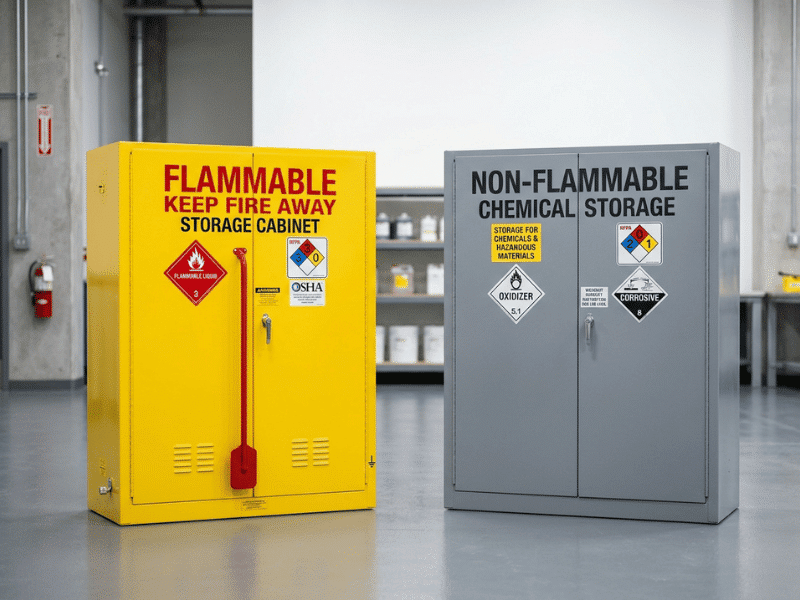
Flammable storage is purpose-built to contain ignition risk. Flammable storage cabinets use fire-rated construction, self-closing doors, and grounding provisions to limit the spread of fire if ignition occurs inside or near the cabinet. Non-flammable storage—standard shelving, general chemical cabinets—provides containment and organization, but it is not rated for fire resistance and is not designed to protect volatile materials.
The practical difference: placing a flammable liquid in a standard cabinet may satisfy a visual audit but will not meet fire code in most jurisdictions. The cabinet selection decision has real consequences.
Flash Point Classifications: Flammable vs. Combustible vs. Non-Flammable
Flash point is the temperature at which a liquid produces enough vapor to ignite momentarily when exposed to an ignition source. It is the primary classification variable used by OSHA (29 CFR 1910.106) and NFPA 30 to determine storage requirements.
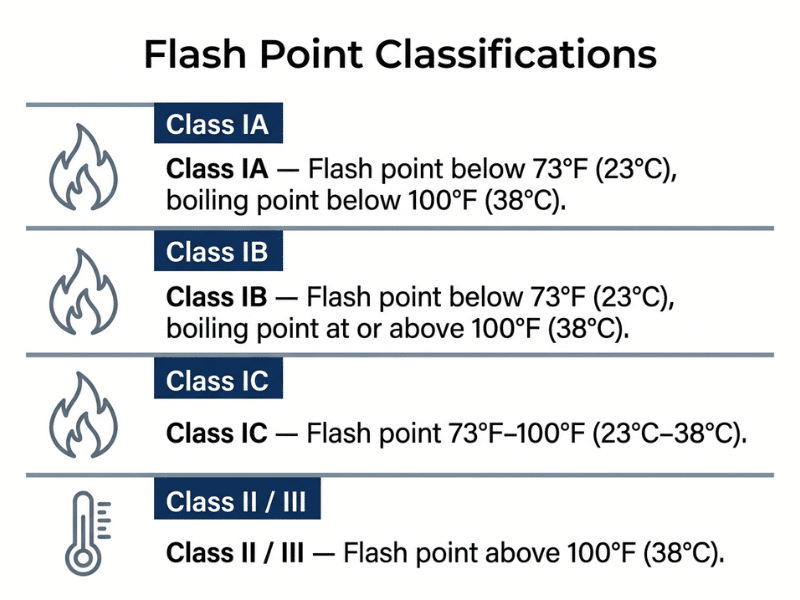
Flammable liquids have a flash point below 100°F (37.8°C) and are divided into three subclasses:
- Class IA: Flash point below 73°F (22.8°C), boiling point below 100°F (37.8°C). Examples: diethyl ether, pentane.
- Class IB: Flash point below 73°F (22.8°C), boiling point at or above 100°F (37.8°C). Examples: acetone, gasoline, toluene.
- Class IC: Flash point at or above 73°F (22.8°C) but below 100°F (37.8°C). Examples: turpentine, isobutyl alcohol.
Combustible liquids have a flash point at or above 100°F (37.8°C) and are generally divided into Class II and Class IIIA/IIIB. Examples include diesel fuel, mineral spirits, and certain lubricating oils. Combustible liquids present lower immediate ignition risk than flammable liquids, though storage controls for combustible liquids often overlap with those for flammable liquids depending on quantity, facility type, and the authority having jurisdiction (AHJ) in your region. Do not assume combustible liquids are unregulated—verify requirements with your local code or AHJ.
Non-flammable materials do not ignite under standard conditions. Common examples include water-based solutions, many inorganic acids (in dilute form), and materials like glass or ceramics. However, some non-flammable materials are corrosive, oxidizing, or otherwise hazardous—they require specialized storage for reasons unrelated to fire risk.
Common Examples of Flammable, Combustible, and Non-Flammable Materials
|
Classification |
Common Examples |
|---|---|
|
Flammable (Class IA–IC) |
Acetone, ethanol, methanol, diethyl ether, isopropyl alcohol, toluene, xylene |
|
Combustible (Class II–III) |
Diesel fuel, kerosene, linseed oil, mineral spirits |
|
Corrosive / Non-flammable |
Hydrochloric acid, sulfuric acid (concentrated), sodium hydroxide, hydrogen peroxide |
|
Oxidizing |
Potassium permanganate, nitric acid, hydrogen peroxide (>30%) |
|
Non-hazardous |
Water-based buffers, saline solutions, glass, ceramics |
Note: classification can shift based on concentration. Hydrogen peroxide at 3% behaves very differently from hydrogen peroxide at 70%. Always confirm classification against the Safety Data Sheet (SDS).
When Is a Flammable Storage Cabinet Required?
The short answer: when the quantity and type of flammable liquids stored in a work area exceed the limits set by applicable codes. NFPA 30 and OSHA 29 CFR 1910.106 both establish quantity thresholds for flammable liquid storage outside of approved storage rooms, and exceeding those thresholds commonly triggers a requirement for listed flammable storage cabinets.
The thresholds themselves vary by liquid class, facility type, and jurisdiction. Some building codes and local fire authorities impose stricter requirements than the federal baseline. The practical guidance: if your facility stores any quantity of Class I flammable liquids in a work area—even for daily use—consult your SDS documentation, review applicable local codes, and confirm requirements with your AHJ before selecting cabinets.
A few situations that commonly trigger flammable cabinet requirements:
- Research and teaching laboratories with multiple flammable solvents in simultaneous use
- Manufacturing or QC areas where flammable cleaning agents are stored near ignition sources
- Facilities subject to periodic fire safety inspections under local or national fire codes
- Projects requiring documented compliance as part of building permit or insurance conditions
What Makes a Flammable Storage Cabinet Compliant?
Flammable storage cabinets referenced in OSHA and NFPA standards are typically required to meet FM Approvals (Factory Mutual) or UL 1275 listing criteria, or be constructed to equivalent specifications. Key construction requirements commonly specified include:
- Fire resistance: Double-wall steel construction with at least a 1-inch air gap between walls. The cabinet must be capable of withstanding a standardized fire test without allowing internal temperature to exceed specified limits.
- Self-closing doors: Doors fitted with a fusible-link or spring-loaded mechanism that closes automatically in the event of fire.
- Liquid-tight sump: A raised sill or integral sump at the base, typically with a minimum 2-inch depth, to contain spills.
- Grounding provision: A grounding connector to dissipate static electricity during dispensing operations.
- Warning label: Labeling indicating “Flammable — Keep Fire Away.”
- Vent openings: Two vent openings (top and bottom) that are factory-sealed with bungs. If venting is connected to a mechanical exhaust system, this must be done according to applicable standards.
Cabinets are commonly available in 12, 30, 45, and 60-gallon capacities. The appropriate size depends on maximum storage quantity, available floor space, and whether the cabinet is supplementing a larger approved storage room.
Cabinet Type Comparison: Which Cabinet for Which Chemical?
Different hazard classes require fundamentally different cabinet designs. Selecting the wrong cabinet type is a common and costly error.
|
Cabinet Type |
Target Hazard |
Key Construction Features |
|---|---|---|
|
Flammable storage cabinet |
Class I–III flammable and combustible liquids |
Double-wall steel, self-closing door, fusible link, grounded sump, FM/UL listed |
|
Corrosive / acid cabinet |
Acids, bases, and corrosive chemicals |
Polyethylene or coated steel interior, corrosion-resistant shelving, vented or non-vented depending on application |
|
Oxidizer cabinet |
Oxidizing agents (nitric acid, peroxides, permanganates) |
Physically separated from flammables; some jurisdictions require dedicated cabinets |
|
Pesticide storage cabinet |
Pesticides, herbicides, and related agrochemicals |
Lockable, corrosion-resistant interior, spill containment, often regulatory-labeled |
A corrosive cabinet is not a substitute for a flammable cabinet. A flammable cabinet is not safe for concentrated oxidizers. Each classification requires a cabinet matched to its specific hazard profile.
For corrosive cabinets specifically: ventilation requirements are application-dependent. Cabinets storing volatile corrosives (e.g., concentrated hydrochloric acid, ammonium hydroxide) typically require vented units connected to building exhaust. For non-volatile corrosives, unvented cabinets may be acceptable. Verify with your facility’s ventilation engineer and applicable codes.
Can Flammable and Non-Flammable Materials Be Stored Together?
Generally, no—at least not in the same cabinet. Whether co-location in the same room is permissible depends on the specific chemicals involved and the applicable codes for your facility type. The broader principle is chemical segregation: incompatible materials must be separated to prevent reactions that could cause fire, explosion, or toxic release.
Storing flammable liquids in a standard general-purpose cabinet—even a metal one—does not provide the fire containment that a listed flammable storage cabinet delivers. The fire rating, the self-closing door, and the sump are functional safety features, not formalities. Mixing flammable liquids with standard storage increases ignition risk and typically disqualifies the installation from compliance.
Chemical Segregation Rules for Incompatible Materials
Chemical segregation is not optional—it is a core element of chemical storage compliance and risk management. The SDS for each chemical lists incompatibilities under Section 7 (Handling and Storage) and Section 10 (Reactivity).
General segregation principles:
- Flammables away from oxidizers: Oxidizing agents accelerate combustion. Storing nitric acid, hydrogen peroxide, or potassium permanganate adjacent to flammable solvents creates a high-risk scenario. These classes require physical separation—ideally separate cabinets in separate locations.
- Acids away from bases: Acid-base mixing generates heat and can produce toxic vapors. Even if neither material is flammable, store them in separate cabinets or on separate shelving units with secondary containment.
- Acids away from flammables: Many organic acids are themselves flammable. Concentrated inorganic acids (e.g., nitric, sulfuric) are corrosive and potentially oxidizing. Either way, store acids in a dedicated acid/corrosive cabinet, not a flammable cabinet.
- Cyanides and sulfides away from acids: Mixing produces toxic hydrogen cyanide or hydrogen sulfide gas. Strict segregation is required.
- Toxics in dedicated, labeled storage: High-acuity toxics should be stored in locked cabinets, separate from general chemical stock.
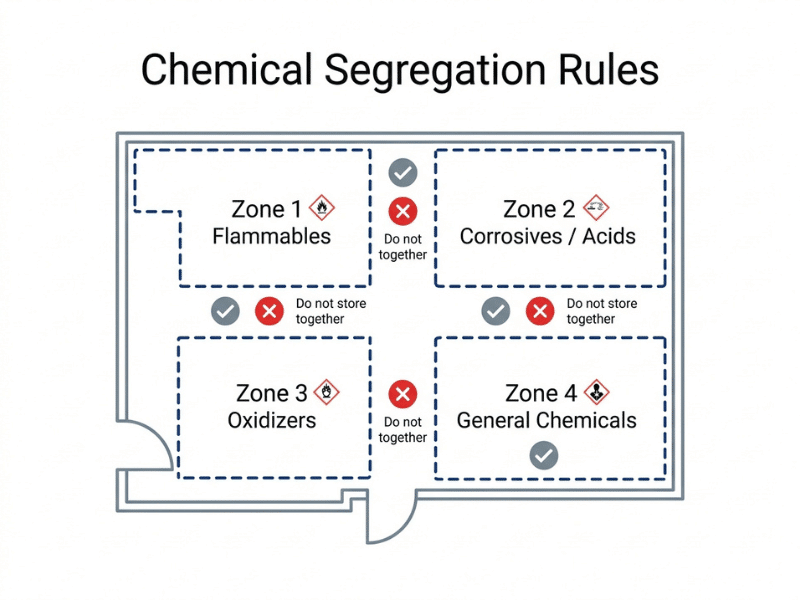
A practical workflow: build your segregation matrix directly from SDS data before procuring cabinets. Map each chemical to its hazard class, then identify incompatible pairings. The cabinet count follows from the segregation map—not the other way around.
Need help mapping your SDS list to cabinet types? Send your chemical inventory to Glorylab and our team will provide a cabinet selection review.
How to Organize a Safe Chemical Storage Area
Physical organization of a chemical storage area follows from the segregation matrix, but there are practical layout principles worth applying regardless of facility size:
1. Designate zones by hazard class. Flammables occupy one zone, corrosives another, oxidizers another. Visual zoning—floor markings, zone labels, color-coded cabinet handles—helps prevent errors during restocking.
2. Store heaviest containers at lower shelf levels. This reduces risk of injury from dropped containers and lowers the center of gravity of stored materials.
3. Minimize quantities in work areas. Only the volume needed for daily or weekly operations should be at the bench. Bulk storage belongs in a designated storage room or external cabinet.
4. Maintain secondary containment. Spill trays under shelving and within cabinets provide a second line of defense. Cabinets with integral sumps satisfy this requirement internally; open shelving requires separate containment trays.
5. Ensure clear egress from storage areas. Storage cabinets must not block emergency exits, emergency showers, or eyewash stations.
6. Post chemical inventory lists. Emergency responders need to know what is stored in each area. A posted inventory or QR-code-accessible SDS binder supports faster incident response.
Common Procurement and Storage Mistakes to Avoid
Even experienced procurement and EHS teams encounter these errors when specifying chemical storage cabinets:
- Selecting cabinet size based on current inventory only. Laboratories grow. A 12-gallon cabinet that fits today’s inventory may be undersized within 12 months. Factor in projected growth when specifying capacity.
- Treating all “safety cabinets” as equivalent. A lockable metal cabinet is not a flammable storage cabinet. A corrosive cabinet is not an oxidizer cabinet. Confirm the listing, the construction standard, and the intended hazard class before purchasing.
- Ignoring ventilation requirements during cabinet placement. Even when a cabinet is technically compliant, poor placement—near ignition sources, in low-airflow areas, or adjacent to incompatible materials—undermines the safety function.
- Assuming the same regulations apply globally. OSHA and NFPA standards apply in the United States. Projects in the EU, Middle East, Australia, or Southeast Asia operate under different frameworks. Specify the applicable standard when requesting a quote from a manufacturer.
- Procuring cabinets without documentation. For compliance audits, insurance reviews, and project handovers, you need test reports, certificates, and conformity declarations. Always request this documentation before finalizing a purchase order.
- Co-locating oxidizers with flammables in the same cabinet or adjacent zone. This combination is explicitly restricted in NFPA 400 and most equivalent international standards.
Inspection and Maintenance Checklist
A flammable storage cabinet that passes installation inspection can degrade over time. Schedule regular inspections using this checklist:
Monthly:
- Self-closing door mechanism functions correctly (test manual release)
- Door seals and gaskets are intact—no gaps or visible deterioration
- Sump is clean and free of accumulated liquid
- Cabinet is properly grounded (check grounding connection)
- Vent bungs are in place (if not vented) or vent ducting is unobstructed (if vented)
- Cabinet contents match the posted inventory
- No incompatible materials have been co-located
Quarterly:
- External cabinet surface inspected for corrosion or physical damage
- Labels and hazard markings are legible and correctly applied
- Cabinet location remains compliant (clearance from ignition sources, egress paths clear)
- SDS documentation is current and accessible
Annually:
- Full cabinet inventory reconciled against SDS records
- Cabinet condition reviewed against original specification
- Compliance documentation on file and accessible
Any deficiency identified during inspection should be corrected before the cabinet is returned to service.
6-Step Decision Framework: Choosing the Right Storage Cabinet
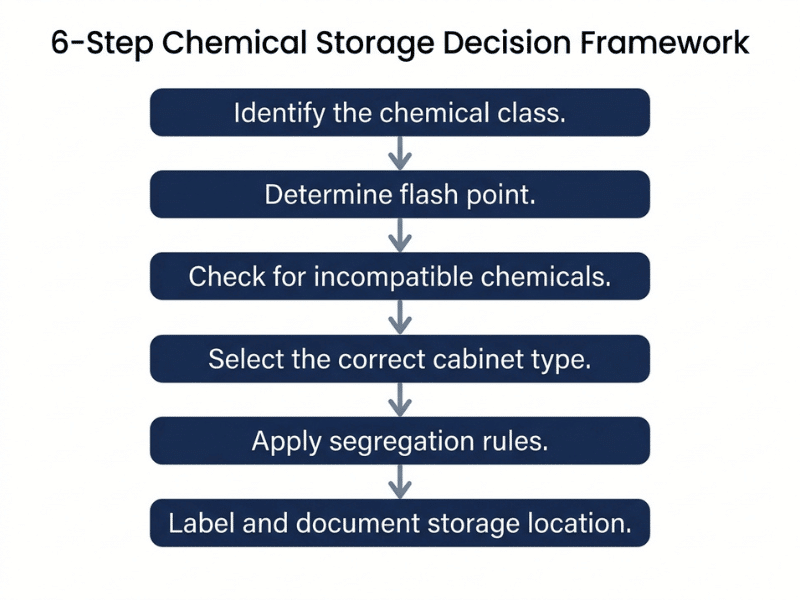
Use this sequence when specifying chemical storage cabinets for a new or existing facility:
Step 1: Collect and review all SDS documents. Identify flash point, hazard class, and incompatibility data for every chemical in scope.
Step 2: Classify each chemical. Sort into flammable (Class I/II/III), corrosive/acid, oxidizer, pesticide/agrochemical, or non-hazardous general storage.
Step 3: Build a segregation matrix. Map incompatible pairings and determine minimum physical separation requirements. This determines the minimum number and type of cabinets required.
Step 4: Determine quantity and capacity requirements. Calculate total storage volume for each chemical class. Select cabinet capacities that accommodate current inventory plus reasonable growth margin.
Step 5: Identify the applicable compliance standard. Confirm whether OSHA/NFPA, EN, AS/NZS, or another regional standard governs the project. Specify the required listing or certification for each cabinet type.
Step 6: Define configuration and documentation requirements. Determine color, locking configuration, ventilation, shelf arrangement, and the documentation package required for compliance, insurance, or project handover.
Ready to get specifications? Submit your SDS list and project details to Glorylab for a cabinet type and quantity recommendation.
How Glorylab Supports Chemical Storage Cabinet Projects
Glorylab manufactures the full range of hazardous chemical storage cabinets at its own facility in Jiangsu Province, China—no subcontracting, no trading company intermediary. Every cabinet is fabricated, surface-treated, and inspected in-house before export.
Flammable Storage Cabinets
Glorylab’s flammable storage cabinets are constructed to double-wall steel specifications with self-closing door mechanisms, fusible links, integral sump trays, and grounding provisions. The flammable cabinet range is CE certified. Available in multiple capacities and color options, with custom dimensions available for non-standard installations.
Corrosive / Acid Cabinets
Corrosive cabinets are available in polyethylene-lined steel and all-PP (polypropylene) construction for high-acid-exposure environments. Shelf material and internal coating are selected based on the specific corrosive chemicals in scope. Vented and non-vented configurations are both available—Glorylab’s team can advise on the appropriate configuration based on your chemical list and room ventilation setup.
Oxidizer Cabinets
Oxidizer storage cabinets are physically distinct from flammable cabinets in construction and color coding. For projects storing both oxidizers and flammables, Glorylab can supply matched sets designed for compliant segregated installation.
Pesticide Storage Cabinets
Pesticide and agrochemical storage cabinets feature lockable construction, corrosion-resistant interiors, and spill containment sumps. These are commonly specified for university agricultural labs, government testing facilities, and industrial hygiene programs.
Custom Configurations
Non-standard dimensions, custom shelf configurations, specific locking mechanisms, and OEM/private-label packaging are all handled as part of Glorylab’s standard manufacturing process—no premium surcharge for customization. Submit technical drawings or a project specification and the team will review fit, materials, and lead time before production begins.
Documentation Support
For procurement and compliance purposes, Glorylab provides test reports, CE certificates (for applicable products), quality management system certification, and export documentation. If your project requires specific documentation formats for handover, confirm this at the inquiry stage.
What to prepare before requesting a quote:
- SDS list for all chemicals requiring dedicated storage
- Quantity (volume) per chemical class
- Applicable compliance standard (OSHA/NFPA, EN, AS/NZS, or other)
- Room dimensions and ventilation details (for corrosive cabinet sizing)
- Cabinet count estimate, or request Glorylab’s team to recommend based on SDS review
- Documentation requirements for project handover or compliance audit
View Glorylab’s lab storage cabinet range | Submit a project inquiry
Make the Right Cabinet Decision Before You Order
Chemical storage cabinet selection is a procurement decision with safety and compliance consequences that persist for the life of the installation. The classification logic covered in this guide—flash point categories, segregation rules, cabinet construction requirements, and inspection protocols—gives EHS teams and procurement managers the framework to specify correctly the first time.
The most common error is treating all safety cabinets as interchangeable. They are not. A flammable cabinet, a corrosive cabinet, and an oxidizer cabinet serve different functions, contain different materials, and are built to different specifications. Getting this right at the procurement stage is significantly less expensive than correcting it after installation.
If you have a chemical storage project in scope—whether a single laboratory or a multi-room facility—Glorylab’s team can review your SDS list and recommend the appropriate cabinet types, quantities, and configurations. Send your project details here and expect a response within 24 hours.
FAQ
What is the difference between a flammable cabinet and a corrosive cabinet?
A flammable storage cabinet is fire-rated, built to double-wall steel construction with self-closing doors and a grounding provision, and is designed to contain flammable liquids with flash points below 100°F. A corrosive cabinet is designed to resist chemical attack from acids, bases, and corrosive substances—typically featuring polyethylene or coated steel interiors. The two cabinet types are not interchangeable and should not be used to store incompatible chemicals.
Can I store combustible liquids in a flammable storage cabinet?
Yes. Flammable storage cabinets are typically used for both flammable (Class I) and combustible (Class II and III) liquids. Whether a cabinet is required for combustible liquids specifically depends on quantity thresholds, facility type, and local code requirements. Verify with your AHJ.
Can I store acids and flammable solvents in the same cabinet?
No. Flammable solvents and corrosive acids must be stored in separate cabinets. Many concentrated acids are oxidizing, which increases fire and reaction risk when co-located with flammable materials. Physical separation—separate cabinets, ideally in separate zones—is the required approach.
What certification should a flammable storage cabinet have?
In the United States, cabinets are commonly specified to FM Approvals or UL 1275 standards. For European and international projects, CE marking is commonly specified. For projects in other regions, the applicable standard depends on local fire codes and the AHJ. Confirm the required certification at the specification stage and request documentation from the manufacturer before purchase.
How do I determine how many cabinets I need?
Start with your SDS inventory. Classify each chemical by hazard class, calculate the total storage volume per class, and build a segregation matrix to identify which chemicals must be physically separated. The number and type of cabinets follow from this analysis. Glorylab can assist with this review if you submit your SDS list.
Does Glorylab manufacture to custom dimensions?
Yes. Custom dimensions, shelf configurations, and material selections are part of Glorylab’s standard manufacturing process. Submit technical drawings or project specifications when requesting a quote.
What documentation does Glorylab provide for chemical storage cabinets?
Glorylab provides CE certificates (for applicable products), SGS test reports, quality management system documentation, and full export documentation for international clearance. Project-specific documentation requirements should be confirmed at the inquiry stage.