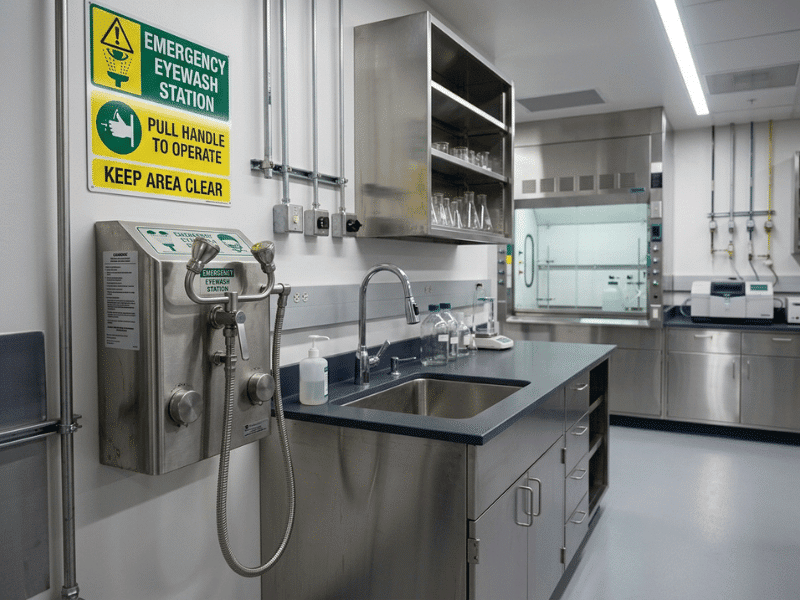
OSHA eyewash station requirements for chemical labs are primarily governed by OSHA 29 CFR 1910.151(c) and the ANSI/ISEA Z358.1 standard. Key requirements include locating eyewash equipment within a 10-second travel time from hazard areas, delivering a continuous tepid water flush, and selecting equipment type based on a site-specific chemical hazard assessment.
Chemical splash injuries happen fast. A corrosive acid or caustic base reaches the eye in a fraction of a second, and the damage accumulates with every second that follows. That’s precisely why eyewash station placement, flow rate, and equipment selection are not afterthoughts in laboratory design — they are foundational safety decisions that need to be addressed before benches and utilities are finalized.
This guide covers the regulatory framework governing eyewash stations in chemical laboratories, explains what each key requirement actually means in practice, and outlines how to select the right equipment type for your specific hazard profile. For labs in the planning or fit-out phase, it also explains how eyewash integration connects directly to bench layout, sink positioning, and plumbing feasibility — areas where Glorylab works alongside procurement teams and contractors from the earliest design stage.
Whether you’re equipping a new build, refurbishing an existing facility, or conducting a compliance audit, this guide gives you a clear, accurate starting point.
What regulatory standards govern eyewash stations in chemical labs?
Two documents form the core compliance framework for eyewash stations in the United States:
OSHA 29 CFR 1910.151(c) requires that employers provide “suitable facilities for quick drenching or flushing of the eyes and body” in workplaces where employees may be exposed to injurious corrosive materials. This is the enforceable OSHA requirement.
ANSI/ISEA Z358.1 — published by the American National Standards Institute and the International Safety Equipment Association — provides the detailed performance specifications that OSHA’s regulation does not. While ANSI/ISEA Z358.1 is a consensus standard rather than a federal regulation, it is widely treated as the practical benchmark for compliance. OSHA regularly cites it in enforcement actions, and most safety professionals, insurers, and AHJs (Authorities Having Jurisdiction) use it as their reference.
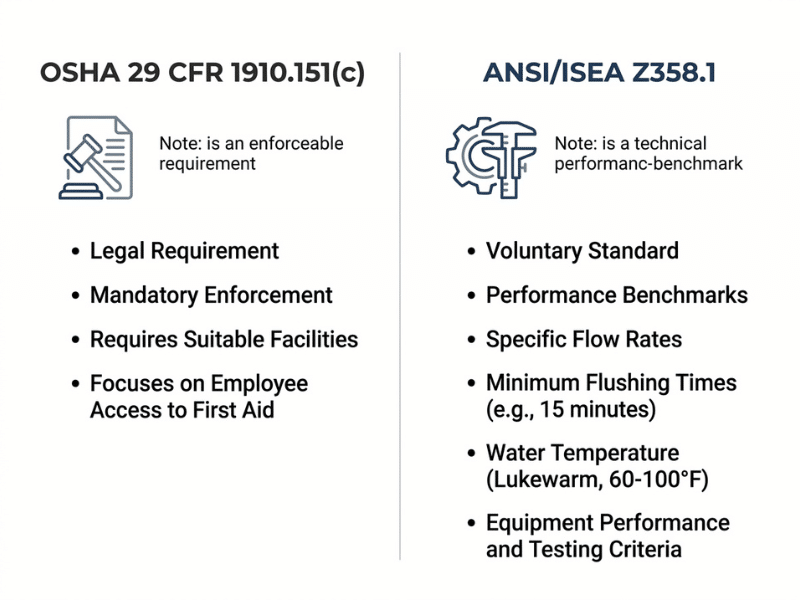
Together, these two documents define the minimum performance expectations for eyewash stations, drench showers, and combination units in chemical laboratory environments.
What is the 10-second travel time rule — and why does it matter more than distance?
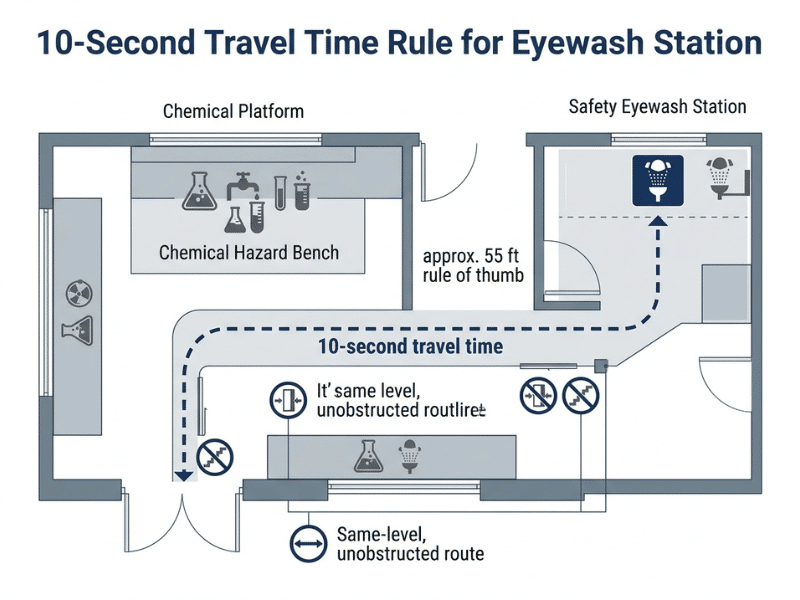
The ANSI/ISEA Z358.1 standard requires that plumbed emergency eyewash and shower equipment be located within a 10-second travel time from the hazard area. This is the governing requirement.
The commonly referenced “55 feet” rule of thumb is a rough approximation based on average walking pace — not a hard regulatory figure. In a real laboratory, the actual distance that can be covered in 10 seconds depends on the floor plan: aisle widths, obstacles, door clearances, and the condition of a person who may be disoriented or partially incapacitated after a chemical splash.
This distinction matters significantly for lab design. A straight aisle in an open-plan facility may allow more than 55 feet of travel distance. A crowded wet lab with narrow aisles between benches might require an eyewash station much closer. The 10-second criterion must be validated against the actual path of travel — not just a straight-line measurement on a floor plan.
Glorylab works with clients during the layout planning phase to assess eyewash placement relative to bench configuration, sink locations, and traffic flow. If you’re reviewing a lab layout or preparing a utilities plan, contact our team to discuss how eyewash positioning integrates with your bench and sink arrangement.
There is one additional proximity rule that applies regardless of travel time: eyewash equipment must be located on the same level as the hazard, with no obstructions — including steps, doors that require two-handed operation, or locked gates — between the hazard and the unit.
What are the flow rate requirements for eyewash stations?
Flow rate requirements under ANSI/ISEA Z358.1 differ by equipment type. Applying a single figure across all units is a common source of confusion.
- Eyewash stations (eye-only): minimum 0.4 GPM (1.5 L/min) for 15 minutes
- Eye/face wash stations: minimum 3.0 GPM (11.4 L/min) for 15 minutes
- Drench showers: minimum 20 GPM (75.7 L/min) for 15 minutes
- Combination units (eye/face wash + drench shower): must meet the respective minimums for each component simultaneously
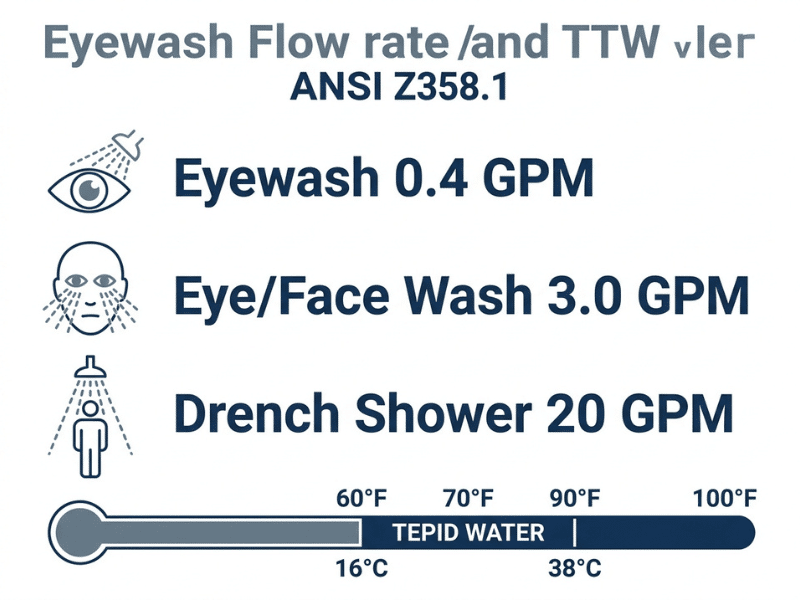
Water temperature must be tepid — generally defined as between 60°F and 100°F (16°C to 38°C). Water that is too cold causes users to stop flushing prematurely; water that is too hot can accelerate chemical absorption. In facilities located in regions with wide temperature variation, a thermostatic mixing valve is often incorporated into the plumbing supply.
How do you select the right eyewash equipment type for a chemical lab?
Equipment selection should be determined by a chemical hazard assessment — not by a default assumption about what constitutes the minimum standard. The right unit for a given location depends on the chemicals present, the concentration and volume in use, the routes of exposure, and the severity of potential contact.
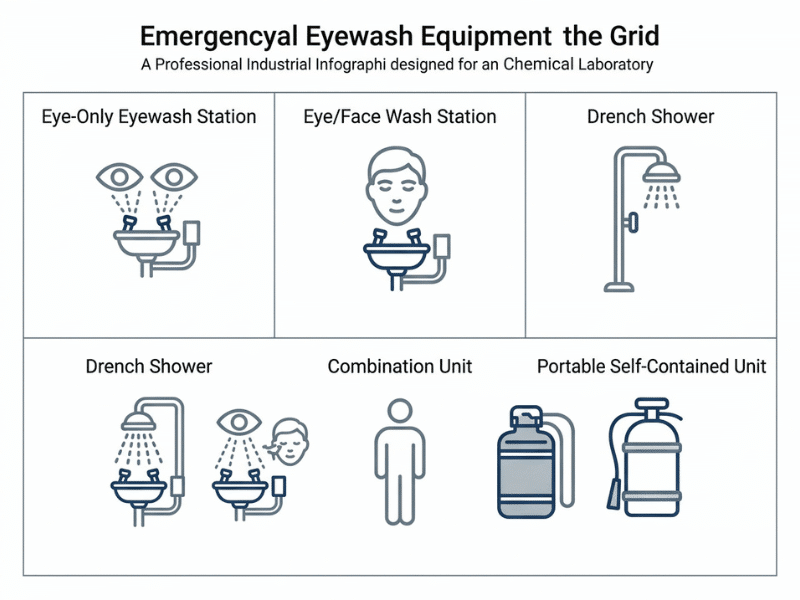
The following matrix outlines the main equipment types and their typical applications:
|
Equipment Type |
Coverage |
Flow Rate (ANSI/ISEA Z358.1) |
Typical Application |
|---|---|---|---|
|
Eye-only eyewash station |
Eyes only |
0.4 GPM for 15 min |
Low-concentration splash risk, secondary position |
|
Eye/face wash station |
Eyes and face |
3.0 GPM for 15 min |
Moderate chemical exposure, general lab benches |
|
Drench shower |
Full body |
20 GPM for 15 min |
High-volume or high-hazard chemical handling |
|
Combination unit (eye/face wash + drench shower) |
Eyes, face, and body |
Both components simultaneously |
Primary emergency station in chemical labs |
|
Portable/self-contained unit |
Eyes and/or face |
Varies by unit |
Temporary setups, remote locations, field use |
A few practical notes on this matrix:
Eye/face wash stations are generally appropriate for standard chemical bench areas where splash exposure primarily affects the face. Selecting eye-only units for concentrated acid or base work may not provide adequate protection and should be evaluated against the hazard profile.
Combination units are commonly specified as the primary emergency equipment in chemical laboratories where full-body exposure is a realistic scenario — for example, where large-volume transfers, overhead chemical handling, or highly corrosive materials are involved.
Portable and self-contained units can serve a legitimate compliance role in temporary setups or areas where plumbing is not feasible. That said, plumbed units are generally preferred in permanent chemical laboratory installations where a continuous, reliable water supply is available. The critical limitation of portable units is their finite water supply, which may not sustain the required 15-minute flush without refilling.
Glorylab supplies deck-mounted, wall-mounted, pedestal-mounted, and combination eyewash configurations. Our team can assist with unit selection based on your chemical hazard profile and help you coordinate the eyewash position with lab sink bench placement and utility supply routing. Submit your lab layout or hazard profile to get started.
What are the installation and maintenance requirements?
Activation: Eyewash units must activate in one second or less using a single, unassisted movement. Valve caps or covers that require removal before activation are not compliant. The valve must remain open — hands-free — for the full 15-minute flush duration.
Signage and lighting: The eyewash station location must be clearly identified with a highly visible sign. The area must be adequately lit so that the unit can be located quickly under emergency conditions.
Clear access: A minimum clearance area around the unit must be maintained at all times. ANSI/ISEA Z358.1 specifies a minimum radius of clear floor space. Storage, equipment, or furniture placed in front of or adjacent to an eyewash station can constitute a compliance violation.
Weekly activation: Plumbed units require weekly activation to flush the supply line, prevent microbial growth (including Legionella), and verify that the unit is operational. This should be documented.
Annual inspection: A formal annual inspection verifying that flow rate, spray pattern, and temperature meet ANSI/ISEA Z358.1 specifications is widely recommended and required by many jurisdictions.
Bowl material: Eyewash bowl material selection — stainless steel versus polypropylene or ABS plastic — should be based on the chemical environment. Stainless steel offers durability and is well suited to general chemical lab environments. Plastic bowls may be appropriate in certain highly corrosive chemical environments where metal degradation is a concern. Neither is universally superior; the selection should be matched to the specific chemicals and concentrations in use.
How does eyewash station placement connect to lab bench and utility planning?
This is where many procurement processes fall short. Eyewash stations are frequently specified in isolation — selected from a safety equipment catalog and ordered separately from the lab furniture package. The result is often a mismatch between the unit’s plumbing requirements and what has already been built into the bench or wall.
Effective eyewash integration requires coordination across:
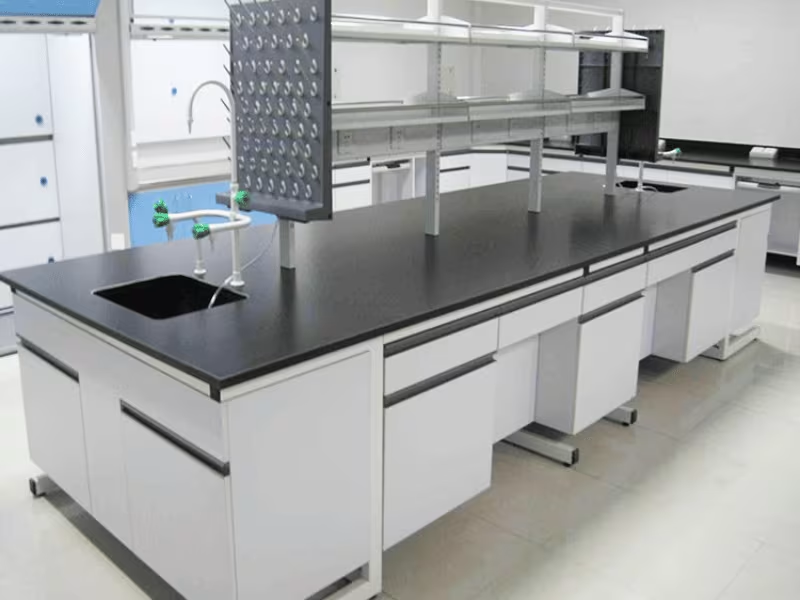
- Bench layout: The position of wet benches, lab sink benches, and island workstations determines where personnel will be working and where the 10-second travel radius is centered.
- Sink and drain positioning: Deck-mounted eyewash units require a sink with adequate drain capacity. Wall-mounted and pedestal units need drain provisions in the floor or adjacent to the unit.
- Plumbing supply routing: Tepid water supply requires either a thermostatic mixing valve in the supply line or a dedicated tempered water source. This needs to be planned before bench installation, not retrofitted afterward.
- Utility planning: In multi-bench layouts, the eyewash supply line may need to be routed through or beneath the bench structure. Glorylab designs bench systems with utility channels and service fittings that accommodate this routing cleanly.
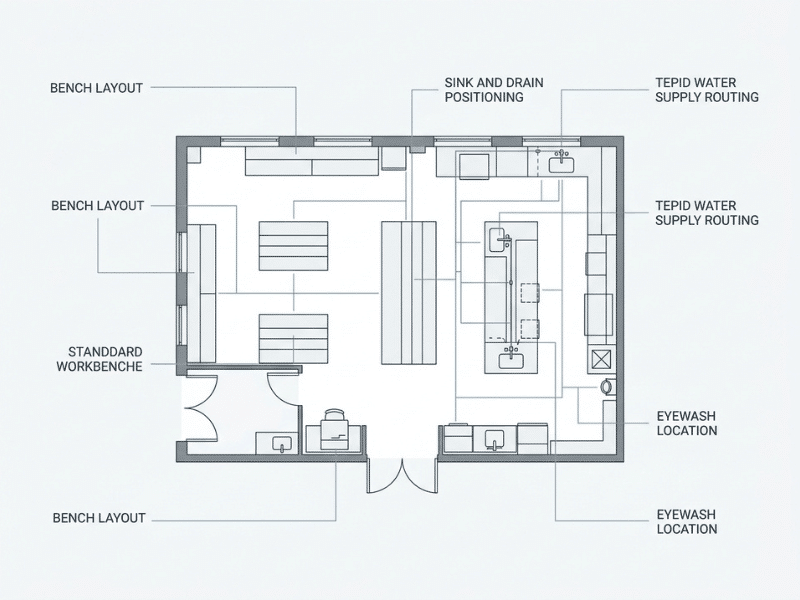
If your facility is in the design or pre-construction phase, this is the optimal point to align eyewash requirements with your bench and utility plan. Share your lab layout with Glorylab’s team for a coordinated review.
Plan Your Eyewash Compliance Before the Benches Go In
Eyewash compliance in chemical laboratories is not a box-ticking exercise. The decisions made during lab design — where benches are placed, where sinks go, how utilities are routed — directly affect whether eyewash equipment can be positioned correctly, plumbed properly, and accessed without obstruction in an emergency.
Getting this right means starting early. Glorylab works with procurement teams, contractors, and facilities managers from the layout review stage through to final product selection. Our team can help you:
- Review your floor plan to assess eyewash placement relative to bench positions and hazard zones
- Coordinate deck-mounted, wall-mounted, pedestal, or combination eyewash units with your wet lab bench and sink configuration
- Plan utility routing for tepid water supply and drain connections
- Select the right unit type based on your chemical hazard profile
Ready to align your eyewash requirements with your lab design? Submit your lab layout or chemical hazard profile, or request a quote for ANSI-compliant eyewash and combination units from Glorylab.
Frequently Asked Questions
Which eyewash station type is most appropriate for a standard chemical lab bench area?
The right unit depends on the hazard assessment for that specific bench area. For general chemical bench work where the primary exposure risk is splash to the eyes and face, an eye/face wash station delivering at least 3.0 GPM for 15 minutes is typically appropriate. For areas involving large-volume chemical handling or highly corrosive materials where body exposure is a realistic scenario, a combination unit — incorporating both an eye/face wash and a drench shower — is generally the better choice. Eye-only units are more suitable as secondary stations or for lower-hazard areas.
When should a combination emergency shower and eyewash station be installed?
A combination unit is generally warranted when personnel in the area could be exposed to chemicals that affect both the face and body — such as during bulk chemical transfers, overhead handling, or work with high-concentration corrosives. ANSI/ISEA Z358.1 does not prescribe exactly when a combination unit is required; the decision should follow a chemical hazard assessment. In practice, most chemical laboratories treat combination units as the primary emergency station wherever body exposure cannot be ruled out.
What should buyers ask suppliers when specifying eyewash stations for a lab project?
Key questions include: Does the unit meet the flow rate and duration requirements of the current edition of ANSI/ISEA Z358.1 for its equipment type? What is the required supply pressure and pipe size? Does the unit require a thermostatic mixing valve, and is one included or separately specified? What are the installation dimensions and clearance requirements? Is the unit hands-free once activated? What maintenance and testing documentation is provided? For laboratory furniture suppliers like Glorylab, also ask how the unit coordinates with bench depth, sink drain capacity, and utility channel routing.
Can portable eyewash units be used as the primary emergency station in a permanent chemical laboratory?
Portable and self-contained eyewash units can serve a compliance role where plumbing is genuinely not feasible — such as temporary installations or remote field locations. In permanent chemical laboratories with access to a water supply, plumbed units are generally preferred because they provide a continuous, sustained flush for the full 15-minute duration required by ANSI/ISEA Z358.1. Portable units have a finite water capacity that may not meet this requirement without refilling, which is a significant limitation in a real emergency.
How does OSHA enforce eyewash station requirements, and what are the penalties for non-compliance?
OSHA enforces eyewash requirements under 29 CFR 1910.151(c) as part of its general industry medical services and first aid standard. Violations can be cited as “serious” or “other-than-serious” depending on the severity of potential harm. OSHA also references ANSI/ISEA Z358.1 when evaluating whether an employer’s eyewash provisions are “suitable.” Penalties vary based on the violation classification and the employer’s compliance history. Beyond regulatory penalties, inadequate eyewash provision exposes employers to significant liability in the event of a chemical injury.
How far in advance should eyewash placement be coordinated with lab furniture design?
Eyewash placement should be decided during the schematic design phase — before bench positions, sink locations, and utility routes are finalized. Retrofitting an eyewash station into a completed lab layout often creates compromises: inadequate drain capacity, insufficient clearance, obstructed access paths, or plumbing routes that conflict with existing infrastructure. Coordinating eyewash requirements alongside lab bench and sink design is significantly more cost-effective and produces better compliance outcomes.