Walk any chemical lab or industrial floor long enough, and you’ll hit the same uncomfortable question: are our emergency shower and eyewash station requirements actually met, or do we just assume they are? There’s a real gap between “we have a unit installed” and “we have a compliant unit that works when someone needs it.” That gap is where injuries and citations tend to live.
Two frameworks govern this in the United States. OSHA sets the legal duty to protect workers. ANSI/ISEA Z358.1 supplies the technical numbers that make “protection” something you can actually measure. The rest of this piece covers when the equipment is required, what each standard demands, and—the part most guides skip—why those numbers exist and where facilities quietly fall short.
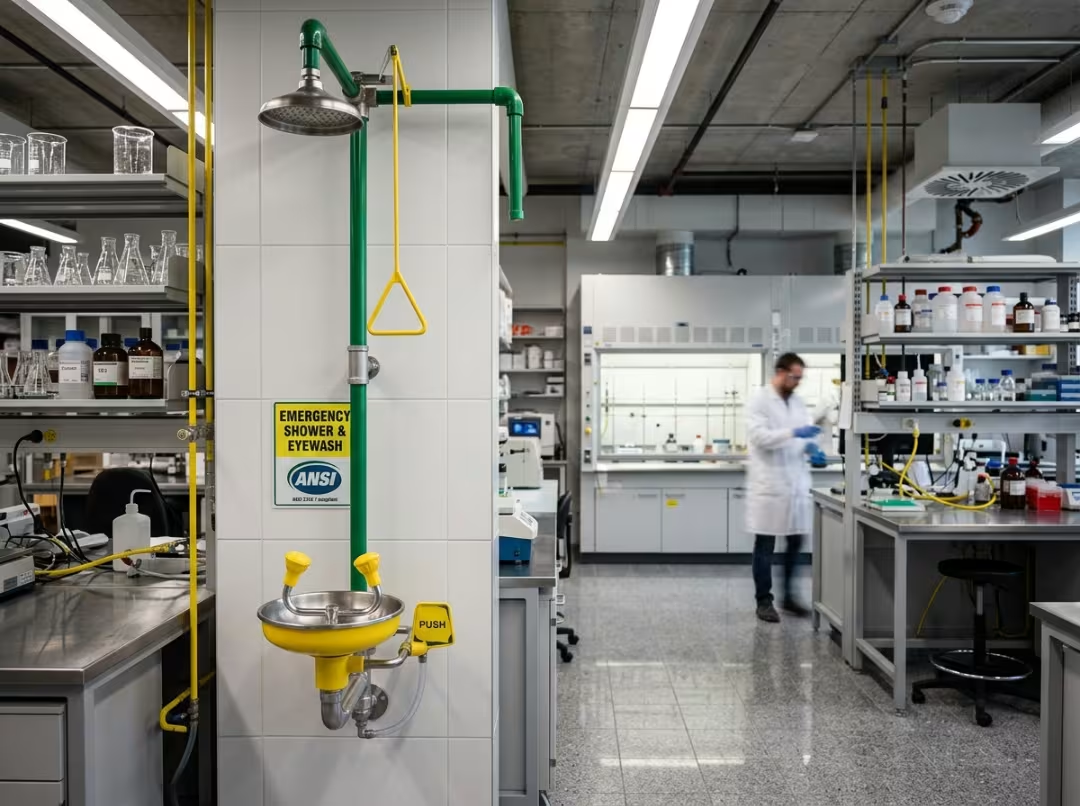
When Are Emergency Showers and Eyewash Stations Required?
The trigger isn’t your industry. It’s your hazard exposure.
OSHA’s language is broad on purpose: wherever employees may be exposed to injurious corrosive materials, you have to provide facilities for quick drenching or flushing. Pay attention to “may be exposed.” Potential contact is enough. You don’t get to wait for someone to get hurt before you prove the need.
To figure out whether a work area qualifies, start with your Safety Data Sheets. Any chemical flagged as corrosive or a strong irritant creates a requirement, full stop. Battery rooms, plating lines, sample prep benches, reagent storage—these almost always qualify.
Here’s how exposure type usually maps to equipment:
|
Exposure scenario |
Typical hazard |
Equipment usually needed |
|---|---|---|
|
Splash to eyes or face only |
Diluted acids, cleaning agents, dust |
Eyewash station |
|
Risk of body or clothing contact |
Concentrated corrosives, large volumes |
Emergency shower |
|
Both risks in one work zone |
Open chemical handling, decanting |
Combination shower/eyewash |
|
Localized, supplemental rinsing |
Small spot contact |
Drench hose (supplement only) |
A drench hose earns its place as an add-on, but it won’t satisfy the requirement on its own. If you’re mapping equipment across a new build, sort this out during early space planning rather than after the benches are in—something we dig into in our guide to laboratory design and planning.
OSHA vs. ANSI Z358.1: What Each Standard Actually Covers
People tend to treat these as rival standards. They’re not. They work as a pair, and once you see the split, most of the confusion about compliance clears up.
What OSHA Requires
OSHA standard 29 CFR 1910.151(c) establishes the obligation to provide suitable facilities for quick drenching or flushing of the eyes and body. That’s the legal hook. What it won’t tell you is the flow rate, the water temperature, or how often to test.
That silence is deliberate. OSHA writes the duty and hands the engineering detail to consensus standards.
What ANSI/ISEA Z358.1 Adds
ANSI Z358.1 fills that vacuum. It pins down flow rates, flush duration, activation speed, water temperature, mounting heights, and inspection frequency. Meet Z358.1 and you’ve got a defensible way to show your equipment is “suitable” in OSHA’s eyes.
Is ANSI Z358.1 Legally Binding?
On paper, ANSI Z358.1 is a voluntary consensus standard. In practice, treat it as mandatory.
OSHA enforces it through the General Duty Clause and regularly cites Z358.1 as the recognized standard of care. When an inspector or a court asks whether your equipment was adequate, Z358.1 is the yardstick they pull out. Our detailed breakdown of OSHA eyewash station requirements walks through how those citations actually play out on the floor.
|
Factor |
OSHA 29 CFR 1910.151(c) |
ANSI/ISEA Z358.1 |
|---|---|---|
|
Role |
Legal duty to provide equipment |
Technical performance spec |
|
Legal status |
Enforceable federal regulation |
Voluntary consensus standard |
|
Level of detail |
Minimal |
Highly specific |
|
How it’s enforced |
Direct citation |
Via the General Duty Clause |
What Are the Core Emergency Shower and Eyewash Requirements?
Bookmark this section. The numbers below come straight from ANSI Z358.1 and hold for most installations.
|
Requirement |
Emergency shower |
Eyewash station |
Combination unit |
|---|---|---|---|
|
Minimum flow rate |
20 GPM |
0.4 GPM |
Both, simultaneously |
|
Flush duration |
15 minutes |
15 minutes |
15 minutes |
|
Activation time |
1 second or less |
1 second or less |
1 second or less |
|
Water temperature |
60–100°F (16–38°C) |
60–100°F (16–38°C) |
60–100°F (16–38°C) |
|
Distance from hazard |
Within 10 seconds (~55 ft) |
Within 10 seconds (~55 ft) |
Within 10 seconds (~55 ft) |
|
Activation type |
Hands-free, stays on |
Hands-free, stays on |
Hands-free, stays on |
The specs matter. So does the reasoning behind them, which is where the next section earns its keep.
Emergency Shower Specifics
An emergency shower has to deliver at least 20 GPM for a full 15 minutes—roughly 300 gallons per event. Undersized supply lines that run dry mid-flush are one of the more common failures we’ve turned up during audits, and a shower that quits halfway through fails the worker at the worst possible moment.
The water column needs to be wide enough to cover the whole body, and the valve has to stay open hands-free. An injured person needs both hands to strip off contaminated clothing, not to grip a lever for 15 minutes.
Eyewash Station Specifics
An eyewash requires a minimum of 0.4 GPM for 15 minutes, delivered as two gentle streams that flush both eyes simultaneously. The soft flow is intentional—forceful water drives contaminants deeper and can tear up eye tissue.
Protective nozzle covers should pop off on their own when the unit activates. If someone has to peel a cover off first, you’ve just spent seconds you didn’t have.
Combination Units
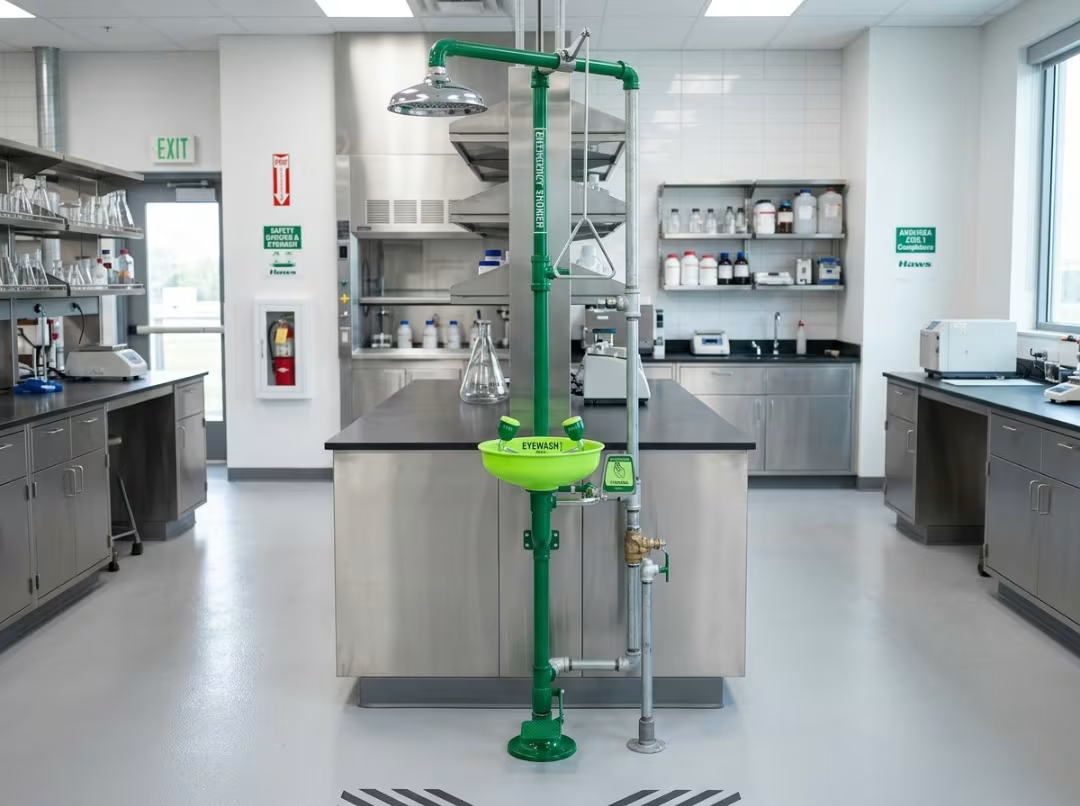
A combination unit must run the shower and eyewash simultaneously with no pressure drop. If firing the shower starves the eyewash, the unit isn’t compliant—period. These pay off in labs where a single spill could hit the eyes and the body at once.
What the 10-Second Rule, 15-Minute Flush, and Tepid Water Requirement Really Mean
Reciting the numbers is easy. Knowing why they exist is what separates a compliant facility from one that appears compliant only on paper.
Why “Within 10 Seconds” Isn’t About Distance
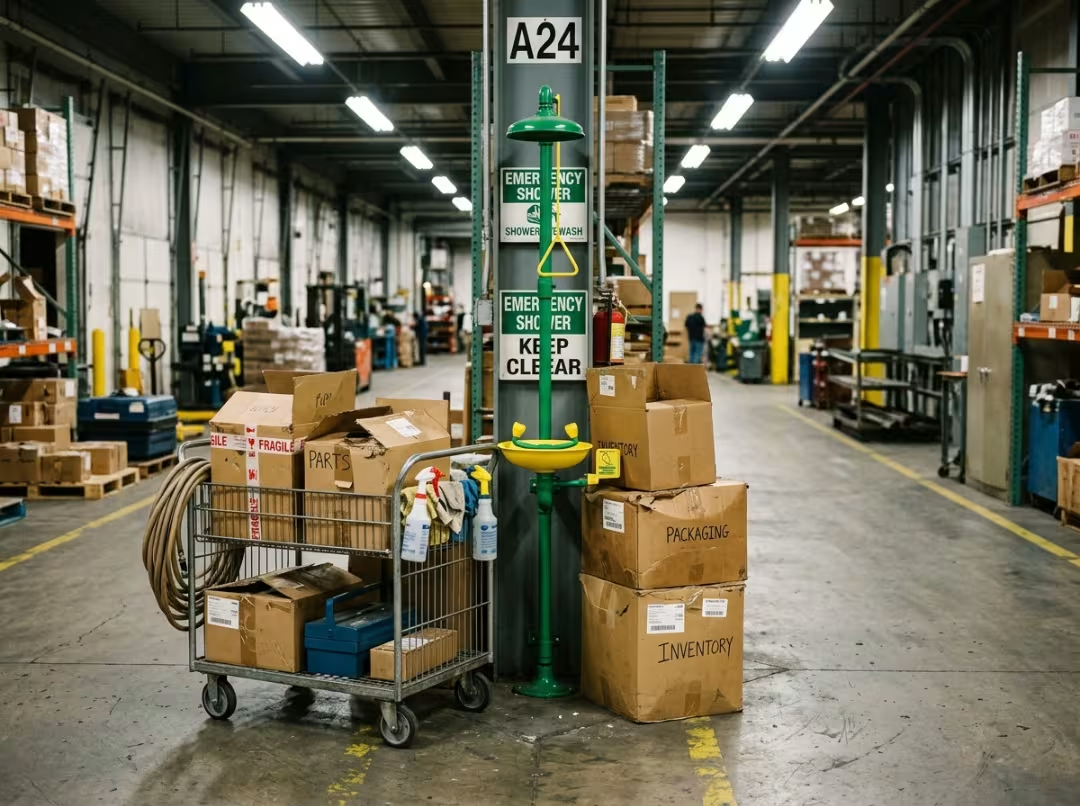
The standard places equipment within 10 seconds of travel time from the hazard—about 55 feet along an unobstructed path. That word unobstructed does a lot of work. Measure walking time, not a straight line drawn on a floor plan.
A door that swings the wrong way, a step up, a pallet parked in the aisle—any one of those turns a “compliant” 50-foot placement into a failure. For strong acids and caustics, don’t settle for the full 10 seconds. Put the unit right next to the hazard because, with those chemicals, the damage in ten seconds is already serious.
Why the Flush Runs a Full 15 Minutes
Fifteen minutes isn’t a round number someone picked. It’s the duration the research supports for diluting and washing most corrosive contaminants from tissue before they cause lasting harm.
This is exactly why supply sizing matters. A plumbed unit tied to a reliable main handles it without a second thought. A self-contained or portable unit must hold enough fluid to sustain full flow for the entire 15 minutes—so tank capacity is a compliance question, not a nice-to-have. Check the SDS, too; some chemicals call for a longer flush than the baseline.
Why Water Has to Be Tepid
Tepid means 60–100°F, and the range comes down to a very human problem: people stop flushing when they’re cold.
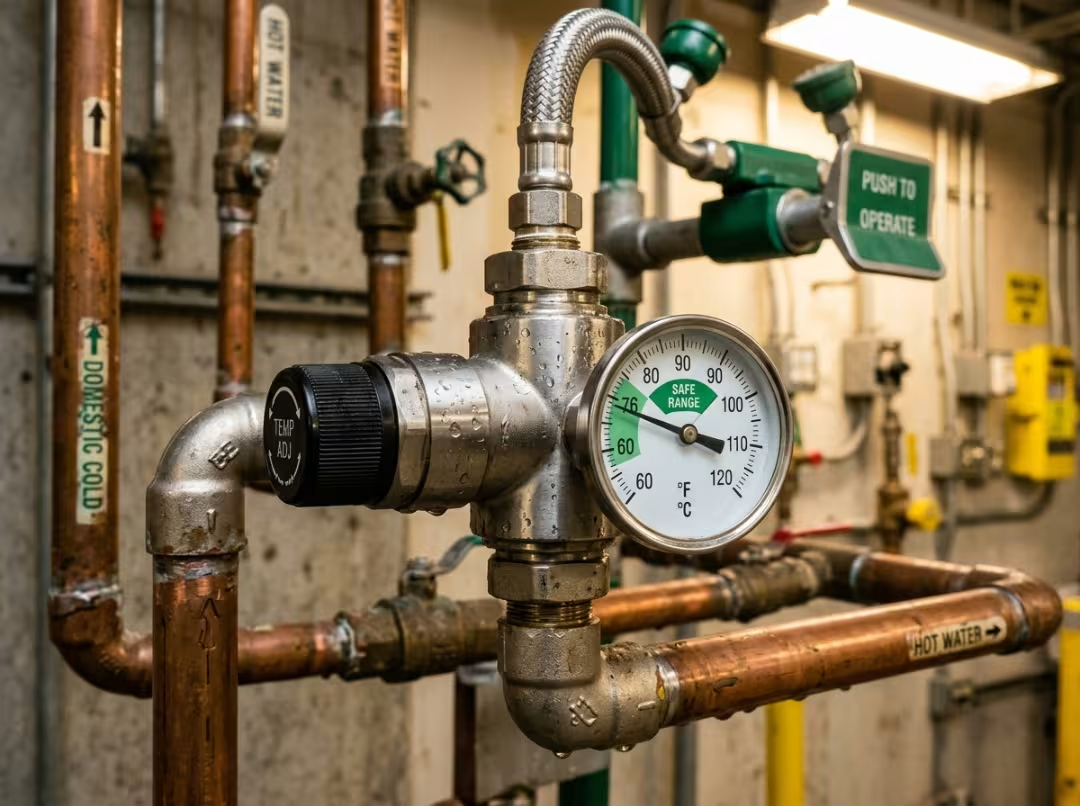
Fifteen minutes under cold water risks hypothermia and shock, and it pushes an injured worker to cut the flush short—right when finishing it matters most. Water that runs too hot scalds damaged tissue and can speed up how quickly some chemicals penetrate the skin. In buildings with extreme ambient temperatures, a thermostatic mixing valve is usually the only dependable way to hold that range across the seasons.
How Should You Inspect and Document These Units?
Inspection is where good intentions go to die. A unit gets installed, then forgotten, and the first real test comes during an actual emergency—which is far too late to find out the valve seized.
There are two rhythms here: a weekly activation and a full annual test. They do different jobs.
Weekly Activation Checks
Running each unit weekly flushes stagnant water from the line, clears sediment, and confirms that it actually fires. Water sitting in an unused eyewash line can grow bacteria, which is one more reason the weekly flush isn’t optional.
|
Weekly check |
Pass/Fail |
Notes |
|---|---|---|
|
Unit accessible, path clear |
||
|
Activates in 1 second or less |
||
|
Valve stays open hands-free |
||
|
Flow confirmed at correct rate |
||
|
Water runs clear (no sediment) |
||
|
Nozzles clean; covers release on activation |
||
|
Signage visible and lit |
||
|
Water temperature spot-check |
Annual Performance Test
Once a year, put every spec to the test under real operating conditions: full flow rate, a sustained 15-minute run, spray coverage, temperature, valve function, and drainage.
|
Annual check |
Pass/Fail |
Notes |
|---|---|---|
|
Full flow-rate test meets GPM minimum |
||
|
Flush sustained for 15 minutes |
||
|
Spray pattern and coverage verified |
||
|
Temperature within 60–100°F |
||
|
Valve and activation mechanism tested |
||
|
Piping, connections, drainage inspected |
||
|
Tags and logs updated |
||
|
Employee training refreshed |
The annual test asks more than a weekly flush does. An EHS manager or a trained facility manager can run it, though high-risk sites often bring in a certified third party for the extra documentation and a second set of eyes.
Why Documentation Protects You
Keep a dated tag on each unit and a log of every check—date, inspector, result, and any corrective action taken. When a facility inspection rolls around, that paper trail is what proves you’ve been compliant all along. It also flags recurring problems early, before they turn into the kind of pattern an auditor notices.
What Are the Most Common Compliance Failures?
Most violations aren’t exotic. They trace back to a short list of predictable mistakes, and each one has a straightforward fix.
|
Violation |
Why it’s dangerous |
Fix |
|---|---|---|
|
Blocked or obstructed access |
Burns critical seconds in an emergency |
Mark and enforce a keep-clear zone |
|
Skipped weekly activation |
Invites sediment, corrosion, and bacteria |
Schedule and log weekly flushes |
|
Wrong water temperature |
Drives users to cut the flush short |
Fit a thermostatic mixing valve |
|
Supply can’t sustain 15 minutes |
Leaves contaminants in tissue |
Size the main or tank correctly |
|
Poor or missing signage |
Workers can’t find the unit fast |
Add bright, lit ANSI signage |
|
No drainage plan |
Creates slip and mold hazards |
Install proper floor drainage |
|
Outdated training |
Workers don’t know how to respond |
Refresh training on a set schedule |
|
Wrong device for the hazard |
Inadequate protection |
Match the unit to your SDS profile |
In labs handling corrosives day in and day out, the first two—blocked access and skipped testing—account for a surprising share of findings. Both are free to fix. All they cost is discipline. The failure point usually isn’t the equipment itself; it’s the follow-through.
How Do You Choose the Right Emergency Shower or Eyewash Station?
Selection really comes down to four questions: what’s the exposure, where’s the water coming from, how harsh is the environment, and how will you drain it?
Match the Unit to the Hazard
If the realistic risk is a splash to the eyes, an eyewash covers it. If a spill could soak someone head to foot, you need a shower. Where both are plausible in the same area, spec a combination unit and stop debating it.
Plumbed, Self-Contained, or Portable
|
Factor |
Plumbed |
Self-contained |
Portable |
|---|---|---|---|
|
Upfront cost |
Higher |
Moderate |
Lower |
|
Maintenance |
Low |
Moderate (refill) |
Higher (frequent refill) |
|
Mobility |
Fixed |
Semi-fixed |
Fully mobile |
|
Best fit |
Permanent, high-traffic areas |
Spaces without plumbing |
Temporary or remote sites |
Plumbed units are the workhorse for fixed, high-traffic labs. Self-contained units earn their spot where running a water line isn’t practical. Portable units are ideal for temporary or remote work, but they’ll only remain compliant if someone stays on top of refills.
Materials, Temperature, and Drainage
In corrosive environments, specify corrosion-resistant construction—stainless steel or high-grade coated components—so the unit doesn’t degrade before the day you actually need it. Confirm the supply can hold tepid temperatures year-round, and plan floor drainage that can take 15 minutes of flowing water without pooling.
When you’re outfitting a chemical-safe workspace, plan the safety stations alongside the benching and storage instead of bolting them on later. Coordinating them with the right laboratory furniture keeps clearances, drainage, and access working together rather than fighting each other.
Frequently Asked Questions
How far can an eyewash station be from a hazard?
No more than 10 seconds of travel—about 55 feet on a clear, unobstructed path. For strong acids or caustics, place them right beside the hazard, since serious damage can occur within seconds.
What is the minimum flow rate for an emergency shower?
At least 20 gallons per minute for a full 15 minutes, totaling roughly 300 gallons per event. Your water supply has to be sized to sustain that without running dry.
What temperature counts as tepid?
Between 60°F and 100°F (16–38°C). That range keeps an injured person comfortable enough to finish the full flush without risking shock, hypothermia, or scalding.
How often do eyewash stations need to be tested?
Activate them weekly to flush the line and confirm they work, then run a full performance test once a year to verify flow rate, temperature, and coverage.
Can an eyewash station go outdoors?
Yes, as long as you protect it from temperature extremes. Use freeze-protected models in cold climates and shaded or tempered setups in hot ones to keep the water tepid.
Do emergency showers need floor drains?
ANSI doesn’t strictly require them, but they’re strongly advised. Fifteen minutes of flowing water creates real pooling, slip, and mold hazards without proper drainage.
Is ANSI Z358.1 mandatory or just recommended?
It’s a voluntary consensus standard, but OSHA enforces it through the General Duty Clause and treats it as the standard of care. Follow it as though it were mandatory.
Can I use plain tap water?
Yes, provided it’s clean, potable, and tepid. In dusty or industrial settings, add filtration so sediment and contaminants don’t reach the eyes.
Keeping Your Facility Ready
Compliance isn’t a box you tick once at installation and forget. It holds only when the equipment sits within reach, delivers tepid water for a full 15 minutes, and gets tested on a schedule someone actually keeps. A working, well-placed unit is what turns a dangerous exposure into a manageable one.
If you’re planning a new lab or upgrading an existing space, walk your current setup against these requirements before an inspector does it for you. Our team can help you assess placement, spec ANSI- and OSHA-ready units, and coordinate them with the rest of your layout. Reach out for a compliance review or a quote when you’re ready to move.
Disclaimer: This article is for educational purposes only and does not constitute legal or compliance advice. Standards change over time and vary by jurisdiction. Always verify the current OSHA regulations and ANSI/ISEA Z358.1 requirements that apply to your facility.