Why a Metal-Free Path Matters
Distilled and deionized water is inherently aggressive. Because it’s stripped of dissolved ions, it readily picks up whatever it touches — and metal surfaces are the first thing to contaminate it. Even trace metal ions can throw off sensitive analytical work.
Here’s why that makes the JH-WL011 the right choice for a dedicated pure-water point:
- Protects analytical accuracy — A metal-free wetted path helps prevent metal ions from entering your water at the point of dispensing, so trace-level measurements stay clean.
- Keeps samples and reagents true — Buffer prep, dilutions, and reagent work depend on water that hasn’t been altered on its way out of the tap.
- Purpose-built, not adapted — Standard brass or stainless faucets put metal directly in the water path. The JH-WL011 instead keeps the entire wetted route in PP.
- Best kept separate — Run it as a distinct distilled/DI outlet, separate from your general service-water lines, so purity is protected end-to-end.
If your bench relies on distilled or deionized water for accurate results, a metal-free dispensing point is the difference between water that stays pure and water that quietly picks up contamination on the way out.
Technical Specifications
| Specification | Detail |
|---|---|
| Model | JH-WL011 |
| Product | Distilled Laboratory Faucet |
| Purpose | Dedicated distilled / deionized water dispensing point |
| Main Material | Polypropylene (PP), fully plastic construction |
| Water Path | Completely metal-free |
| Valve | Fully plastic valve |
| Max Static Pressure | 3 bar (low-pressure dispensing) |
| Water Type | Distilled and deionized water |
| Body resistance | PP resists corrosion and moisture; confirm compatibility for specific chemicals and water standards |
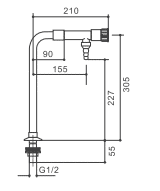
This faucet is designed as a low-pressure, single-purpose pure-water outlet. Mounting hole size, inlet connection sizes, and suitability for your specific water quality standard can be confirmed for your project. Share your bench layout and water system details, and we’ll advise on exact fit before you order.
Key Features
1. Completely Metal-Free Wetted Path
Distilled or deionized water never comes into contact with metal as it passes through the faucet. The whole wetted route — body, valve, and outlet — is plastic, helping keep high-purity water free from metal-contact contamination right up to the point of use.
2. Full Polypropylene (PP) Construction
The faucet is built entirely from PP, chosen first for its non-metal wetted path and second for its resistance to corrosion and moisture. PP won’t rust or leach metal into the water, so the dispensing point stays stable through daily lab use.
3. Fully Plastic Valve
The valve is plastic throughout, so the metal-free promise holds from inlet to outlet — there’s no metal seat or stem in contact with your water. It gives a steady, controlled flow for precise dispensing.
4. Low-Pressure Dispensing (3 Bar Max)
Rated to a maximum static pressure of 3 bar, the JH-WL011 is built as a dedicated pure-water point, not a general wash-up tap. This low-pressure design suits controlled dispensing at the bench — confirm your line pressure stays within the limit before installing.
Applications
The JH-WL011 is built as a dedicated distilled/DI water outlet at the bench, best suited to work where water purity affects results:
- Sample preparation — Dispensing distilled or deionized water for dilutions and sample prep, where trace metals would skew accuracy.
- DI rinse stations — A dedicated point for final rinsing of glassware and equipment with metal-free water.
- Reagent and buffer prep — Making up reagents and buffers that depend on water that hasn’t picked up metal ions.
- Analytical and testing benches — A separate pure-water outlet alongside standard service-water faucets in analytical, chemistry, and QC labs.
Its role is dedicated pure-water dispensing — a distinct outlet for distilled and deionized water, kept separate from general-purpose wash-up taps.
Installation & Compatibility
The JH-WL011 mounts as a dedicated distilled/DI water point at the bench. Because it’s a low-pressure, single-purpose faucet, a few checks matter more than usual:
- Confirm your supply pressure first — The valve is rated to a maximum static pressure of 3 bar. Check that your distilled/DI line stays within this limit before ordering; higher pressure calls for a regulator or a different setup.
- Keep it separate from service water — Plumb the JH-WL011 to your distilled/DI supply, not your general service-water line, so the metal-free path serves its purpose.
- Confirm the mounting hole in your bench or sink matches the faucet base.
- Check the inlet connection matches your pure-water tubing or line without adapters that reintroduce metal to the wetted path.
- Confirm your water standard — For specific purity or system-level requirements, share your water quality standard, and we’ll confirm suitability.
Share your bench layout, distilled/DI line pressure, and connection details, and we’ll confirm the right mounting and setup for your pure-water point.
FAQ
Why choose a distilled-water faucet instead of a standard brass or stainless faucet?
A brass or stainless faucet puts metal directly in the water path. For distilled and deionized water, that’s a problem — the water readily picks up metal ions, which can compromise analytical results. The JH-WL011 keeps the entire wetted path in PP, so your high-purity water stays free from metal-contact contamination. For a dedicated pure-water point, that metal-free path is the whole reason to choose it.
Is the JH-WL011 only for distilled and deionized water?
Yes — it’s purpose-built as a dedicated distilled/DI dispensing point, not a general-purpose faucet. Its value is the metal-free wetted path and low-pressure control. For everyday wash-up or general service water, a standard brass or stainless faucet is the better fit. Run the JH-WL011 as a separate outlet specifically for your pure water.
Can I use it as a regular sink tap?
It’s not intended for that. The 3-bar pressure limit and single-purpose design make it a controlled pure-water outlet, not a high-flow wash-up tap. Using it as a general faucet would waste its metal-free advantage and push it outside its pressure range. Keep it as a dedicated distilled/DI point.
What does “metal-free wetted path” mean?
It means every surface the water touches on its way through the faucet — the body, the valve, and the outlet — is plastic, with no metal contact. This helps minimize metal-contact contamination at the point of dispensing, so the water leaves the tap as clean as it entered.
Why is the pressure rating only 3 bar?
It’s designed as a dedicated, low-pressure dispensing point rather than a general wash-up faucet. Distilled/DI outlets typically run at controlled, lower pressure, and the fully plastic valve is rated accordingly. Confirm your line pressure stays at or below 3 bar before ordering — if it’s higher, ask us about adding a regulator.
Will it work with my water quality standard?
The JH-WL011 provides a metal-free wetted path suited to distilled and deionized water points and other high-purity applications where a plastic wetted path is preferred. Purity requirements vary by project and system, so for specific water quality standards, send us your details, and we’ll confirm suitability before you order.
Does the full PP construction affect durability?
No. Polypropylene is a tough, chemical-resistant material that withstands frequent handling and daily lab use, and it won’t corrode the way some metals can. With simple, routine cleaning, it stays reliable for years while keeping the water path metal-free.
How do I clean and maintain it?
Wipe the PP body with a mild detergent and a soft cloth, then rinse with clean water. The plastic construction resists staining and residue, so routine care keeps it lab-ready. Avoid abrasive cleaners or harsh scrubbing, which could scratch the surface, and ensure the outlet flows freely during regular upkeep.
What should I confirm before ordering?
Confirm four things: your distilled/DI line pressure (it must stay within the 3-bar max), your mounting hole size, your inlet connection to the pure-water line, and your specific water quality standard, if you have one. Checking these in advance helps ensure a secure fit and proper protection of the pure-water point. Share your setup, and we’ll confirm compatibility.
How do I request a quote?
Send us your required quantities, your distilled/DI line pressure, and your inlet connection details. For a larger fit-out, share your bench layout and water system details so we can confirm scope and lead time.
Request a Quote
Setting up a new lab or adding a dedicated distilled water point to your bench? Send us your required quantities, your distilled/DI supply pressure, and your inlet connection details, and our team will prepare a tailored quotation for your JH-WL011 faucets. Because this is a low-pressure, purpose-built pure-water outlet, let us know your line pressure and water quality standard up front so we can confirm the right fit. For larger projects, share your full bench and water system layout, and we’ll confirm configuration, scope, and lead time — and help you match the right dispensing point to your pure-water setup.