Adjustable science lab stools are essential for school labs because they accommodate different student heights, support safe posture during hands-on work, and withstand chemical exposure. Key buying decisions include stool type, base style, seat material, and height range by grade level.
Standard classroom chairs are not designed for science labs. Lab environments require seating that matches higher work surfaces, supports active movement, and stands up to spills, chemicals, and heavy daily use. When schools rely on fixed-height or non-lab seating, the result is often poor posture, reduced comfort, and unnecessary safety risk.
Adjustable science lab stools solve these problems by offering better ergonomic fit, greater flexibility across age groups, and materials suited to demanding school lab environments. This guide covers the key features to look for, how to compare stool types and bases, how to choose the right height range, and what procurement teams should check before placing an order.
Why Standard Classroom Chairs Don’t Work in Science Labs
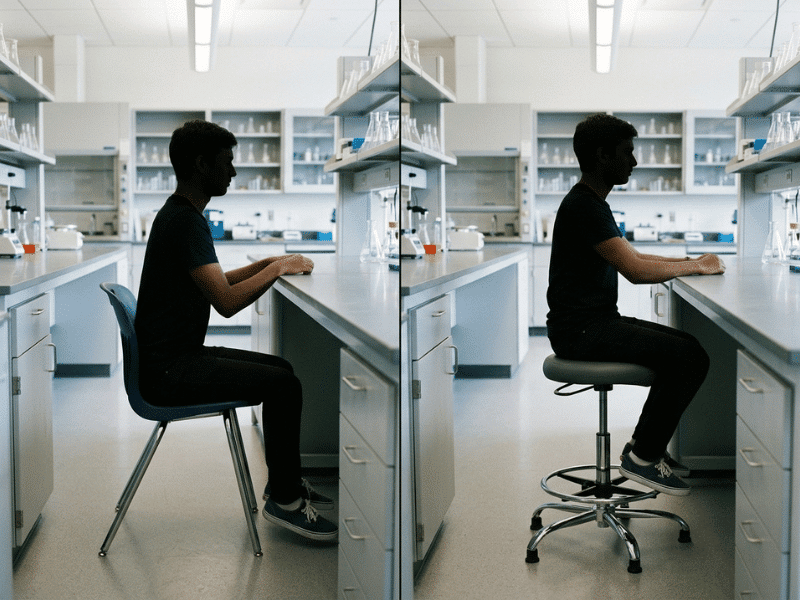
Classroom chairs are engineered for a specific context: sitting upright at a desk, facing forward, with feet flat on the floor. Science labs demand something very different. Students shift between sitting, standing, leaning, and reaching. Bench heights are typically 90–95 cm, well above standard desk height. Work involves liquids, heat, and chemicals that would destroy a fabric-upholstered chair within a semester.
Fixed-height chairs also create real ergonomic problems. A student who is 150 cm tall and a student who is 185 cm tall cannot both sit correctly on the same fixed seat. One will have their feet dangling; the other will be hunched. Over a 90-minute lab session, that mismatch compounds into fatigue, reduced concentration, and musculoskeletal strain.
Adjustable science lab stools solve these problems by offering a height range that accommodates the full spectrum of student sizes, paired with materials and construction suited to the demands of a working laboratory.
Why Adjustable Science Lab Stools Matter for Schools
The core value of adjustability is inclusivity. A single stool model with a broad height range can serve students across multiple grade levels and body types, which simplifies procurement, reduces SKU complexity, and delivers long-term cost efficiency.
Beyond comfort, ergonomic seating has a measurable effect on student performance. Research consistently links discomfort and poor posture with reduced attention span and task accuracy—both of which matter in a precision-focused environment like a science lab. Stools that allow students to maintain neutral spinal alignment, with thighs roughly parallel to the floor and feet supported, reduce fatigue and help students stay focused for longer.
Safety is another factor that is often underweighted in purchasing decisions. A stool that is too high for a student can cause them to lean dangerously over a bench. A stool with an unstable base is a genuine hazard during active experiment work. Properly specified adjustable stools minimize both risks.
What Key Features Should You Look for in School Lab Stools?
Not all adjustable lab stools are equal. When evaluating options, procurement teams should assess the following features:
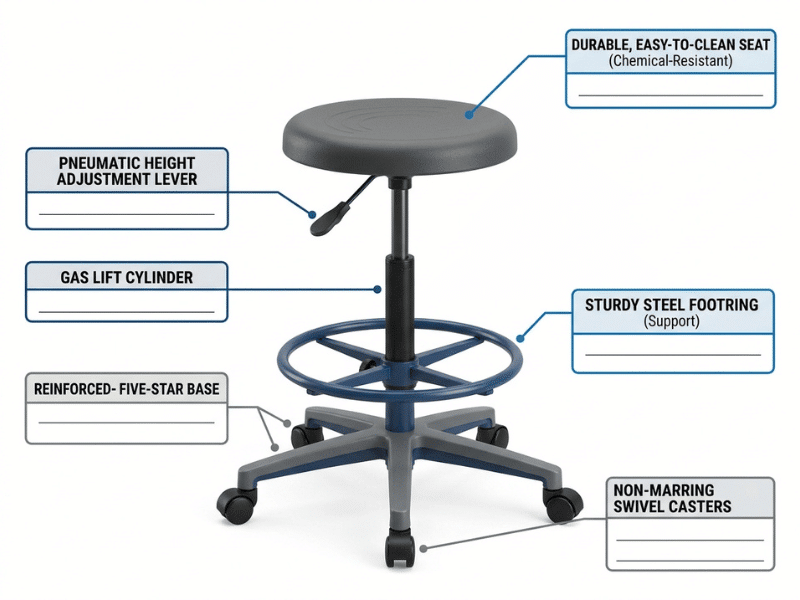
- Height adjustment range: Look for a minimum range of 45–75 cm to cover most student populations. Pneumatic gas-lift mechanisms offer smooth, tool-free adjustment and are far more practical in a school setting than threaded-spindle mechanisms.
- Seat diameter and shape: Larger diameter seats (35–40 cm) offer more comfort for longer sessions. Contoured or slightly dished seats distribute weight more evenly than flat surfaces.
- Footrest: A fixed or height-adjustable footrest is non-negotiable for taller stools. Without foot support, students dangle their legs—cutting off circulation and increasing fatigue.
- Weight capacity: School lab stools should be rated for at least 120 kg. Higher-rated stools typically signal more robust construction.
- Chemical and stain resistance: Seat upholstery and finishes must resist common lab chemicals. Polyurethane and vinyl are the standard choices; fabric is unsuitable.
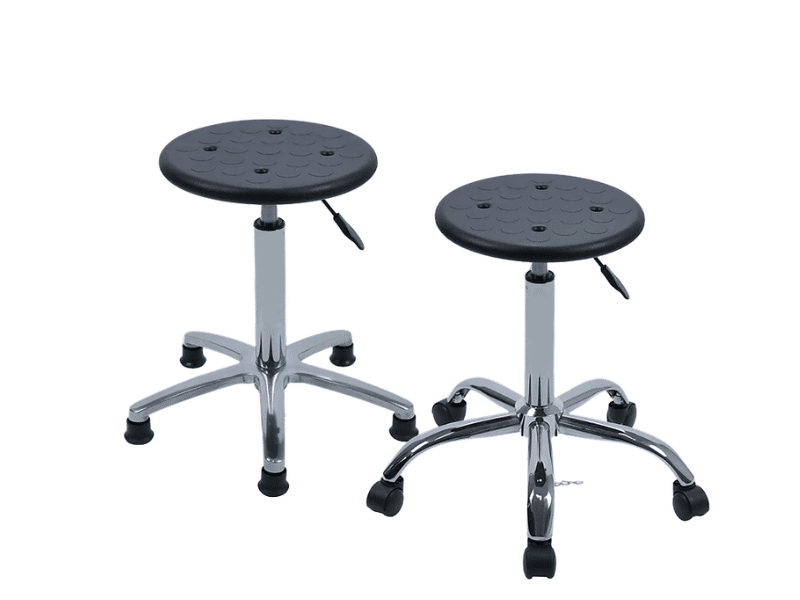
- Base construction: Five-star bases offer superior stability over four-leg or round-ring bases, especially for active tasks.
Backless Stools vs. Stools with Backrests: Which Is Right for Your Lab?
This is one of the most debated decisions in lab seating procurement, and the answer depends on how your lab is used.
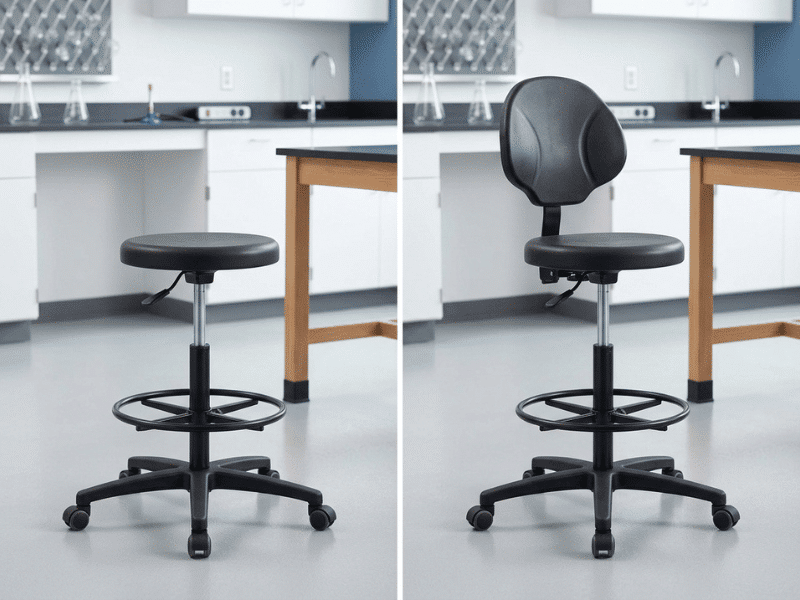
Backless stools are the traditional choice for science labs. They allow students to rotate freely, face different directions, and move between bench positions without the backrest getting in the way. They’re easier to store under bench overhangs and are generally more compact. The trade-off is that they require students to engage their core muscles for support, which can become fatiguing during longer sessions.
Stools with backrests provide lumbar support and are better suited to labs where students spend extended periods in a seated position—during data recording, microscopy work, or written components of a lab session. They are also the more appropriate choice for students with back conditions or physical disabilities. The limitation is that backrests can restrict movement and may not fit under all bench overhangs.
Recommendation: For general-purpose school science labs, backless stools with an ergonomic seat contour and footring are the more practical choice. If your lab includes dedicated writing stations or is used by students with specific physical needs, specify backrest stools for at least a portion of the seats.
Glides vs. Casters: Which Base Is Better for School Labs?
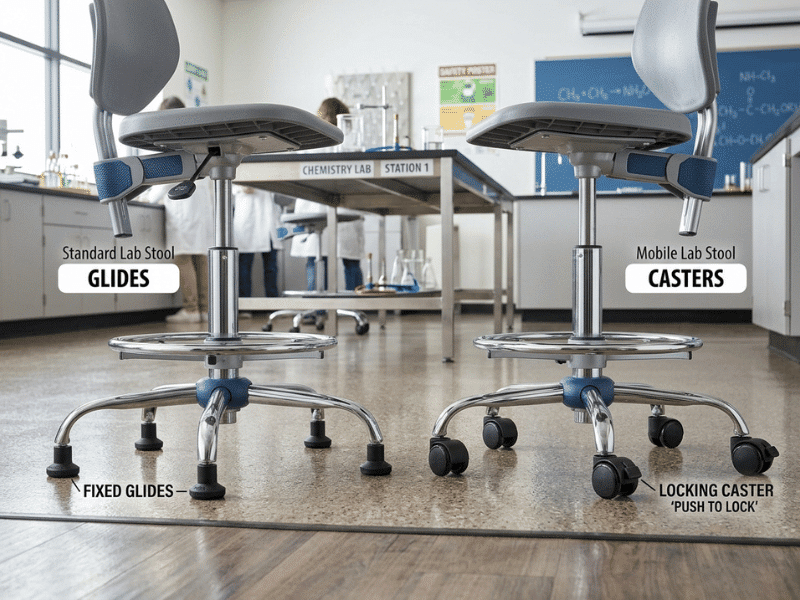
The choice between glides (fixed feet) and casters (wheels) comes down to how much mobility you need—and how much risk you’re willing to accept.
Glides keep the stool firmly in place. They’re the safer option in active lab environments where accidental rolling could cause a student to collide with equipment or spill a hazardous substance. Glides also work well on smooth epoxy or vinyl flooring without marking or scratching. The downside is that students must lift the stool to reposition it, which creates noise and increases wear on the floor.
Casters make it easy to move around a shared bench, which is useful in collaborative lab designs where students work in groups. However, casters on smooth flooring can roll unexpectedly, and most safety guidelines for active laboratory environments recommend caution when specifying wheeled seating. If you opt for casters, look for models with locking mechanisms or dual-wheel casters that require deliberate weight shift to move.
Recommendation: For most K–12 science labs, glides are the safer and lower-maintenance choice. Reserve casters for specialist lab configurations—such as electronics or computer-integrated labs—where mobility is a deliberate design requirement.
What Are the Best Materials for School Lab Stools?
Material selection affects durability, chemical resistance, maintenance burden, and lifecycle cost. Here’s how the main options compare:
Seat Upholstery
- Polyurethane (PU): The most widely specified material for school lab stools. PU is durable, easy to clean, resistant to a broad range of lab chemicals, and comfortable. It holds up well under heavy daily use without cracking or peeling—provided it is commercial-grade, not domestic-grade.
- Vinyl (PVC): A cost-effective alternative with similar chemical resistance to PU. Vinyl is slightly less breathable and can crack over time in environments with extreme temperature fluctuations, but it performs well in typical indoor lab conditions.
- Fabric: Not suitable for science labs. Fabric absorbs spills, harbors bacteria, and cannot withstand chemical exposure. Avoid it entirely.
- Hard polypropylene: Used in some budget lab stools. Durable and chemical-resistant, but significantly less comfortable for extended sitting. Appropriate for shorter-duration use or high-turnover labs.
Frame and Base Materials
- Powder-coated steel: The standard for lab stool frames and bases. Powder coating provides corrosion resistance and is available in a range of colors to match lab aesthetics. Choose stools with welded (not bolted) frame joints for maximum longevity.
- Chrome-plated steel: Common in footrings and column hardware. Easy to clean but can corrode in humid environments over time.
- Aluminum: Lighter than steel and naturally corrosion-resistant, but typically found in higher-cost models.
How to Choose the Right Stool Height for Different Grade Levels
One of the most common procurement errors is specifying a single seat height for an entire school without accounting for how student heights vary by grade. The following guidance is based on standard bench heights of 90–95 cm, which are typical for school science labs:
|
Grade Level |
Approximate Student Height Range |
Recommended Seat Height Range |
|---|---|---|
|
Primary / Elementary (Grades 4–6) |
130–150 cm |
45–58 cm |
|
Middle School (Grades 7–9) |
148–168 cm |
55–68 cm |
|
High School (Grades 10–12) |
160–185 cm |
63–78 cm |
|
Mixed / Multi-Year Labs |
Full range |
45–78 cm (broad-range stool) |
The key principle is that when seated at the correct height, a student’s elbows should sit at approximately bench surface level, with thighs roughly parallel to the floor and feet either flat on a footrest or on the floor. Purchasing stools with a broad pneumatic adjustment range (45–78 cm) is the most flexible and cost-efficient approach for labs that serve multiple grade levels.
If your lab serves a single grade or year group, you can specify a narrower range—but always verify against the actual bench height before ordering. Bench heights vary between manufacturers and older installations may not conform to current standards.
Common Mistakes Schools Make When Purchasing Lab Stools
Procurement teams that haven’t purchased lab furniture before tend to make predictable errors. Avoiding these can save significant budget and prevent early replacements.
1. Prioritizing price over lifecycle cost. A stool priced 30% lower than the market average may look attractive on a purchase order, but if it fails within three years, the total cost of ownership is substantially higher. Evaluate stools on a cost-per-year basis, factoring in warranty coverage and replacement part availability.
2. Not verifying adjustment range against bench height. This mismatch is surprisingly common. Always confirm the seated height range of any stool against the actual height of your lab benches before specifying.
3. Ignoring footrest height. A stool specified for high-school students may be too tall for its footring to support middle-school students comfortably. Look for stools with height-adjustable footrings, or specify different models for different age groups.
4. Specifying casters in active lab environments. As noted above, wheeled stools in chemistry or biology labs introduce unnecessary movement risk. Check your local safety guidelines before specifying casters.
5. Purchasing without testing samples. Lead times for lab furniture can be long. Procurement teams that order without requesting samples first can find themselves locked into a product that doesn’t perform as expected—with no practical remedy until the next procurement cycle.
6. Overlooking warranty terms. A five-year warranty on a lab stool is meaningless if it excludes the gas-lift mechanism, which is typically the first component to fail. Read warranty exclusions carefully.
7. Failing to account for storage. Lab stools need to be stored under benches or stacked when not in use. Check that the stool’s minimum height allows it to clear the bench overhang, and confirm whether stacking is possible with the model specified.
Buyer’s Checklist for School Lab Stools
Use this checklist before finalizing any lab stool procurement:
Ergonomics & Fit
- Seat height range covers the grade levels using the lab
- Seat height range is compatible with your bench heights
- Footring height is appropriate for the intended student size
- Seat diameter and contour are suited to extended use
Safety & Stability
- Five-star base (minimum)
- Appropriate base type for your lab (glides vs. casters)
- Weight capacity rated at 120 kg or higher
- Meets relevant safety and quality standards for your region
Materials & Durability
- Seat upholstery is polyurethane or vinyl (not fabric)
- Seat material is confirmed as chemical-resistant
- Frame is welded powder-coated steel
- No exposed foam or unprotected edges
Practical Considerations
- Stool fits under bench overhang at minimum height
- Stacking or nesting is possible if storage space is limited
- Replacement parts (gas lift, footring) are available from supplier
- Warranty covers all major components including the adjustment mechanism
Procurement Process
- Physical samples requested and tested before bulk order
- Total cost of ownership (not just unit price) has been evaluated
- Lead time confirmed against project timeline
- Supplier can provide references from comparable school projects
Frequently Asked Questions
What height should science lab stools be for high school students?
For high school students (typically aged 14–18), a seat height range of 63–78 cm is appropriate when working at standard lab benches of 90–95 cm. The goal is a position where the student’s elbows align with the bench surface and their feet rest comfortably on the stool’s footring. Because student heights vary significantly even within a single grade, a stool with a broad pneumatic adjustment range is strongly recommended over a fixed-height model.
Are backless lab stools or stools with backrests better for school science labs?
Backless stools are generally better suited to active lab work because they allow full 360-degree rotation and fit more easily under bench overhangs. Stools with backrests are preferable for labs where students spend significant time seated in a fixed position—such as during microscopy, data recording, or written tasks. Many schools specify a mix of both types to cover different use cases within the same lab.
What is the most durable seat material for school lab stools?
Commercial-grade polyurethane is the most durable and widely recommended seat material for school lab stools. It resists spills, common laboratory chemicals, and heavy daily use without deteriorating. Vinyl is a cost-effective alternative with comparable chemical resistance. Fabric and domestic-grade PU should be avoided in laboratory environments.
Should school lab stools have wheels or glides?
Glides are recommended for most school science labs, particularly chemistry and biology labs where stability during active experiment work is a safety priority. Casters are only appropriate in lab configurations where student mobility is a deliberate design requirement—such as electronics labs or collaborative workstation setups—and should include locking mechanisms for safety.
How many lab stools should a school purchase per lab?
A standard rule of thumb is one stool per student workstation, plus 10–15% additional stock to cover breakage, replacements, and growth. For a lab serving 30 students across 15 dual-position benches, that typically means 30–35 stools. Confirm your bench layout and maximum class size before finalizing quantities.
What warranty should I expect on school lab stools?
Reputable lab furniture suppliers typically offer warranties of five to ten years on structural components. Critically, ensure the warranty covers the gas-lift height adjustment mechanism, which is the component most likely to require replacement under heavy daily use. Ask suppliers to specify exactly what is and is not covered before committing to a purchase.
Ready to Spec the Right Stools for Your School Lab?
Seating might not be the most visible element of a lab fitout, but it directly affects how students work, how safely they work, and how long your investment lasts. The difference between a well-specified adjustable lab stool and a poor one shows up quickly—in how students sit, how often stools need replacing, and whether your lab passes a safety audit without issues.
Every lab is different. Bench heights, student age ranges, lab type, and storage constraints all influence which stool is right for your project. If you’d like to discuss your specific requirements—or request samples before committing to a bulk order—reach out to our team for personalized recommendations. We work with lab managers, procurement teams, and facility designers at schools of all sizes to spec seating that performs for the long term.